
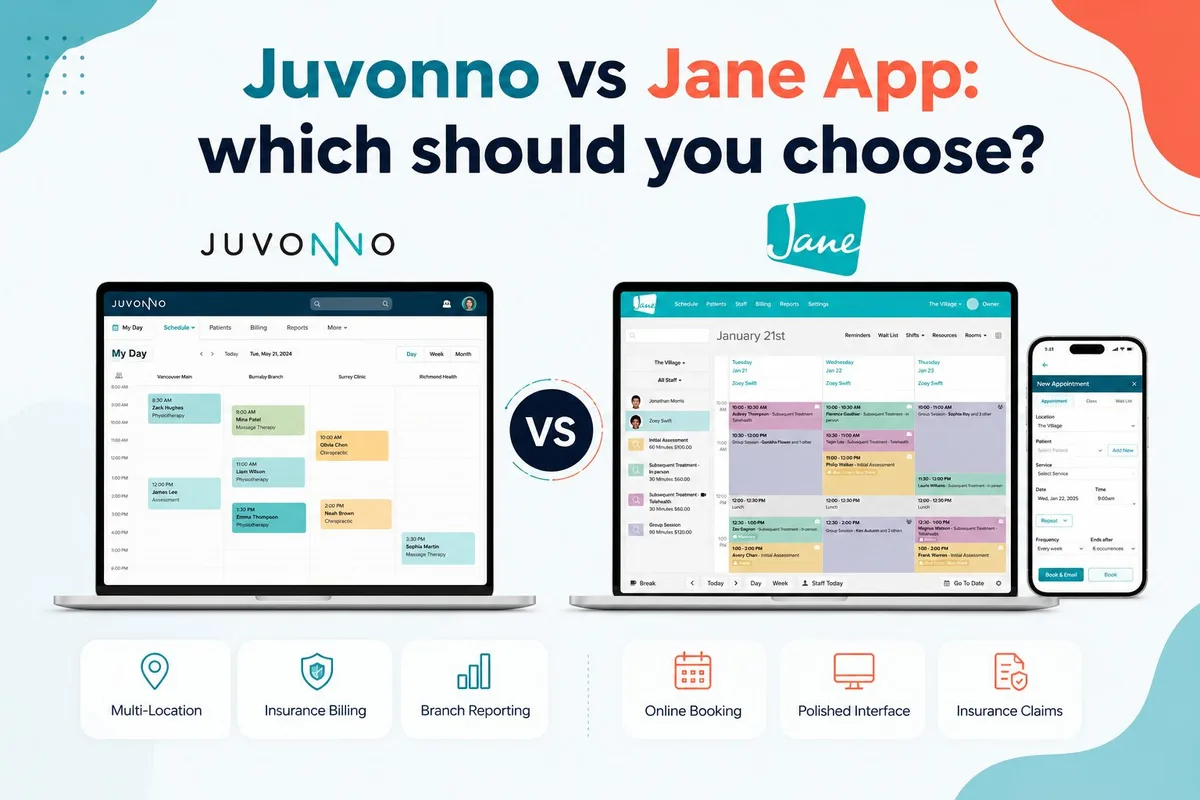
Juvonno vs Jane App: Which Clinic Software Fits You?
If you run a Canadian clinic and you've narrowed your software search down to two homegrown names, it's often these two: Juvonno and Jane. Both are Canadian-built, both go deep on insurance billing, and both have loyal followings. The hard part is that they're strong in different places, so the right answer comes down to what your clinic looks like.
Short answer: Jane fits clinics that want the most polished, modern interface and the largest community behind it, especially multi-room, multi-practitioner practices. Juvonno fits multi-location, billing-heavy clinics that want one system to go deep on operations and insurance, with concurrent-user pricing that rewards a lot of part-time staff.
We help clinics with the marketing that sits on top of tools like these. We work with clinics on Jane and we know and work with the Juvonno team, so we've had hands in both. This is the honest version, written from the seat of someone who sees how each tool plays with the rest of your business, especially the marketing side.
Full disclosure: NewFrame Digital is a Jane affiliate and earns a commission if you sign up through our link. We also know the Juvonno team and have an ongoing working relationship with them. We've kept this comparison balanced and called the trade-offs both ways.
So, Is Juvonno or Jane Better for Your Clinic?

Jane is the better fit if:
- You want the most polished, modern interface with the shortest training curve
- You run multiple treatment rooms and practitioners booking concurrently
- You want the largest peer community and the strongest brand recommendation
- You're a solo or small clinic that plans to grow into a team
- You want the simplest way to connect Google Analytics 4 to measure the marketing side
Juvonno is the better fit if:
- You run multiple locations and want branch-level scheduling, billing, and reporting in one place
- You bill a high volume of extended health, WSIB, or HCAI claims
- You have a lot of part-time or rotating staff and want to pay for seats in use, not headcount
- You want deep customization rather than a one-size template
- You want AI charting included clinic-wide instead of billed per practitioner
- You have growth or expansion plans and want a system that scales into more locations with you
- You value hands-on support, with a team that will meet, walk you through setup, and help your staff learn the platform
Both are strong, and for a lot of clinics either one would run the practice well. The details below are where the decision gets made.
Pricing: Side-by-Side
The two platforms price differently enough that a flat plan-to-plan comparison can mislead, so here's how each one works.
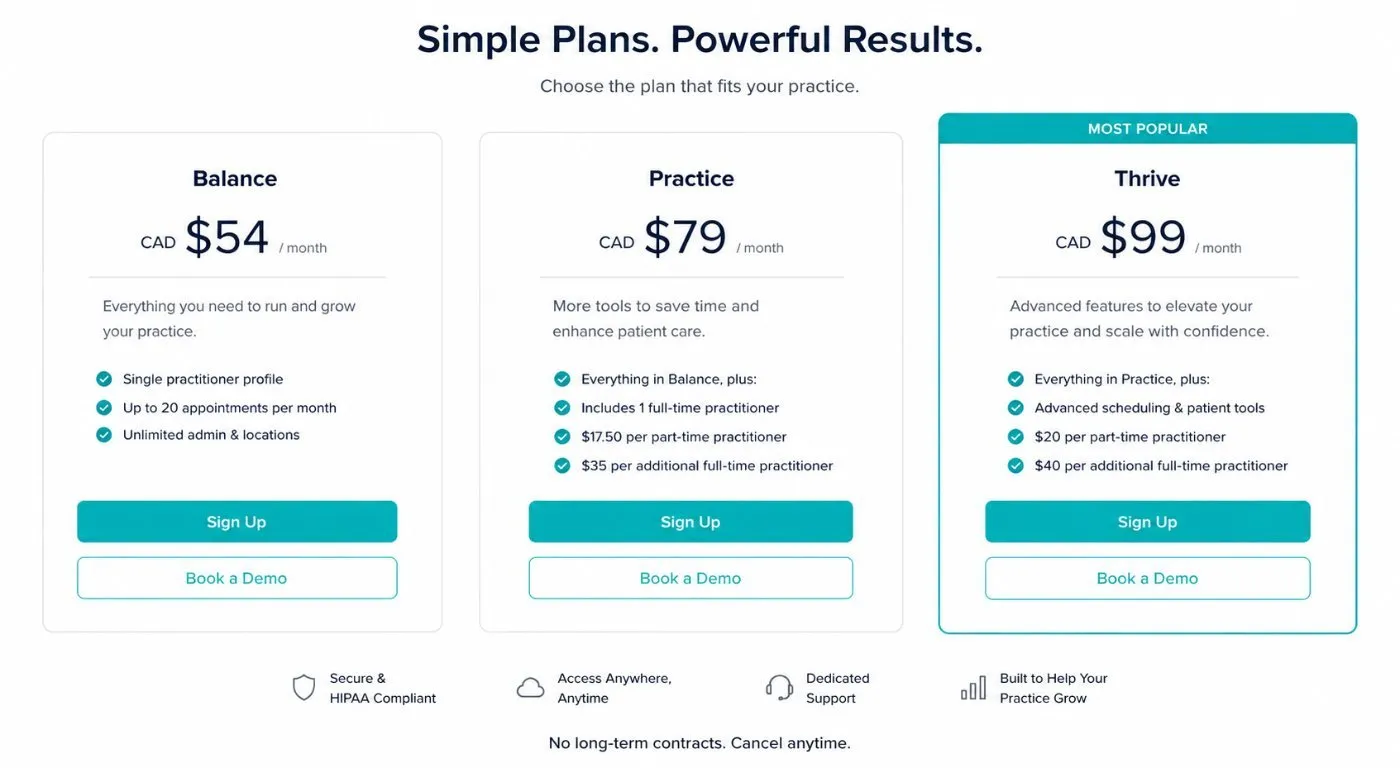
Jane App Pricing (Canadian Dollars, Monthly)
| Plan | Monthly | Appointments |
|---|---|---|
| Balance | $59 | Capped at 20 |
| Practice | $79 | Unlimited |
| Thrive | $99 | Unlimited |
Extra practitioners on Practice or Thrive add $17.50 to $40/month depending on part-time or full-time. Add-ons: AI Scribe at $15/month per practitioner who uses it, Insurance Billing at $20/month (Practice and Thrive only) plus per-practitioner fees, Group Telehealth at $15/month per practitioner, Jane Payroll at $40/month plus $6 per staff member, and Jane Websites at $59/month. Every plan also gets 5 free AI Scribe notes a month. Current pricing is always at jane.app/pricing.
Juvonno Pricing (Per Location Per Month)
| Plan | Monthly | Annual | Built for |
|---|---|---|---|
| Launch | $55 | $49 | New and smaller clinics |
| Grow | $99 | $89 | Growing and multi-location clinics |
| Scale | $129 | $119 | 5+ locations or 100+ staff |
A currency note, because Juvonno's pricing page causes confusion here: the figures display in US dollars, but their FAQ states, "We bill Canadian clinics in CAD, and clinics in the US or abroad in USD." Both platforms bill Canadian clinics in Canadian dollars, so you can compare these numbers directly.
The piece that changes the math: Juvonno bills by concurrent user, not per practitioner. One license equals one person logged in at the same time, so a clinic with ten part-time therapists who are never all online at once pays for the few seats in use, not all ten. Current pricing is on the Juvonno pricing page.
The Cost Comparison
Jane charges per practitioner; Juvonno charges per concurrent login and per location. That makes the right comparison depend on your staffing more than your plan name. Both bill Canadian clinics in CAD, so these figures are like for like.
- A solo practitioner lands around $79 CAD/month on Jane Practice (unlimited) or $55 CAD/month on Juvonno Launch.
- A 3-practitioner single-location clinic with online booking and unlimited appointments runs about $149 CAD/month on Jane Practice (one full-time included, two added at $35 each) versus around $99 CAD/month on Juvonno Grow, before add-ons on either side.
- A clinic with a lot of part-time staff is where Juvonno's concurrent-user model pulls ahead, since you pay for who's online at once rather than total headcount.
Neither is the "cheap" option the way Noterro is. Both are priced for clinics that bill insurance and want depth. Where they split is staffing shape: per-practitioner pricing suits a stable full-time team, concurrent-user pricing suits a rotating part-time one.
Insurance and Billing
This is the category both platforms compete hardest on, and where Juvonno has built its reputation.
Jane is strong here for Canada: direct submission to TELUS eClaims, Teleplan, and Pacific Blue Cross PROVIDERnet, with payments reconciling inside Jane through Jane Pay. For most Canadian clinics billing extended health, that's clean and enough.
Juvonno goes deeper. It connects to TELUS eClaims, Claim.MD, HCAI, OHIP, Alberta Health, eHealth Saskatchewan, Manitoba Health, and Teleplan, which is unusually broad coverage of Canadian provincial systems. On top of that it handles insurance predetermination, batch claim submission, denial management, CMS1500 generation, and automatic reconciliation of electronic remittance. For a clinic that lives in insurance, especially WSIB and HCAI volume, that depth is the feature that pays for the software. A chiropractic clinic we work with carries decades of patient history in Juvonno, and the billing side handles that depth without strain.
The honest read: if your billing is standard extended health, both handle it well and Jane's interface makes it pleasant. If you're submitting high HCAI and provincial volume across locations, Juvonno's billing engine is built for exactly that.
Scheduling and Multi-Location
Both run multi-practitioner calendars, room and equipment booking, waitlists, and calendar sync. The difference is what they're optimized around.
Jane was built for in-clinic scheduling complexity. Multiple practitioners booking different services in different rooms at the same time, overlapping schedules, group sessions, rooms and equipment as bookable resources. If you run a clinic with a physio in Room 1, an RMT in Room 2, and a chiro adjusting in Room 3, all aligning with shared front desk staff, Jane handles it smoothly and the patient-facing booking experience is polished.
Juvonno was built around the multi-location version of that problem. Branch-level management is in the core of the platform, not bolted on, so scheduling, billing, and reporting all roll up per location and across the group. Its client list reflects that, including large multi-location groups like Massage Addict, the national massage therapy franchise. For a single busy location, both are fine. For a clinic group running several locations as one operation, Juvonno's branch model is the more natural fit.
Support and Switching Over
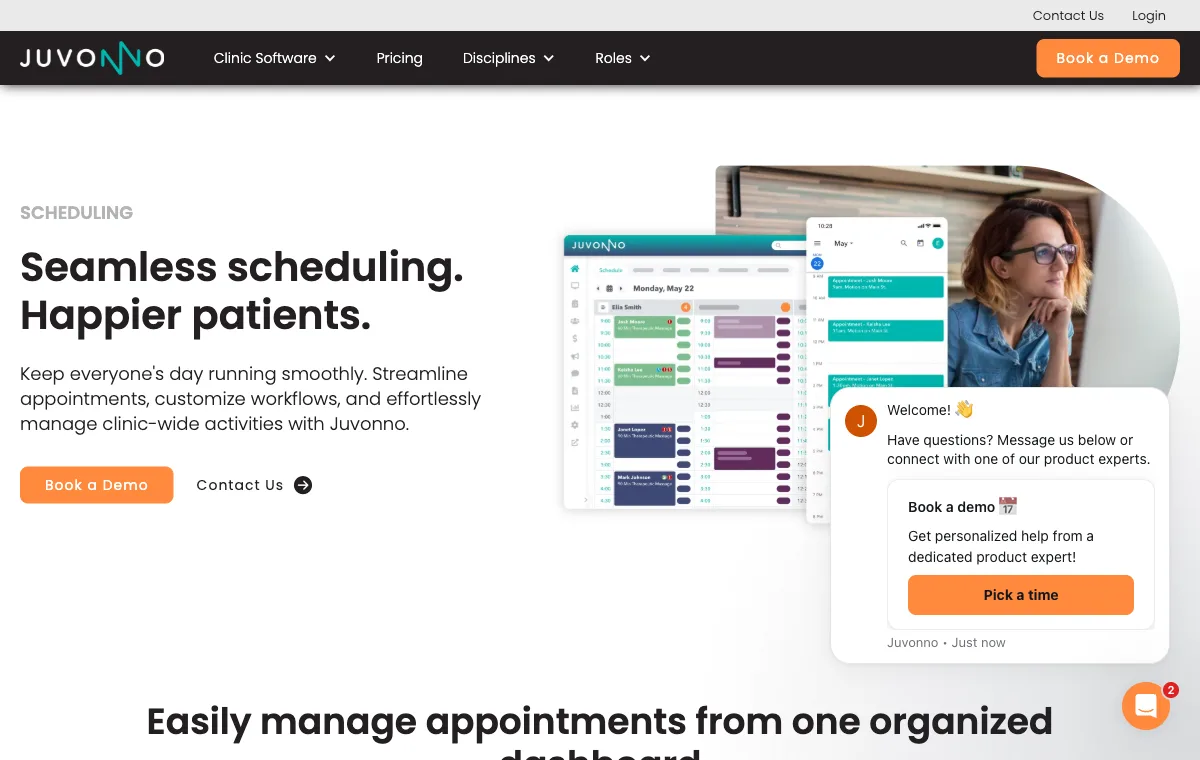
This is the part you only learn by working alongside a company, and it cuts in Juvonno's favour. Both are Canadian and both have engaged communities, but the Juvonno team is responsive and close to their product. When we had questions about setting things up for one of the clinics we work with, their customer service team was incredible, taking extra time to show us things and explain how they worked. Juvonno offers seven-day support by phone, chat, and email, and won a Software Advice award for customer support in 2025, which lines up with what we see. For a clinic owner, support you can reach when something breaks matters more than a long feature list.
Migration is the other piece owners underrate. The biggest reason clinics stay on software they've outgrown is the dread of moving their data. Juvonno leans into that in two ways: free import tools you can use to move the data yourself, or a paid premium import service where their team extracts and formats the data from your old system for you. Every plan also includes 1:1 training and weekly webinars. They've moved a lot of clinics across in their twenty-plus years, with a typical setup running about three to five weeks, and that support is a genuine reason the switch feels less risky. Jane's onboarding is well regarded too; the point is that for a billing-heavy clinic group, Juvonno's hands-on migration is built for exactly the move that puts owners off switching.
Interface and Ease of Use
Jane has set the bar for how modern clinic software should look and feel. Practitioners pick it up fast, reception teams need little training, and new hires can start charting on day one. It's one of the biggest reasons Jane gets recommended unprompted in physio and chiro communities.
Juvonno's team is candid that interface polish is the area they're investing in, and they've told us improving the user experience is an active priority. So if a slick, low-training-curve interface is your single biggest requirement today, Jane has the edge. What that's measured against is where Juvonno has chosen to go deep: billing, multi-location, and customization. That's a deliberate focus, not a gap. Juvonno is building to own the multi-location, billing-heavy end of the market, and a platform built for the complicated end tends to handle the simple end fine, while the reverse is rarely true.

AI Charting and Patient Communication
Both have moved on AI charting, but they package it differently. Jane offers AI Scribe as an add-on at $15/month per practitioner who opts in. Juvonno includes clinic-wide AI charting and chart summaries on every plan rather than per seat, which is a real saving once you have a few practitioners using it.
On patient communication, Jane handles reminders, two-way messaging, and rebook prompts well, and syncs opted-in patients to Mailchimp for newsletters. Juvonno runs communication through JComm, a paid add-on from $40/month covering two-way texting, segmented email and SMS marketing, reactivation campaigns, and team messaging inside the same system. Juvonno's retention and reactivation tooling is a notch deeper; Jane's reminder and rebooking experience is more polished. Worth checking which matters more for how your front desk runs.
The Marketing Layer Neither Tool Fully Solves
Here's the part we'd add if we were sitting across from a clinic owner making this call. Both platforms run a clinic well. Neither grows one on its own.
Jane's marketing integrations are thin. There's no built-in Google Tag Manager on any plan yet, though a private beta is underway, and no Meta Pixel. It does connect to Google Analytics 4 on every plan, and it syncs opted-in patients to Mailchimp, which is a separate tool you pay for on top. Juvonno goes a step further here: its Google Tag Manager integration lets you push patient-portal and booking-page activity into Google Analytics 4 and track appointment bookings as conversions. The trade-off is that it's more hands-on than Jane's (you wire it up through Tag Manager rather than dropping in a GA4 ID), and it sits on the higher Scale tier. Where both still leave off is the rest of growth: retention through Juvonno's JComm is strong, but net-new patient acquisition lives outside either platform.
So whichever you pick, the same gap shows: measuring paid ads, running lifecycle email and reactivation, ranking when someone searches for your clinic, and turning first visits into long-term patients all live outside the EMR. That's not a knock on either. They're practice management tools, and they do that well. It means the software decision is one piece, and the marketing engine that sits on top is a separate conversation, and one we've spent the last few years helping clinic owners solve at Cliniverse.
Who Each One Is For
Choose Jane if: you want the most polished interface and the strongest peer community, you run concurrent multi-room scheduling, you're a solo or small clinic planning to grow, or you want the simpler, drop-in route to Google Analytics. Jane is the safe default for a reason, and it's hard to go wrong with it as a foundation.
Choose Juvonno if: you run multiple locations, you bill heavy insurance volume (especially WSIB and HCAI), you have a lot of part-time staff that suits concurrent-user pricing, or you want deep customization and AI charting included clinic-wide. For the complicated end of the market, it's built for exactly that.
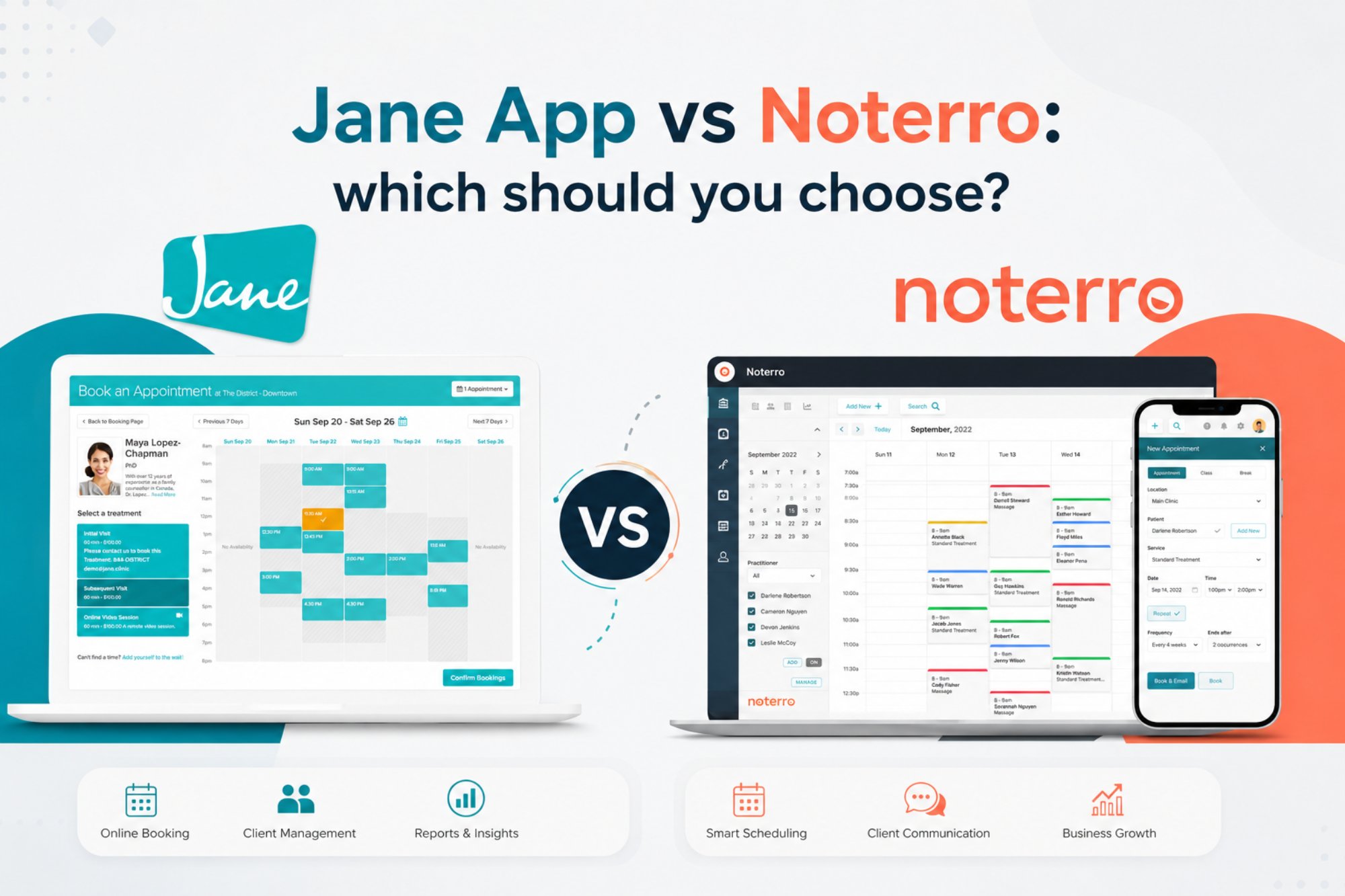
If neither sounds like you, it's worth looking wider. Solo practitioners on a tight budget often do better on a leaner tool like Noterro, and massage-first clinics focused on reviews tend to fit ClinicSense. If those two are your shortlist, ClinicSense vs Noterro settles it, and ClinicSense against Jane covers the other pairing. We cover the full set in our Jane App vs Noterro comparison and the individual overviews.
Juvonno vs Jane App: Frequently Asked Questions
Is Juvonno or Jane cheaper?
It depends on your staffing. Jane charges per practitioner, Juvonno charges per concurrent login per location. For a stable full-time team, the two land close at the equivalent tier (roughly $99 to $149/month for a 3-practitioner single location). For a clinic with a lot of part-time or rotating staff, Juvonno's concurrent-user model is usually cheaper because you pay for seats in use, not total headcount. Neither is a budget tool; both are priced for clinics that bill insurance.
Which is better for insurance billing?
Juvonno, for high-volume and complex billing. Both handle standard Canadian extended-health claims well, but Juvonno reaches more provincial systems and adds predetermination, batch submission, denial management, and automatic remittance reconciliation. If you run heavy WSIB or HCAI volume across locations, that depth is the difference. For straightforward extended-health billing, Jane covers it cleanly and the experience is more polished.
Which is better for a multi-location clinic group?
Both support multiple locations, but they approach it differently. Jane handles multi-location with separate schedules, location-specific booking pages, and per-location reporting, and it's one of the strongest options for clinic groups. Juvonno builds branch-level management into the core of the platform, so scheduling, billing, and reporting roll up per location and across the group natively. For several locations run as one operation with heavy billing, Juvonno's branch model tends to fit more naturally.
Which has the better interface, Juvonno or Jane?
Jane has the more modern, polished interface today, with a shorter training curve, and Juvonno's own team is open that user experience is where they're investing next. Where Juvonno has put its depth is billing, multi-location, and customization, which is the market it's built to own. So if interface polish is your top requirement, Jane has the edge; if multi-location and billing depth are, Juvonno is built for that.
Can you switch from Jane to Juvonno, or the other way?
Yes. Both let you export your data, and Juvonno offers free import tools plus a paid premium service where its team extracts and formats your old data for you, with a typical setup of three to five weeks. The bigger question is fit: clinics tend to move to Juvonno as they add locations and billing complexity, and stay on Jane when interface and a simpler single-location workflow matter most. Plan the move around a quieter stretch in your calendar so the changeover doesn't collide with peak booking weeks.
Should You Choose Juvonno or Jane?
If your top priority is a polished, modern interface backed by the largest peer community, and you run concurrent multi-room scheduling, Jane is the safe pick and a genuinely excellent product. If you run multiple locations, bill heavy insurance volume, and want one system that goes deep on operations with pricing that rewards part-time staff, Juvonno is built for exactly that, with a Canadian team that answers.
If you're not sold on either, our roundup of the best clinic software for Canadian clinics widens the shortlist to nine platforms with verified pricing and who each one is built for.
The bigger point applies to both: your software runs the clinic, it doesn't grow it. Filling the schedule, bringing new patients in, and showing up when someone searches for you is a different job, and the one we handle through done-with-you clinic marketing, whichever booking system you land on.
Jane doesn't run a free trial, though you can book a demo or request access to their demo account. You can book one through our link.
Related Articles
 AI & Tools
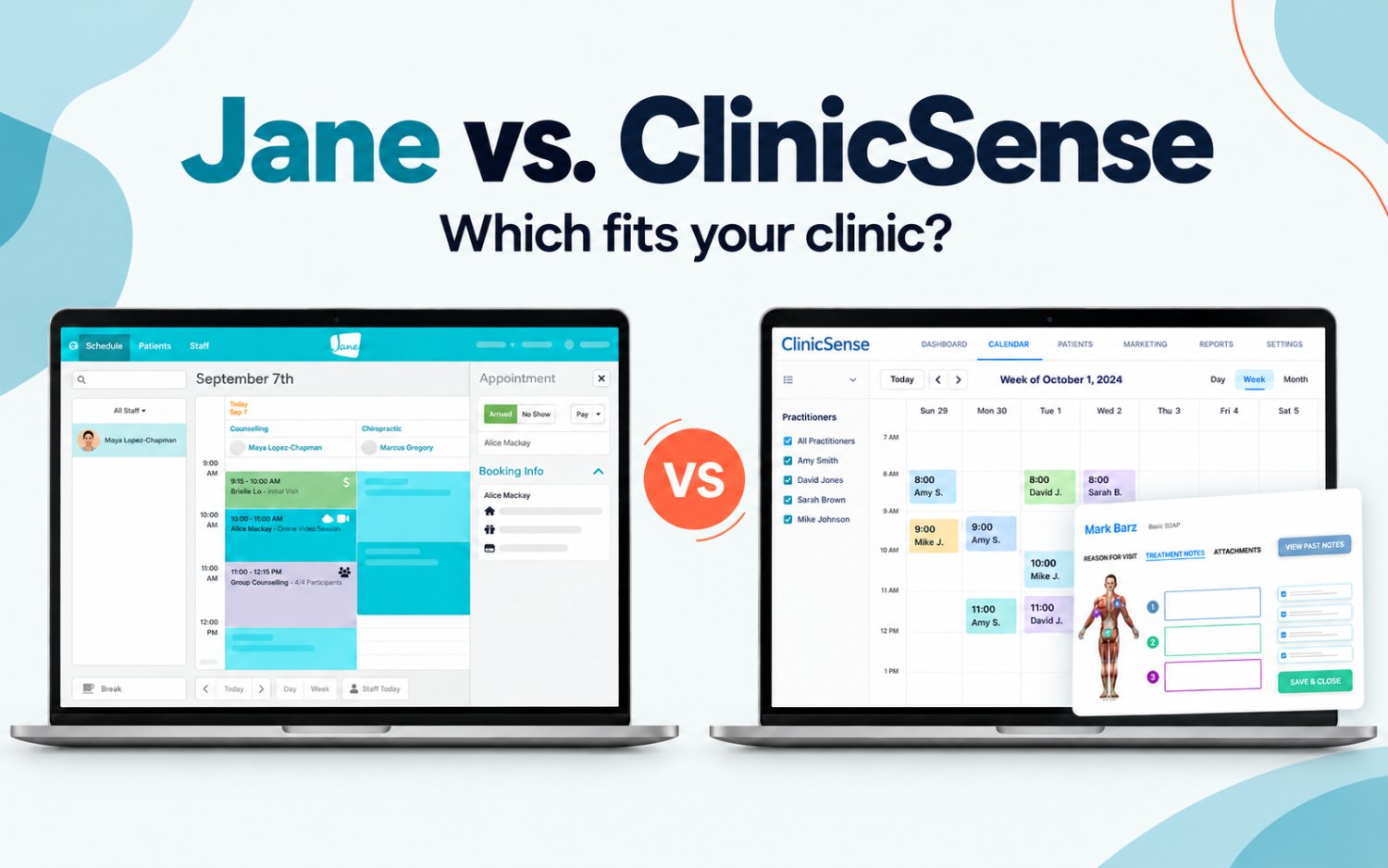
Jane App vs ClinicSense: Which Fits Your Clinic?
Jane App vs ClinicSense for Canadian clinics: pricing, appointment caps, charting, reviews, insurance billing, and who each one fits.
Tyler · October 1, 2026
 AI & Tools
Best Clinic Software for Canadian Multidisciplinary Clinics
Nine clinic management platforms compared for Canadian multidisciplinary clinics. Pricing, currency, insurance billing, and who each one fits.
Tyler · October 1, 2026
 AI & Tools
Jane App vs Noterro: Which Is Right for Your Clinic?
Jane App vs Noterro, compared by a Canadian clinic marketing agency. Pricing, features, scheduling, marketing tools, and who each fits best.
Tyler · October 1, 2026
Run Your Own Clinic Marketing
Cliniverse gives you the ads, posts, courses, and AI to grow your clinic, with experts on call. You own everything you build.