
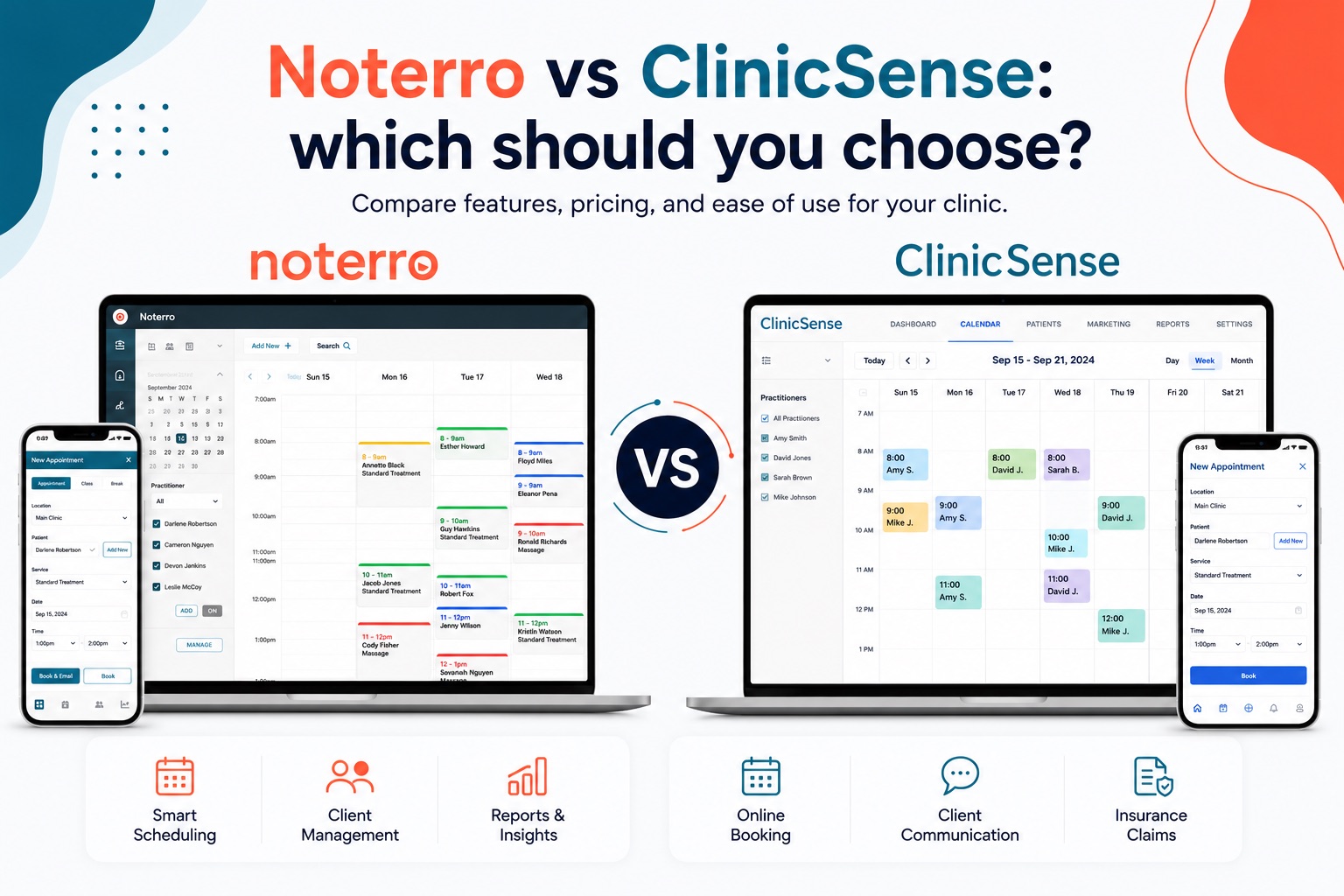
Noterro vs ClinicSense: Which Is Better for Massage Clinics?
If you run a massage practice and you've narrowed your software search to two Canadian names, it's usually these: Noterro and ClinicSense. Both are built for RMTs. Both are priced for a solo therapist or a small clinic. And nearly every comparison you'll find is a directory grid that lines up checkmarks without telling you which one fits your practice.
We work with clinic owners every day and watch the Canadian clinic-software market closely. We're not an affiliate of either tool. This is the honest head-to-head, with pricing and review data verified against both companies in July 2026.
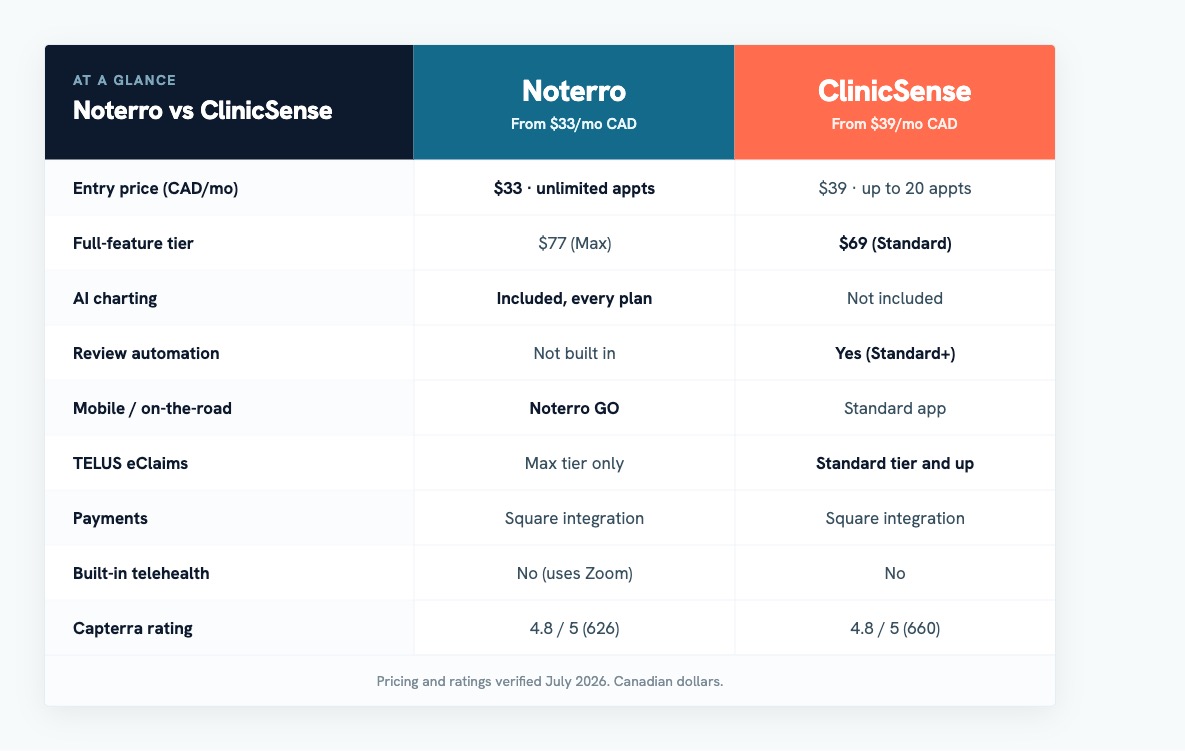
Short answer: ClinicSense fits the massage clinic whose biggest growth lever is reviews and rebooking, and who wants the simplest possible tool. Noterro fits the clinic that cares most about price, wants AI charting included, or runs mobile and on-the-road appointments.
Both are strong. The right pick comes down to what you want the software to do best.
Noterro vs ClinicSense at a Glance
Now the parts that matter once you've lived in one of these tools for a while.
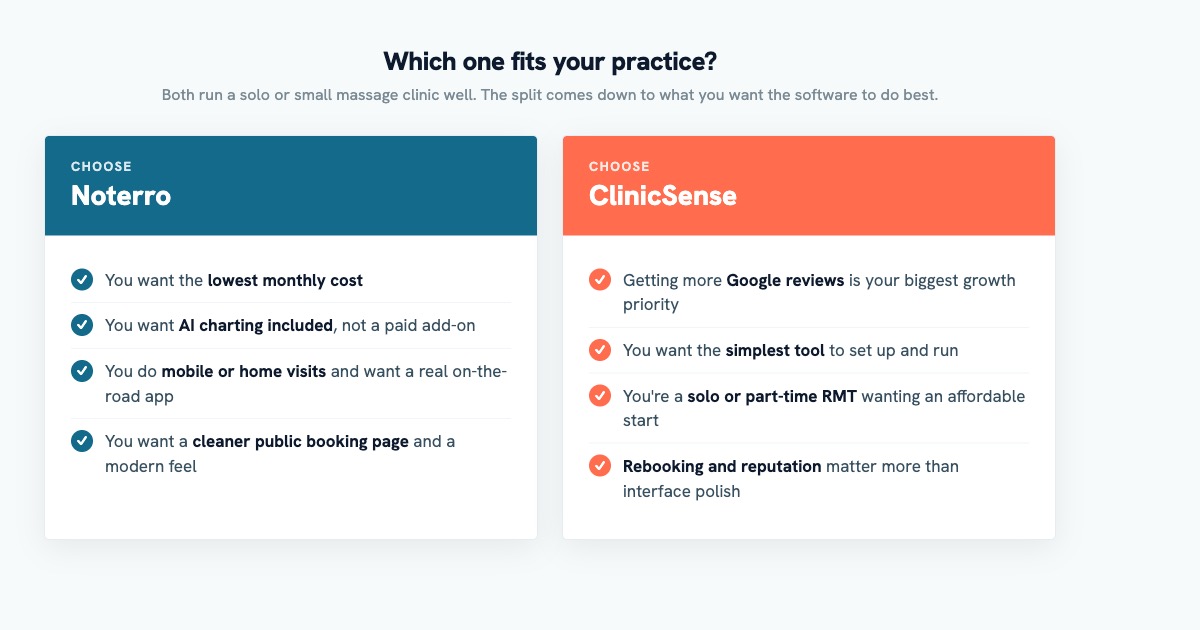
Is ClinicSense or Noterro Better for Your Clinic?
Choose ClinicSense if:
- Getting more Google reviews is your single biggest growth priority
- You want the simplest tool to set up and run
- You're a solo or part-time RMT and want an affordable way in
- Rebooking and reputation matter more to you than a modern interface
Choose Noterro if:
- You want to keep monthly cost as low as possible
- You want AI charting included rather than paid as an add-on
- You do mobile or home visits and want a proper on-the-road app
- You want a cleaner public booking page and a more modern feel
If you're a solo massage practice, you could run either one happily. The details below are what tip the decision.
Pricing: Side by Side
Both are affordable next to a platform like Jane. Here's what each costs, as of July 2026 (prices in Canadian dollars).
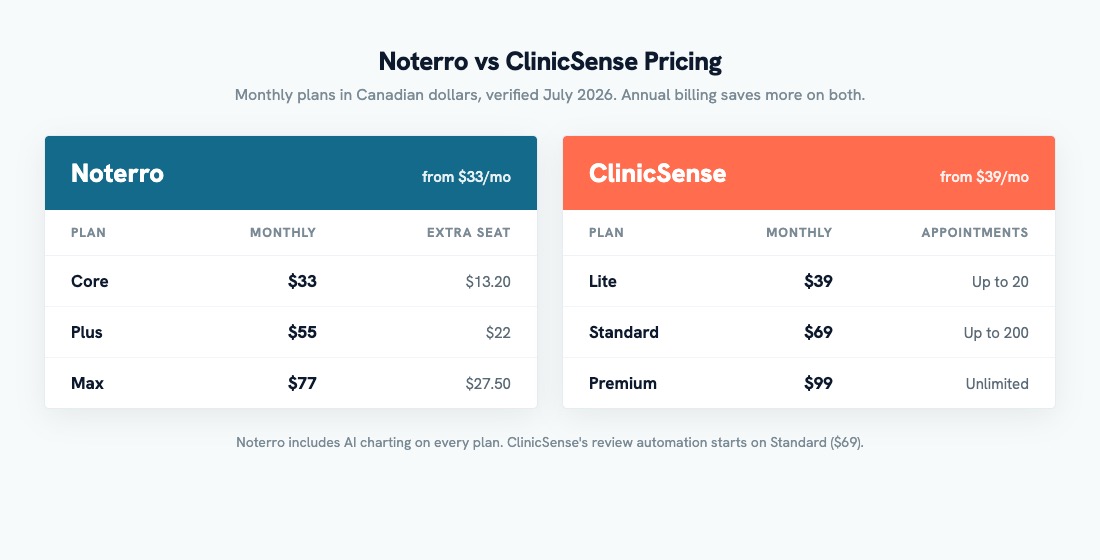
Before the numbers, a currency note that changes the comparison: ClinicSense prices in US dollars and Noterro bills Canadian clinics in Canadian dollars. Both companies are based in Ontario. Add the exchange rate to every ClinicSense figure below.
ClinicSense Pricing
| Plan | Monthly (USD) | Appointments |
|---|---|---|
| Lite | $39 | Up to 20/month |
| Standard | $69 | Up to 200/month |
| Premium | $99 | Unlimited |
Extra practitioners are $20/month each on Standard and Premium. Pay annually and you get a month free, which drops the effective rates to about $35.75, $63.25, and $90.75 USD. There's a 14-day free trial with no card. Source: clinicsense.com/pricing.
The catch worth knowing: the feature ClinicSense is best known for, review automation, lives on the $69 Standard plan, not the $39 one. SMS reminders, No-Show Guard, and TELUS eClaims sit there too.
Noterro Pricing
| Plan | Monthly (CAD) | Extra seat |
|---|---|---|
| Core | $33 | $13.20/month |
| Plus | $55 | $22/month |
| Max | $77 | $27.50/month |
Annual billing takes 15% off across the board. There's a 14-day free trial with full Max access and no card. Source: noterro.com/pricing.
The standout here: Noterro's AI (voice-to-chart and intake-form summaries) is included on every plan, with 300 credits a month built in. For a solo therapist, that's usually enough that the AI feels free.
The Cost Read
For a solo RMT who wants unlimited appointments:
- ClinicSense Standard: $69 USD/mo (review automation, SMS, eClaims, capped at 200 appts)
- Noterro Core: $33 CAD/mo (unlimited appts, AI charting included, no text reminders)
- Noterro Plus: $55 CAD/mo (adds text and call reminders, Noterro GO)
Noterro is the cheaper entry into unlimited booking, and the gap is wider than the numbers suggest once you convert the ClinicSense figure. But the tools aren't priced on the same shape. ClinicSense bundles its review-and-marketing layer into one Standard plan. Noterro keeps the base price low and moves insurance and packages up to the top Max tier. So the honest answer to "which is cheaper" is: it depends which features you need.
Charting and Intake
Both handle the day-to-day of a massage practice: online booking, customizable SOAP notes, intake forms, invoicing, receipts, and reminders. For basic charting, it's close to a wash.
The difference is AI. Noterro includes Scribe (voice-to-chart that drafts your notes from dictation) and Form Summaries (pulls the key points out of an intake form so you don't read every line before a session) on every plan. ClinicSense doesn't have a built-in AI charting equivalent. If you've been curious about voice charting between clients, Noterro gives it to you without a separate line item.
There's also a difference in feel that RMTs notice. Some massage therapists describe Noterro's charting as more anatomy-focused, which suits the body-mapping side of massage documentation. ClinicSense keeps its SOAP charting straightforward and customizable, which is part of why it earns its ease-of-use reputation. On plain functionality, both cover SOAP notes, custom forms, and treatment plans well enough that most solo therapists won't feel a ceiling.
A Word on Feature Lists
Put the two pricing pages side by side and Noterro's feature grid is noticeably longer. It lists orthopedic assessments, predictive charting, note tagging and drawing, memberships, Mailchimp sync, US insurance rails, and dozens more line items. It reads like a platform that does a lot, and it does.
Two things to keep in mind before a long checklist sways you. First, a longer feature list also means more to set up and learn, which is the opposite of what most solo therapists want on day one. Second, plenty of those rows won't apply to a Canadian RMT (the US insurance integrations, for example), so the list looks bigger than the part you'll use. ClinicSense takes the other approach: fewer features, presented simply, aimed squarely at a massage practice. Neither is wrong. Don't pick on checkmark count alone. Pick on the handful of features you'll touch every day and the ones with the biggest impact on your clinic. One feature you need can outweigh fifty you never will.
Reviews and Marketing: Where ClinicSense Earns Its Reputation
This is the category that separates them, and it's the reason ClinicSense gets recommended in massage circles.
ClinicSense has automated review generation built in. After a visit, it asks the client for feedback and nudges the happy ones toward a Google review, on autopilot. For a massage practice that lives on local reputation and word of mouth, having that running in the background is real leverage. It also includes birthday emails, referral prompts, wellness check-ins, and promo codes. Remember it's a Standard-plan feature, not an entry-plan one.

Noterro takes a different route. It has native Mailchimp sync, so patients who opt in flow straight into your email audience, plus built-in practice analytics dashboards (revenue by treatment, city, practitioner, demographic). It also runs a Share & Save program that pays you a free month for every clinic you refer. Worth knowing what that is and isn't: it rewards the practitioner doing the referring, not your patients, so it does nothing to grow your own clinic. It's also part of why you'll see Noterro recommended so often in practitioner groups, since some of those posts come from people earning free months. What Noterro doesn't have is ClinicSense's automated review-request engine, and its newsletter lives in Mailchimp rather than inside the tool.
So if reviews are the thing you most want handled without lifting a finger, ClinicSense has the clearer edge. If you'd rather have a clean Mailchimp setup and revenue analytics, Noterro leans that way. One cost to plan for: Mailchimp is a separate subscription on top of Noterro, and its pricing climbs quickly as your patient list grows.
Booking Page and Mobile
Both give you a clinic-branded online scheduler and both let clients book from Facebook and Instagram. Where they pull apart is polish and mobility.
Noterro's public booking flow is the one practitioners tend to call cleaner and more modern. And Noterro GO is one of the more thoughtful mobile-clinic products going: Apple CarPlay and Android Auto support, route overviews, voice-to-chart from the car, and offline capability for when you lose signal between visits. If you do home or mobile massage, that's a genuine advantage. Noterro GO is included on Plus and Max.
ClinicSense has a mobile app too, so you can manage your schedule, clients, and notes from your phone. It's solid for running the practice on the go. It isn't built around the mobile-first, on-the-road use case the way Noterro GO is.
Insurance and Billing (The Canadian Lens)
For Canadian massage clinics that bill extended health, this is where the money lives.
ClinicSense includes direct TELUS Health eClaims submission on Standard ($69) and up. So the moment you're on the plan most clinics land on anyway, insurance billing is there.
Noterro puts direct TELUS eClaims on the top Max tier ($77) only. On Core and Plus you get insurance codes and policies, but not the direct-submit integration (Plus can add basic insurance as a $15/month add-on).
Neither covers the full spread of Canadian insurers natively. Both run card payments through a Square integration rather than a native processor, so that's one extra account to reconcile on either tool. For a clinic that bills a lot of TELUS eClaims, ClinicSense makes it available one tier sooner and one step simpler.
What Users Are Saying
Both tools are genuinely well liked, and the numbers are nearly identical. On Capterra (verified July 2026):
- ClinicSense: 4.8/5 across 660 reviews. Ease of use 4.9, customer service 4.9.
- Noterro: 4.8/5 across 626 reviews. Ease of use 4.6, customer service 4.8.
A dead heat on the overall score, with ClinicSense edging ease of use, which fits its reputation as the simpler tool to run.
The sentiment in massage therapy communities lines up with that. On Reddit, one ClinicSense user summed it up: "I'm mostly happy with it. Made for massage therapists... it has a lot of automated email marketing options. Integrates with Square, pulls reports and tracks easily for you." The same person was honest about the trade-off, saying they didn't always find tech support helpful on their issues, while adding the team is "fast to respond" and the tool is "reasonably priced and worth looking into." A balanced, real-world read straight from the r/MassageTherapists thread.
Noterro gets described in the same thread as "pricier, but much nicer." The therapist who wrote that had switched over from another tool after it stopped showing clients available booking times, and pointed to Noterro's cleaner interface and mobile app: "Particularly if you do mobile sessions, as Noterro GO is very nice." The through-line across the community: ClinicSense for the mature, review-and-marketing-focused massage tool, Noterro for the cleaner interface and mobile experience.
Who Probably Shouldn't Pick Either
Both are small-clinic tools, and both share the same ceilings.
- Larger multidisciplinary clinics with several practitioners across physio, chiro, and RMT, multiple treatment rooms booking at once, and heavy insurance workflows will outgrow both. That's Jane or Juvonno territory, and if you're weighing the step up, our Jane App vs Noterro and Juvonno vs Jane App breakdowns cover it.
- Clinics that need built-in telehealth should look elsewhere or plan to run a separate video tool. Neither ClinicSense nor Noterro has native video visits.
- Clinics paying practitioners on commission splits won't find formal commission tracking in either tool.
If your practice is solo or small, massage-led, and you care about price, simplicity, reviews, or mobile, one of these two is likely your answer.
Noterro vs ClinicSense: Frequently Asked Questions
Is Noterro cheaper than ClinicSense?
At the entry level, yes. Noterro Core is $33/month with unlimited appointments, while ClinicSense Lite is $39/month but caps you at 20 appointments. The comparison gets closer at the top: ClinicSense Standard ($69) bundles review automation, SMS, and insurance, while Noterro moves insurance up to its Max plan ($77). Which is cheaper for you depends on which features you need switched on.
Which is better for getting more Google reviews?
ClinicSense, and it's not close. In the Noterro vs ClinicSense matchup this is the biggest single gap: ClinicSense has an automated review engine and Noterro has none. If you went with Noterro and still wanted review automation, you'd bolt on a separate tool to do what ClinicSense includes out of the box.
Which one has AI charting?
Noterro, on every plan including the $33 entry tier, and the 300 monthly AI credits are usually enough that a solo therapist never pays extra. ClinicSense has no built-in AI charting, so if voice-to-chart is a must-have, that alone can settle the decision.
Can I switch from one to the other?
Yes. Noterro even publishes a migration guide for moving over from ClinicSense. The bigger cost of switching usually isn't the data, it's the time to retrain your team and rebuild your intake forms, note templates, and booking settings. Worth trialling the one you're leaning toward before you commit.
Are they both Canadian and secure?
Both are Canadian companies (ClinicSense in Toronto, Noterro in Oakville) and both state they follow healthcare privacy rules. Noterro's policy names Ontario's PHIPA directly and stores data on Canadian servers. ClinicSense states HIPAA and PIPEDA compliance but doesn't specifically name PHIPA and doesn't guarantee Canadian data residency. If provincial compliance is critical for you, confirm the specifics with each company directly.
Which Booking Platform Should You Use?
For most solo and small massage clinics, this comes down to one question: what do you want the software to do best?
If your growth engine is reviews and rebooking, and you want the simplest tool that gets out of your way, ClinicSense is the pick. Its review automation is the strongest reason to choose it, and its ease-of-use reputation is earned. Plan for the $69 Standard plan, since that's where the good stuff turns on.
If you want the lowest monthly cost, AI charting included, or you run mobile appointments, Noterro is the better business decision. You'll pay less at entry, get voice charting for free, and Noterro GO is one of the best mobile-clinic experiences on the market.
If your clinic is bigger than either tool is built for, or you bill more insurance than they handle, our roundup of the best clinic software for Canadian clinics covers nine platforms with verified pricing and the billing rails each one supports.
Whichever you choose, the software is one decision. The marketing engine that fills your schedule (getting found, turning searches into bookings, keeping patients coming back) is a separate job, and it's the part neither tool fully solves. That's the layer we help clinic owners with through Cliniverse and done-with-you clinic marketing.
You can start a free trial of either right from their pricing pages: ClinicSense or Noterro. And if you want to talk about the marketing that goes on top of whichever one you pick, that's what we're here for.
Related Articles
 AI & Tools
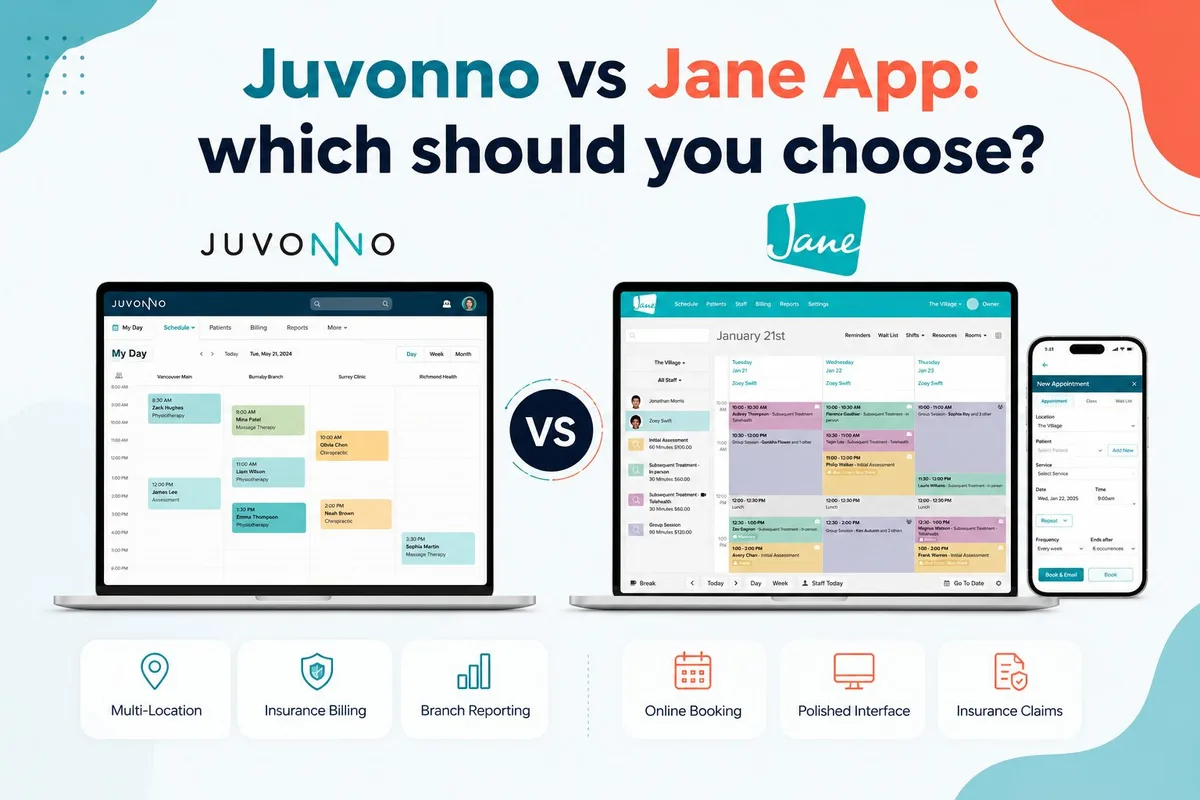
Juvonno vs Jane App: Which Clinic Software Fits You?
An honest Juvonno vs Jane App comparison for Canadian clinics. Pricing, billing, multi-location, interface, and who each one fits best.
Tyler · July 19, 2026
 AI & Tools
Best Clinic Software for Canadian Multidisciplinary Clinics
Nine clinic management platforms compared for Canadian multidisciplinary clinics. Pricing, currency, insurance billing, and who each one fits.
Tyler · August 16, 2026
 AI & Tools
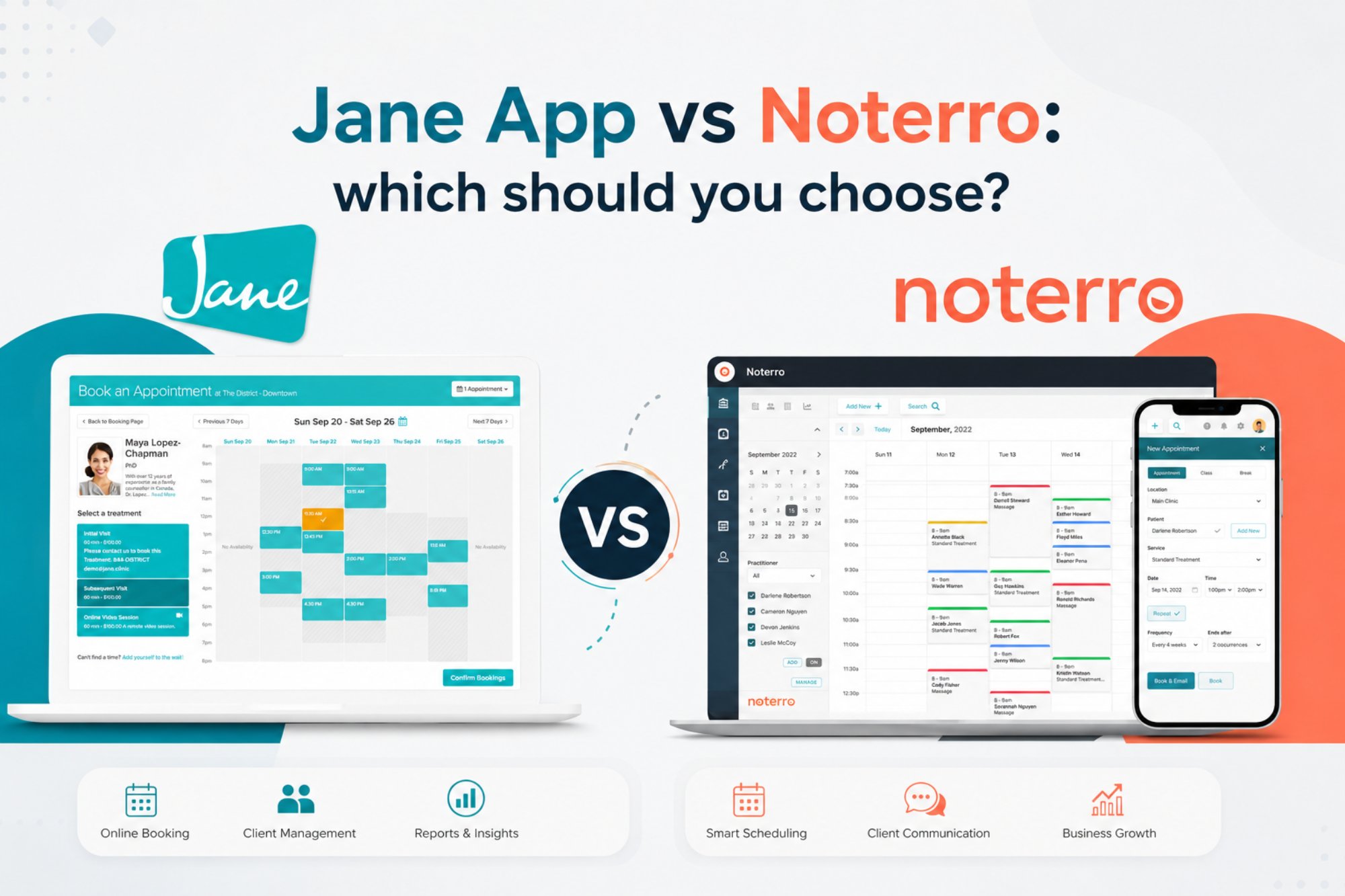
Jane App vs Noterro: Which Is Right for Your Clinic?
Jane App vs Noterro, compared by a Canadian clinic marketing agency. Pricing, features, scheduling, marketing tools, and who each fits best.
Tyler · May 22, 2026
Run Your Own Clinic Marketing
Cliniverse gives you the ads, posts, courses, and AI to grow your clinic, with experts on call. You own everything you build.