

Should You Use Juvonno? What Clinic Owners Should Know
If you run a multi-location clinic or a practice with heavy insurance billing, Juvonno has probably come up next to names like Jane and Noterro. It doesn't get talked about in physio Facebook groups as loudly as Jane, but the clinics that pick it tend to stay, and they tend to be bigger. So what is it, and is it the right fit for your clinic?
Juvonno is a Canadian-built clinic management platform and EMR used across physiotherapy, chiropractic, massage, occupational and speech therapy, naturopathy, acupuncture, mental health, and other allied-health practices. It handles scheduling, charting, online booking, billing, insurance claims, telehealth, and patient communication in one system, and it is built around multidisciplinary, multi-location, and insurance-heavy clinics.
We work with clinic owners on the marketing that sits on top of tools like this, and we know and work with the Juvonno team. Here's everything about Juvonno from our experience.
Full disclosure: we know the Juvonno team and have an ongoing working relationship with them. We have tried to keep this overview honest about both the strengths and the gaps.
What Juvonno Does
At its core, Juvonno runs the day-to-day operations of a clinic. Patients book online through a branded scheduler, complete digital intake forms before they arrive, chart is handled in customizable templates, reception manages the calendar and payments, and the system submits insurance claims and tracks coverage. The intake piece is easy to underrate until you see the before and after. One chiropractic clinic we work with ran everything on paper, with patients filling out forms by hand at the front desk, until we set up digital intake forms in their system. New patients now complete intake from their phone ahead of the visit, and the front desk stops re-keying paperwork.
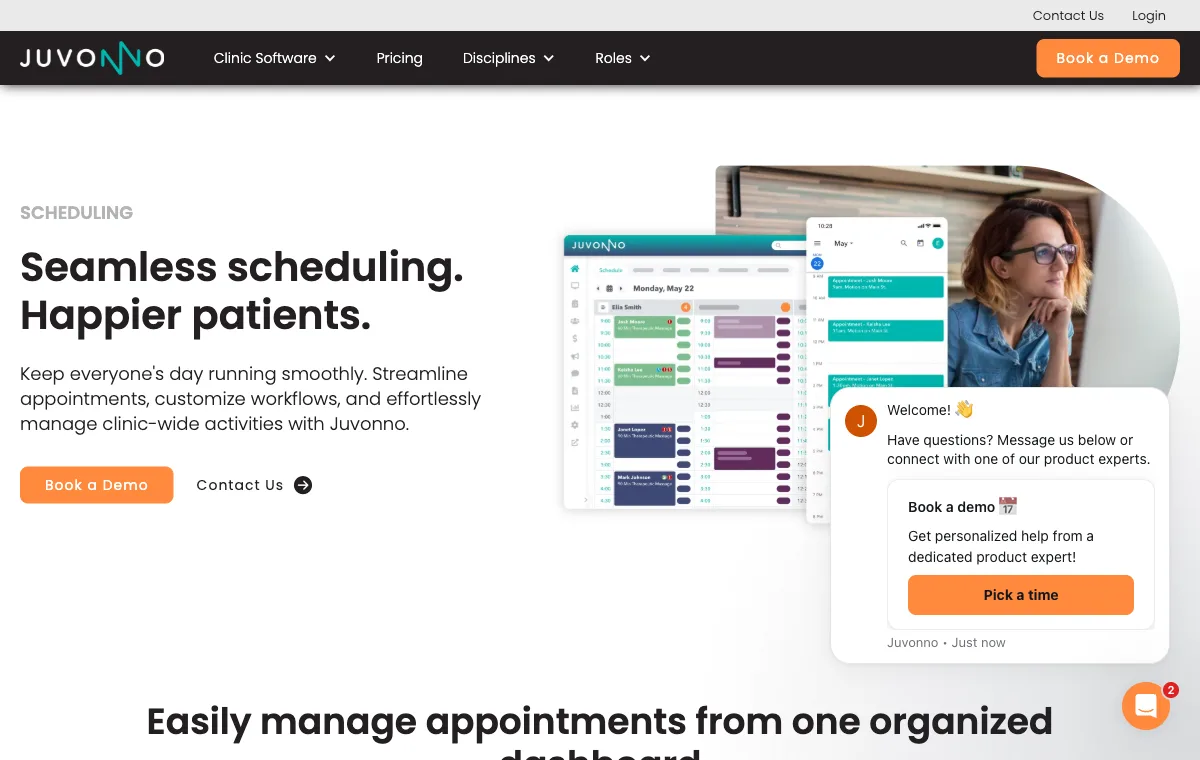
The fuller picture:
- Charting and EMR: Customizable charts and treatment plans per discipline, with AI Scribe and AI chart summaries included on every plan rather than billed per practitioner
- Scheduling: Multi-practitioner calendars, room and equipment booking, waitlists to fill cancellations, and calendar sync with Google, Apple, and Outlook
- Reminders and rebooking: Automated email and SMS reminders, which Juvonno says cut no-shows by up to 57%, plus patient retention reports that flag who has not rebooked
- Online booking: A patient portal for self-service booking, intake forms, and invoice management
- Billing and insurance: Integrated payments, benefit coverage tracking, and direct insurance submission through TELUS eClaims, Claim.MD, and HCAI for Canadian clinics
- Communication (JComm): A paid add-on from $40/month covering two-way texting, targeted email and SMS marketing, patient app messaging, and internal team mail and chat
- Telehealth: Unlimited 1:1 HD video with screen sharing included on every plan, plus an optional group telehealth add-on ($20/month) for up to 25 related clients
- Reporting: More than 90 downloadable reports plus per-practitioner dashboards covering retention, profitability, no-shows, and productivity, exportable to PDF, Excel, or CSV
- Multi-location: Branch-level management built into the platform, not bolted on
It covers what a mid-sized or growing clinic needs to run operations, and it goes deeper on billing and multi-location than most tools at this price. The places it leaves to a partner are mostly marketing and growth, which we'll get to.
Who Juvonno Is Built For
Juvonno is a Canadian company that has been at this for more than twenty years, and that shows in how it bills and how it moves clinics over from other systems. The product is purpose-built for clinics that look like:
- Multi-location practices that need branch-level scheduling, billing, and reporting in one place
- Insurance-heavy clinics that submit a high volume of extended health, WSIB, and HCAI claims
- Larger or growing teams with part-time and rotating staff
- Multidisciplinary practices that want customization rather than a one-size template
The clinic group with three locations and a busy front desk is squarely who Juvonno is for. When we asked the Juvonno team directly where they fit best, the answer: multi-location clinics that want one system to be the best at billing and operations. That focus is a feature, not a hedge. A platform built for the complicated end of the market tends to handle the simple end fine, but the reverse is rarely true. It shows in their client list too, which includes large multi-location groups like Massage Addict, the national massage therapy franchise.
It's used outside Canada as well, but the Canadian billing depth (TELUS eClaims, HCAI, provincial workflows) is what makes it a natural fit for Canadian clinics that bill a lot of insurance.
How Much Does Juvonno Cost?
Juvonno pricing, per location per month (as of July 2026). One thing to clear up before the numbers, because the pricing page causes confusion: the figures are displayed in US dollars, but Juvonno's own FAQ states, "We bill Canadian clinics in CAD, and clinics in the US or abroad in USD." If your clinic is in Canada, the number you see is the number you pay, with no exchange rate on top.
| Plan | Monthly | Annual | Built for |
|---|---|---|---|
| Launch | $55 | $49 | New and smaller clinics |
| Grow | $99 | $89 | Growing and multi-location clinics |
| Scale | $129 | $119 | 5+ locations or 100+ staff |
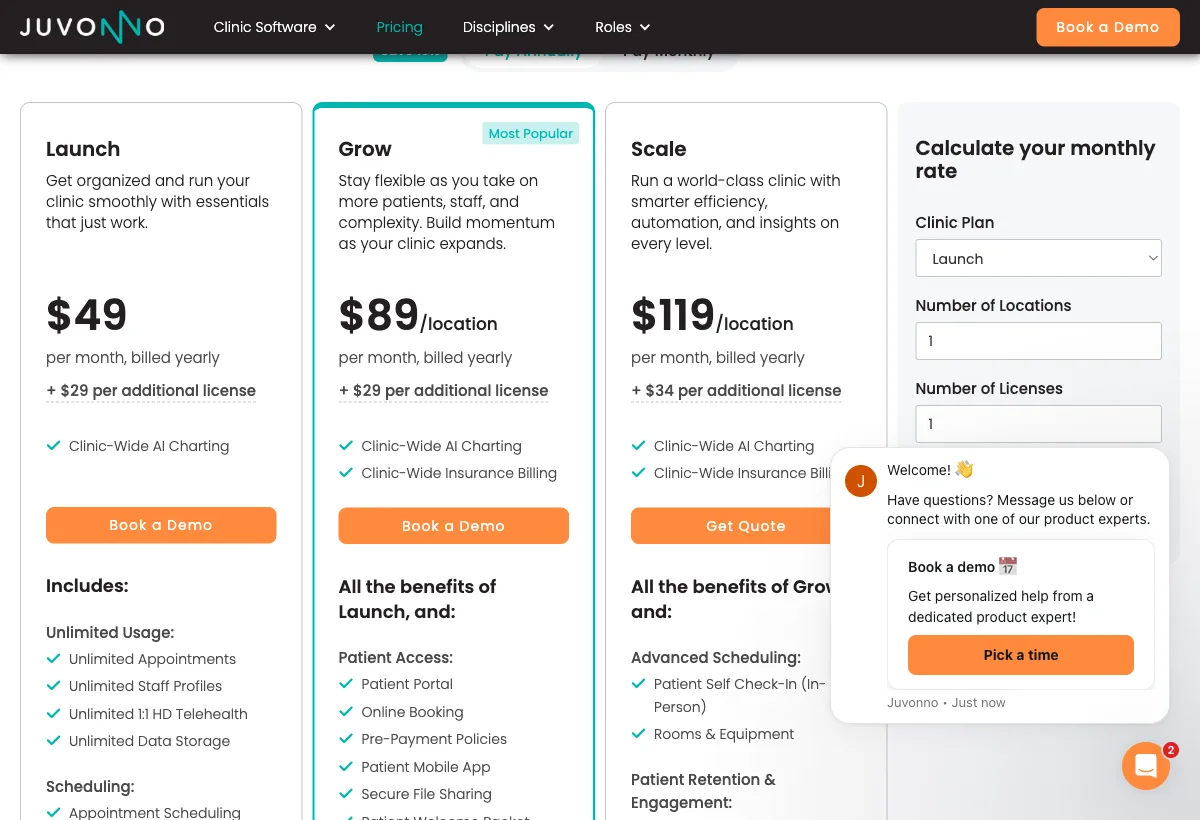
The part worth understanding is the licensing model. Juvonno bills by concurrent user, not per practitioner. One license equals one person logged in at the same time, so a clinic with ten part-time therapists who are never all online at once pays for the few seats in use, not all ten. For clinics with rotating or part-time staff, that math works out cheaper than the per-practitioner pricing most competitors use.
What each tier unlocks: Launch is more generous than most entry plans, with unlimited appointments, staff profiles, telehealth, and data storage, plus scheduling, charting, invoicing, and role-based permissions. Grow is where the patient portal, online booking, patient mobile app, multi-location management, treatment plans, and integrated insurance billing (TELUS eClaims, Claim.MD) switch on. Scale adds patient self check-in, inventory, memberships and subscriptions, class programs, and marketing tools including Rating and Reviews and native Google Tag Manager. HCAI and provincial health billing are add-ons. Current pricing is always on the Juvonno pricing page.
The read: at $55 to $129 CAD per location for a Canadian clinic, Juvonno is competitively priced for what it does, and the concurrent-user model is a genuine saving for clinics with a lot of part-time staff. Note that online booking and insurance billing live on the Grow plan, not the entry-level one.
Where Juvonno Is Strong
A few things stand out, both from the product and from what we see working alongside it.
Insurance and billing depth: This is the strongest part of the platform. Juvonno connects to TELUS eClaims, Claim.MD, HCAI, OHIP, Alberta Health, eHealth Saskatchewan, Manitoba Health, and Teleplan, which is unusually broad coverage of Canadian provincial systems. On top of that it handles insurance predetermination, batch claim submission, denial management, CMS1500 generation, and automatic reconciliation of electronic remittance from Claim.MD. For a clinic that bills a high volume of extended health, this is the feature that pays for the software. A small chiropractic clinic we work with runs close to 8,800 patient records through Juvonno, and the billing side handled that history without strain.
Multi-location and customization: Branch-level management is built into the core, not stapled on, and the platform is genuinely customizable around how a clinic works. It lands well with clinic groups that have outgrown a tool built for a single practitioner.
Concurrent-user pricing: The licensing model is rare and clinic-friendly. Paying for simultaneous logins rather than total headcount is money saved for any practice with part-time or seasonal staff.
A real integration ecosystem: Juvonno connects to home exercise program tools (Physitrack, Wibbi, Careplan), accounting (Xero), secure faxing (SRFax), Doxy.me telehealth, calendar sync, and Stripe and TD for payments. For a clinic that already runs a HEP platform or wants its books to reconcile automatically, having those wired in matters, and it's an area where some competitors leave you stitching tools together yourself.
A team that answers: This is the part you only learn by working with a company. The Juvonno team is responsive and close to the product. When we had questions about setting things up for one of the clinics we work with, their customer service team was incredible, taking extra time to show us things and explain how they worked. Juvonno also won a Software Advice award for customer support in 2025, which lines up with what we see. For a clinic owner, a vendor that picks up the phone matters more than a long feature list.
Help switching over: The biggest reason clinics stay on software they have outgrown is the dread of moving their data. Juvonno leans into this in two ways: free import tools you can use to move the data yourself, or a paid premium import service (from $250 per data set) where their team extracts and formats the data from your old system for you. On top of that, every plan includes 1:1 training, seven-day chat, phone, and email support, and weekly webinars. They have moved a lot of clinics across in their twenty-plus years, with a typical setup running about three to five weeks, and the migration support is a genuine reason the switch feels less risky.
AI charting included, communication available in-platform: Clinic-wide AI charting is included on every plan rather than sold as a per-seat add-on, which is a real saving since many platforms charge per practitioner for it. Patient communication runs through JComm, a paid add-on from $40/month that handles two-way texting, email and SMS marketing, and team messaging inside the same system, so you're not bolting on a separate tool.
Where Juvonno Falls Short
No platform is the right call for everyone, and Juvonno has clear trade-offs.
The interface feels dated next to Jane: The Juvonno team owns this one. Jane has set the bar for how modern clinic software should look and feel, and Juvonno's interface is behind that bar today. The team has told us improving the user experience is an active priority, but if a polished, low-training-curve interface is your top requirement, Jane currently has the edge.
It keeps patients, it doesn't find new ones: This is the honest line on marketing. Juvonno is strong at retention. JComm runs reactivation campaigns for patients who have not been in for months, birthday and insurance-reset messages, segmented email and SMS, and outstanding-balance requests, which is more than most EMRs do. Where it stops is net-new patient acquisition. It does more than you'd expect on measurement: its Google Tag Manager integration (on the Scale plan) can push patient-portal and booking-page activity into Google Analytics 4 and track bookings as conversions, so the tracking is there if you're willing to wire it up through Tag Manager rather than drop in an ID the way Jane lets you. What it doesn't do is the acquisition itself, nothing for SEO or content, and no ad platform built in. So clinics running paid ads to bring in new patients, or wanting a website that connects to Juvonno and ranks on Google and AI search, still need a separate marketing layer to measure and grow that side. That's not unique to Juvonno; almost every EMR runs the clinic well and grows it modestly.
Best for big, not tiny: The depth that makes Juvonno great for a clinic group can feel like more than a solo practitioner needs. If you're a one- or two-person practice without heavy insurance billing, a lighter tool may fit better.
Check the billing terms before you sign: The pricing page lets you choose monthly or annual billing, with annual saving about 10%. Juvonno's terms of service, though, describe subscriptions as a twelve-month term that renews automatically, so it's worth confirming with their team how much flexibility you have to leave, especially if you want to keep things month to month while you settle in.
Who Probably Shouldn't Pick Juvonno
Juvonno is a strong platform, but it's not the right fit for everyone.
- Solo practitioners on a tight budget usually do better with Noterro, which is built for smaller practices and runs lean.
- Massage-only clinics focused on reviews and rebooking often fit ClinicSense better, since its review request sits on a lower plan tier than Jane's. If you're choosing between it and Noterro, ClinicSense vs Noterro compares them directly, and we cover it against Jane here.
- Clinics whose top priority is a modern, polished interface may prefer Jane today, with the caveat that Juvonno goes deeper on multi-location billing.
If your clinic is multi-location, billing-heavy, and looking for one system that goes deep on operations, Juvonno is built for exactly that. If you fit one of the cases above, there's a better-matched tool.
Frequently Asked Questions About Juvonno
What disciplines and professions does Juvonno support?
Juvonno is built for multidisciplinary clinics and supports a wide range of professions, including physiotherapists, chiropractors, massage therapists, occupational therapists, speech therapists, naturopaths, acupuncturists, osteopaths, dietitians, nurse practitioners, clinical psychologists, mental health counsellors, physicians, and medical spas. The platform leans toward clinics that run more than one discipline under one roof.
Is Juvonno secure and compliant?
Yes. Juvonno hosts on Amazon Web Services in SOC 1, 2, and 3 certified data centres, encrypts data in transit with TLS 1.3 and at rest with AES-256, and offers two-factor authentication with audit trails tied to individual user accounts. It runs daily backups retained for 35 days. On compliance, Juvonno handles personal data in line with Canada's PIPEDA and the EU's GDPR, and Canadian patient data is stored solely on Canadian AWS infrastructure, which matters for provincial data-residency requirements. For clinics that need formal agreements, Juvonno will sign a HIPAA Business Associate Agreement, an HIA Information Manager Agreement, a GDPR Data Processing Addendum, and PIPEDA or PHIPA agreements on request.
How long does Juvonno take to set up?
Juvonno says a typical setup runs about three to five weeks, drawing on close to twenty years of moving clinics over from other systems. Every plan includes a 1:1 training program, and you can prepare your own data with their free import tools or pay for a premium import service (from $250 per data set) where their team extracts, formats, and tests the migration for you. Extra training beyond what is included is billed at $150 per hour.
Who owns Juvonno?
Juvonno is owned and operated by Global Office Software Inc., a Canadian company based in Winnipeg, Manitoba (with parent company Great White North Software Solutions Inc.). It's a privately held, Canadian-built platform, which is part of why its billing and data residency are tuned for Canadian clinics.
Does Juvonno have a contract, or can I cancel anytime?
Juvonno's pricing page lets you choose monthly or annual billing, with annual saving about 10%. Its terms of service describe subscriptions as a twelve-month term that auto-renews, with a 30-day grace period at the start where you can leave and have unused fees refunded minus any setup, migration, and training used. Because the marketing and the terms read differently on flexibility, confirm the cancellation details with their team before you sign. If you do leave, you can export your patient, appointment, transaction, and prescription data yourself, and chart history exports to HL7 XML at no charge.
What are the alternatives to Juvonno?
The main alternatives for Canadian clinics are Jane, Noterro, and ClinicSense. Jane is the closest comparison, with a more modern interface and a larger community, though Juvonno goes deeper on multi-location billing. Noterro suits smaller and solo practices on a tighter budget, and ClinicSense is built around review generation for massage and allied-health practices. Cliniko comes up if you operate across more than one country, but it carries none of the Canadian billing rails Juvonno is built around. The right swap depends on your size and how much insurance you bill.
How does Juvonno compare to Jane?
Both are Canadian-built and strong on insurance billing. Jane has the more modern interface and the larger community, and it's often the default recommendation in physio and chiro groups. Juvonno goes deeper on multi-location management and customization, and its concurrent-user pricing can be cheaper for clinics with a lot of part-time staff. Juvonno's main gap is interface polish, which its team has said it's working to improve. For a multi-location, billing-heavy clinic, Juvonno is well worth a look. We break the decision down feature by feature in our Juvonno vs Jane App comparison.
Should You Choose Juvonno?
If you run a multi-location or billing-heavy clinic and you want one system that goes deep on operations, insurance, and customization, Juvonno is a serious, Canadian-built option with a team that answers. The honest caveat is the interface, which is behind Jane today, though the team is working on it. If a polished interface is your single biggest requirement, weigh that against the billing and multi-location depth you'd be trading for it, and against where you want your clinic to be in a few years.
If you're still building your shortlist, our roundup of the best clinic software for Canadian clinics sets Juvonno against eight other platforms with verified pricing and the billing rails each one supports.
The bigger point is the one that applies to every clinic platform: Juvonno runs your clinic, it doesn't grow it. Filling the schedule, bringing new patients in, and showing up when someone searches for your clinic is a different job. That's where Cliniverse comes in, the marketing layer that sits on top of whatever booking system you run.
Related Articles
 AI & Tools
What Is Jane App? An Honest 2026 Overview for Clinic Owners
Jane App is a Canadian-built practice management platform for clinics. Here's an honest 2026 overview from a team that works with clinics on Jane every day.
Tyler · October 1, 2026
 AI & Tools
What Is Cliniko? An Honest Look for Canadian Clinics
Cliniko is a well-built Australian clinic platform. Here's the pricing, the features, and the Canadian billing gap you need to know about first.
Tyler · August 9, 2026
 AI & Tools
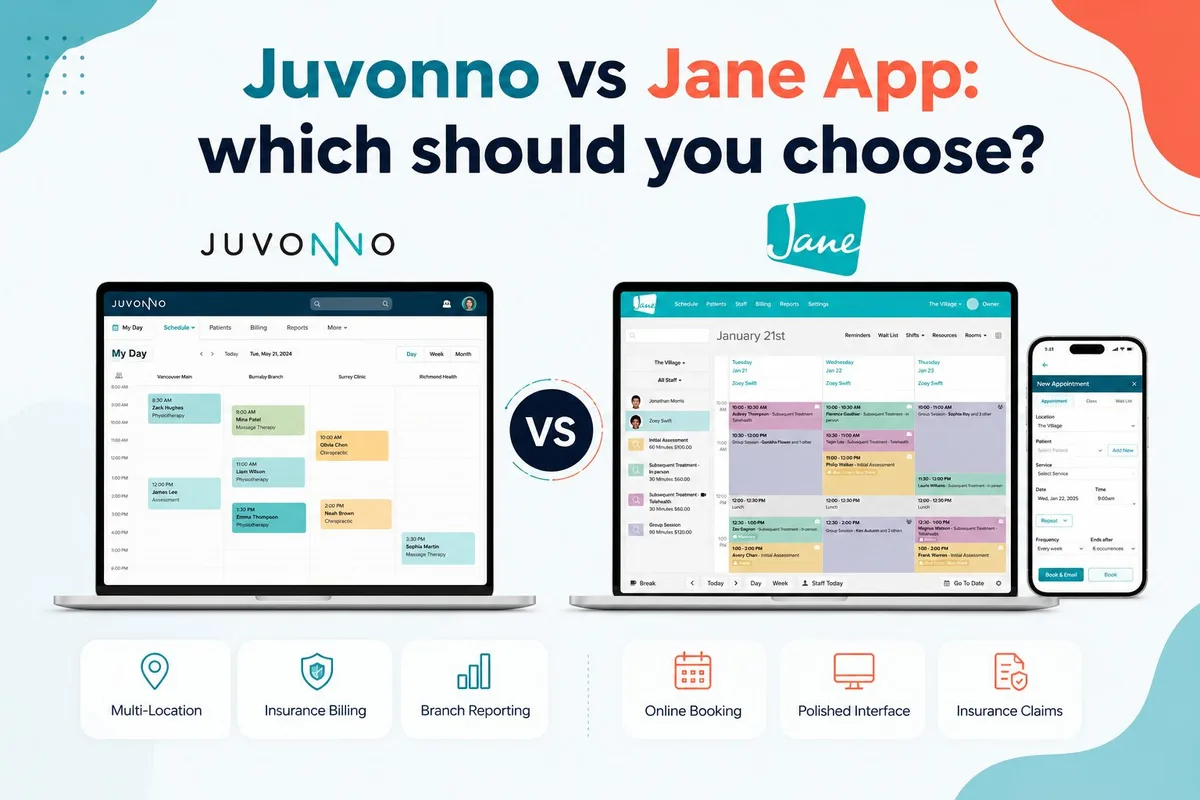
Juvonno vs Jane App: Which Clinic Software Fits You?
An honest Juvonno vs Jane App comparison for Canadian clinics. Pricing, billing, multi-location, interface, and who each one fits best.
Tyler · October 1, 2026
Run Your Own Clinic Marketing
Cliniverse gives you the ads, posts, courses, and AI to grow your clinic, with experts on call. You own everything you build.