

An Easy Weekly Marketing Checklist for Local Businesses
Most local business owners know they should “do more marketing”, but the problem isn’t always knowledge, it’s consistency. Wearing every hat, between running the business and serving customers, marketing often gets pushed to the back burner.
The good news? You don’t need complex strategies to win locally. Visibility, leads, and long-term growth come from simple, repeatable actions done every week. We believe you can get it done in just an hour every week.
Our goal, to give you a checklist you can follow to stay consistent and move the needle. Stick to these, and over time, you’ll be dominating your local market.
Weekly Local Marketing Checklist (Overview)
Before we dive into the full breakdown, here’s a snapshot of what you should focus on. These are the core marketing tasks that all local businesses should prioritize.
- Update your Google Business Profile Respond to reviews and messages
- Add new photos or short videos
- Create one monthly blog post
- Post 2–3 times on social media with local captions
- Keep your website info accurate and optimized
- Build relationships with other local businesses
- Look for ways to share useful, data-backed content
What Drives Local Visibility Today
The way local businesses get discovered has fundamentally changed. It’s no longer just about having a website or posting occasionally on social media, today, real visibility comes from real activity and trust.
Search engines like Google, and now AI tools like ChatGPT, are surfacing answers based on what’s happening right now. They’re pulling from active business profiles, websites with clear local signals, and content that directly answers people’s questions.
That means:
- An active Google Business Profile
- Fresh reviews (and replies to them)
- A website that clearly says who you are, what you do, and where you do it
- Content that’s helpful, not just keyword-stuffed filler
Freshness, trust, and usefulness now beat length and backlinks.
The goal? Be the source that Google and AI engines trust when someone searches for a local service. That’s how you get chosen, whether by an AI assistant, voice search, or a classic Google results page.
And the good news is: showing up consistently in just a few key places can move the needle far more than trying to do everything.

Website and Local SEO Basics
Your website is still one of the most important signals for local visibility, both for Google and AI search engines.
But it’s not just about having a site. It’s about making it clear, consistent, and locally relevant.
Here’s what to focus on:
- State clearly what you do and where you do it. Visitors, and search engines, should be able to tell this within seconds of landing on your site.
- Use local keywords naturally. Mention your city, neighbourhood, or service area across key pages, especially in your headings, introductions, and meta descriptions.
- Create location-specific pages. If you serve multiple areas, dedicate a separate page for each one. This helps search engines match your business to local searches.
- Ensure contact information is consistent. Your business name, address, and phone number (NAP) should match your Google Business Profile exactly and any other listings that you have.
- Include embedded maps and driving directions. These help both users and local algorithms connect your business to your geographic area.
Your website should back up your Google profile, not compete with it. When both are aligned and locally optimized, you give yourself the best shot at ranking higher and showing up in more searches.
Once a month, it's worth a quick look at Google Search Console to see which searches are already bringing people to your site and which pages are close to the first page. It's free, the data comes straight from Google, and it tells you where the next hour of effort will do the most good.
Content and Blogging (Monthly but Planned Weekly)
Regular blog content is one of the most effective ways to earn local authority, both with humans and search engines.
You don’t need to publish every week, just consistency. One well-planned blog per month can go a long way if it’s built with intent.
Focus your content on:
- Common cost-related questions (“How much does [service] cost in [city]?”)
- Service-specific explanations that clarify what you do and how it helps
- Locally relevant searches, things your audience is already Googling
- Educational content that positions you as the trusted resource in your area
This is the kind of content Google, and now AI tools, want to surface. Becoming a reliable source of answers helps you earn visibility beyond traditional rankings.
Social Media Activity (Supportive, Not Primary)
Social media won’t replace your website or your Google Business Profile, but it absolutely supports them.
Post 2–3 times per week to keep your business visible and active. You’re not just reaching followers, you’re now building signals that feed into search.
Use your captions strategically. Focus on:
- What you offer (clearly stated, not implied)
- Who you help (types of clients or problems you solve)
- Where you operate (mention your city or neighborhood)
Avoid vague or emoji-only captions. Social platforms are now being indexed, and posts can show up directly in Google results, especially for branded searches. Search Console will now show you which of your social posts are getting found, and what people searched to land on them.
A few well-placed posts can now reinforce your local authority across multiple channels.
Optional but High-Impact Add-Ons
Once you’ve covered the essentials, there are a few extra steps that can give your local visibility a serious boost, without adding a ton of complexity.
Send Out A Monthly Newsletter
This is a rather under-utilized and high impact task that you can do to drive results, while also staying top-of-mind.
If you have a list of potential customers, send out a helpful, educational, or entertaining newsletter every month. It doesn’t have to be anything crazy or in-depth, just something that could be valuable and help people remember you.
Local Partnerships and Mentions
Connecting with other local businesses helps you build trust, get noticed, and earn local relevance in the eyes of both people and search engines.
Simple ways to collaborate:
- Exchange blog mentions or resources – Share helpful content and link to each other.
- Partner on events or community initiatives – This naturally leads to mentions and online visibility.
- Get listed on association or chamber websites – These carry local authority and often link back to your business.
These local mentions act as credibility signals, showing that your business is active and connected in the community.
Local Backlinks (Light Touch)
You don’t need a full SEO outreach strategy. A few local backlinks can go a long way, especially when they come from relevant, trusted sources.
Easy backlink opportunities include:
- Writing a short guest blog for a local business or publication
- Being listed as a sponsor on local event pages
- Getting featured in community spotlights, interviews, or “best of” lists
These types of links help search engines recognize your business as a valuable part of the local ecosystem, without needing advanced SEO knowledge or tools.

Using Data and “Journalist Keywords” to Earn Links
One of the most overlooked ways to build long-term SEO authority is by publishing data-driven content, something journalists, bloggers, and even AI tools love to cite.
Unlike service pages or sales copy, data gets linked to.
Why? Because people writing content (especially journalists) need credible stats to support their points, and they prefer to link to sources that publish original or clearly presented data.
What Are “Journalist Keywords”?
These are search terms often used by content creators looking for statistics, trends, or insights. Think:
- “Local business statistics [year]”
- “Average cost of [service] in [city]”
- “How many people [do X] locally”
- “Search trends for [industry]”
Publishing even a simple blog post or chart on these topics can help your business show up in those searches, and get referenced by others creating content.
Ideas for Easy Data-Driven Content:
- Local business statistics – Share updated info on how many businesses operate in your area, what types, etc.
- Industry cost breakdowns – Help people understand what they should expect to pay for services in your market.
- Search behavior trends – Use free tools like Google Trends to show rising interest in services you offer.
- Customer surveys or insights – Share feedback or usage data from your own clients (anonymized).
You don’t need to conduct large-scale studies, clarity, relevance, and freshness matter more than volume. Even a basic chart or list, if useful, can attract high-quality backlinks and boost your website’s authority over time.
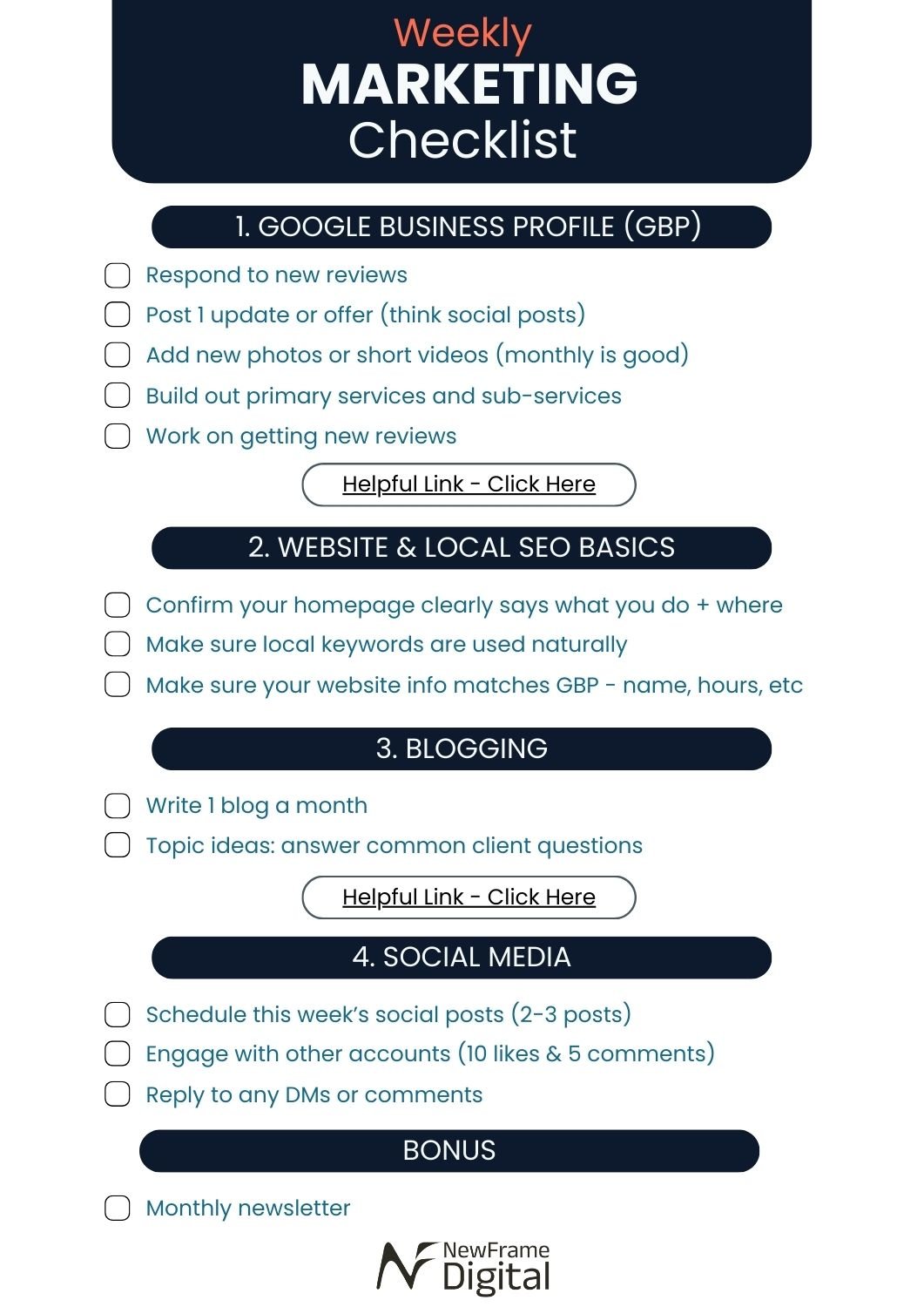
Download the Weekly Marketing Checklist
Don’t try to keep everything in your head. Use a simple checklist to stay on track and make progress every single week.
- Download the printable weekly marketing checklist
- Save it, print it, or share it with your team
This isn’t about doing everything, it’s about showing up consistently in the right places. This checklist helps you stay focused without the overwhelm.
Keep It Simple. Keep It Consistent.
Local marketing doesn’t need to be complicated. When you focus on visibility, trust, and consistency, results follow.
One clear post. One small update. One review response. Done weekly, these small steps compound into big outcomes.
Don’t overthink it. Don’t burn out. Stick to the system, and win locally.
Related Articles
 Get Found Online
5 Easy Marketing Moves To Get More Patients Without Ads
5 easy, proven marketing tactics clinic owners can implement today to get more visibility, more patients, and more bookings. No experience needed.
Tash · July 21, 2025
 Get Found Online
9 Free Marketing Platforms for Clinics (Not Facebook & Instagram)
Discover underused free marketing platforms clinics can use to boost local visibility, rankings, and patient trust in 2026.
Tyler · January 3, 2026
 Get Found Online
Halton Region Small Business Numbers You Need To Know
Discover how many small businesses operate in Burlington, Hamilton, and Oakville, and how this data can shape your marketing strategy for growth.
Tyler · April 5, 2025
Run Your Own Clinic Marketing
Cliniverse gives you the ads, posts, courses, and AI to grow your clinic, with experts on call. You own everything you build.