
Does Your Clinic Still Need a Website? What 7,900 Bookings Have to Say
With ChatGPT answering questions and Google writing AI summaries at the top of the page, a fair question for a clinic owner is whether a website is still worth it, or whether a booking page and a Google listing are enough. We pulled the numbers from the clinics we have analytics access to: 7,901 online bookings at 14 clinics, plus Google Analytics from 22 clinic websites and Search Console from 26.
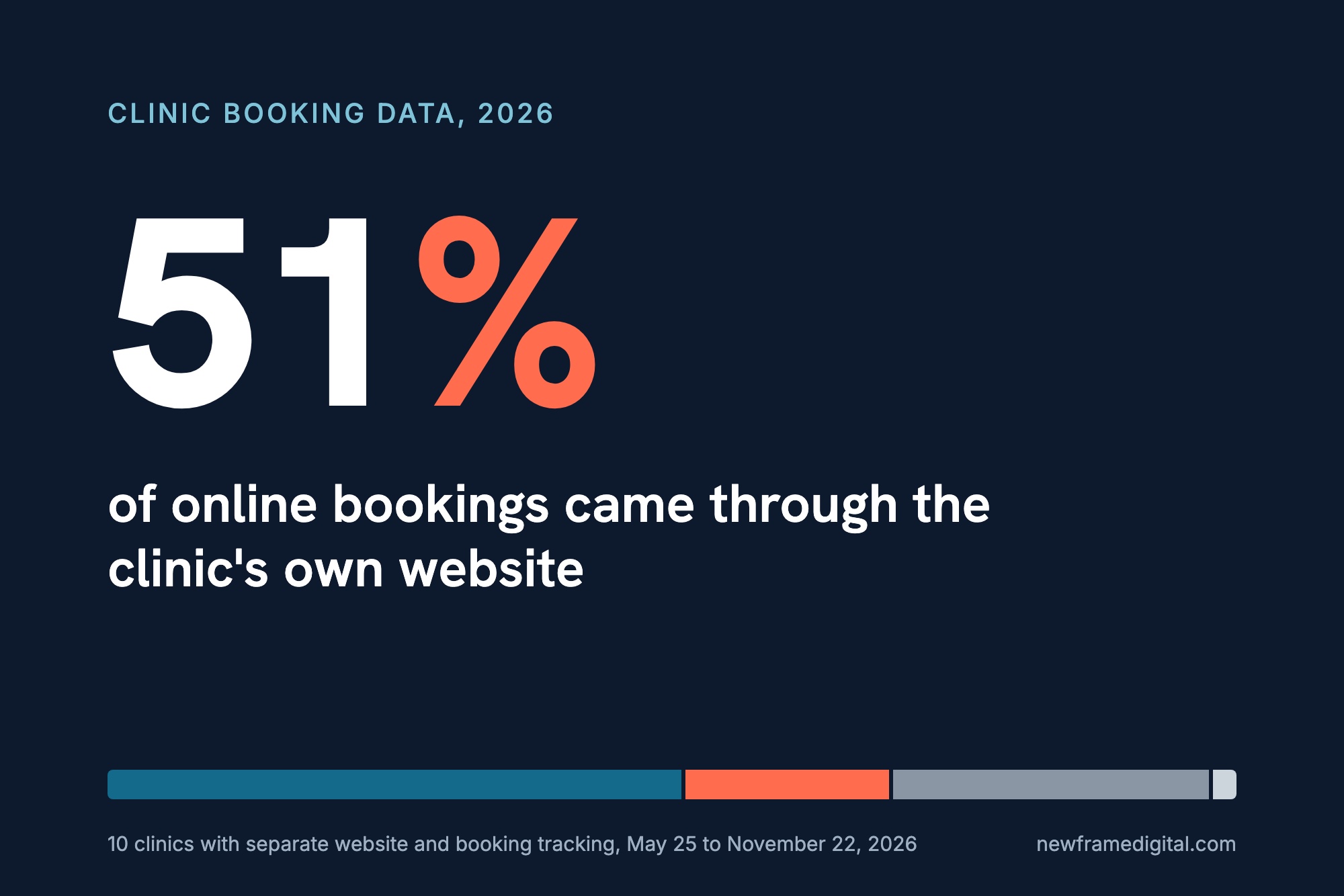
Yes, a clinic still needs its own website: at the 10 clinics where we could track it cleanly, 51% of online bookings came through the clinic's website before reaching the booking page. Google search brought half of all website visits and 59% of the clicks on Book, call and contact buttons. AI assistants sent less than 1% of visits, and the answers those tools give are built from websites like these.
Below: where the bookings came from, what people searched to find each clinic, what AI traffic looks like today, and why it matters most for multidisciplinary clinics.
Where 7,901 Online Bookings Came From
All 14 clinics book online through Jane, and each has Google Analytics on its Jane booking site. We counted a booking once per appointment confirmation page and looked at where that visit came from, between May 25 and November 22, 2026.
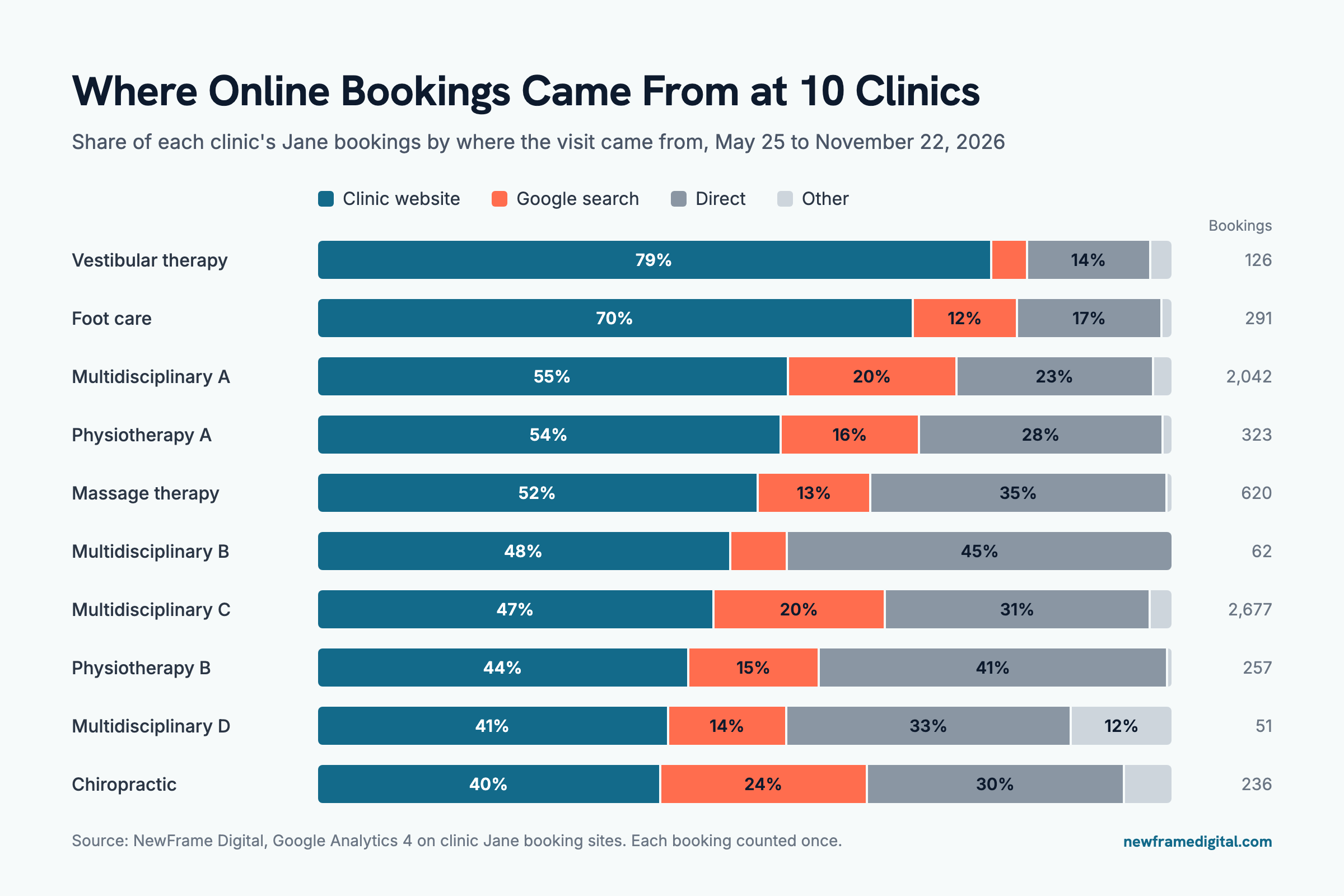
At 10 of the clinics, the website and the booking site are tracked separately, so a patient who clicks Book on the clinic's website shows up as coming from that website. That gives a clean read:
| Where the booking came from | Bookings | Share |
|---|---|---|
| The clinic's own website | 3,435 | 51.4% |
| Direct (typed the link, a saved link, an email or text from the clinic) | 1,895 | 28.3% |
| Google search, straight to the booking page | 1,216 | 18.2% |
| Everything else (social, other sites, ads) | 139 | 2.1% |
| Total | 6,685 |
The median clinic got 50% of its online bookings through its website, and none of the 10 got less than 40%. The highest were a vestibular therapy clinic at 79% and a foot clinic at 70%.
"Direct" is the catch-all here. It includes existing patients booking their next visit from a reminder email or a saved link, so among new patients the website's share is likely higher still.
The other 4 clinics have cross-domain tracking (a setting that makes Google Analytics treat the website and the booking site as one visit). With it on, a booking gets credited to wherever the visit started, like Google or an ad, even when the patient clicked through the website on the way. Their bookings showed only 10% from the website for that reason. It's one of the reasons Jane booking numbers look wrong in Google Analytics, and why we report them separately.
How People Reach a Clinic Website
Across 22 clinic websites over the same dates, we counted engaged visits (longer than 10 seconds, 2 or more pages, or a tracked action), which filters out most bot traffic. One site has a large blog audience and made up 42% of all visits, so we left it out of the shares below to keep one site from setting the average.
| Channel | Share of visits | Share of booking actions | Booking actions per 100 visits |
|---|---|---|---|
| Google search (unpaid) | 50.9% | 59.3% | 32 |
| Direct | 35.0% | 24.2% | 19 |
| Google Ads and other paid search | 7.6% | 9.0% | 32 |
| Links from other websites | 3.6% | 4.9% | 38 |
| Social media (unpaid) | 1.6% | 0.9% | 15 |
| AI assistants | 0.6% | 0.8% | 36 |
Booking actions are the clicks each site tracks: Book buttons, phone taps, contact forms. Some sites log the same click twice (once for Google Analytics, once for Google Ads), so read that column as direction, not a precise conversion rate.
Two things stand out. Unpaid Google search was the largest source of visits and an even larger share of the booking clicks. And visitors from Google took a booking action about 70% more often than direct visitors, who are more likely to be existing patients looking up an address or phone number.
Search visitors also don't all arrive on the homepage. Across these sites, 45% of visits from Google started on a service, condition, practitioner or blog page. Each of those pages is a separate way in that a booking page alone doesn't have.
What People Search Before They Find a Clinic
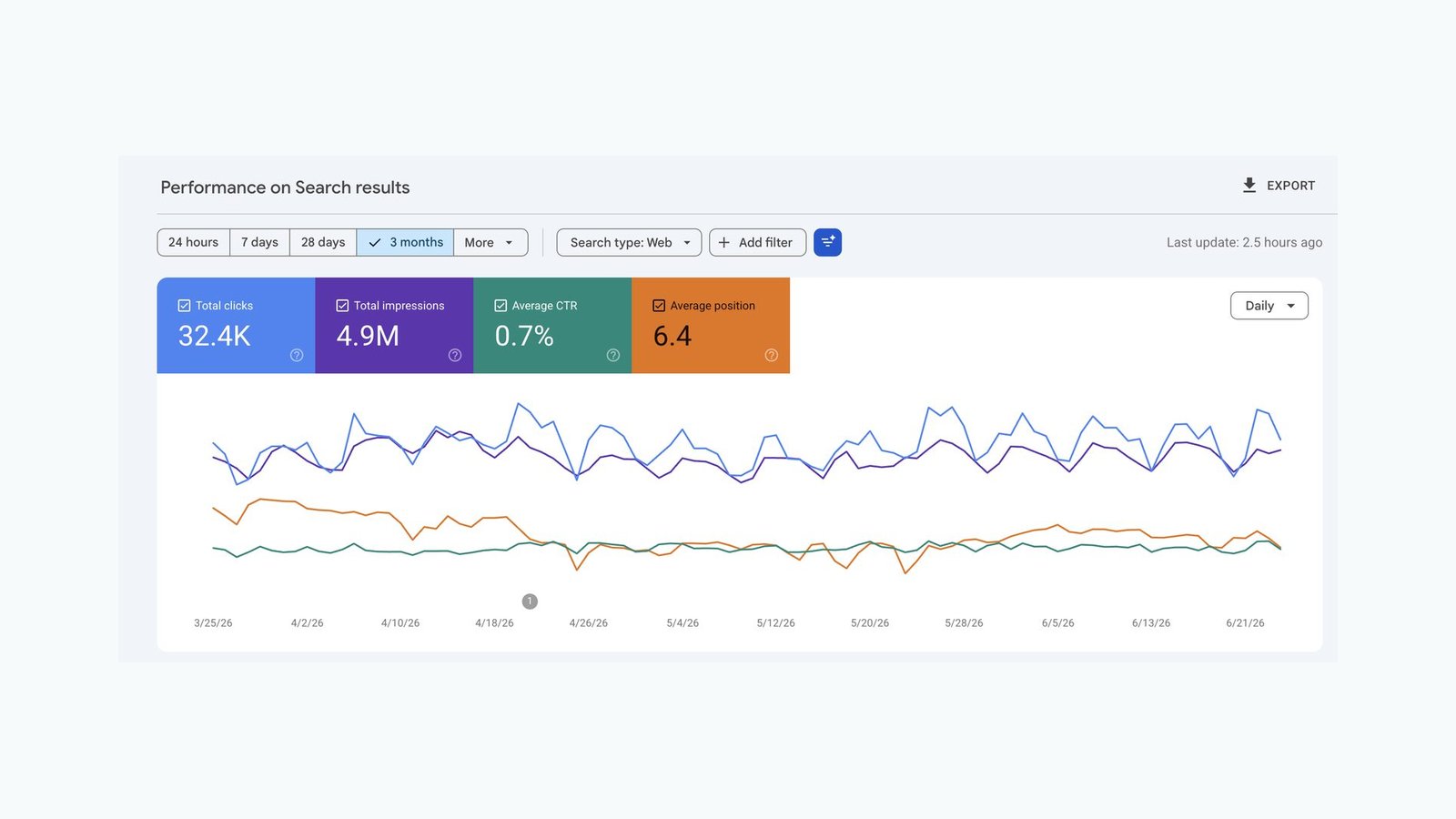
Search Console (Google's free report on the searches that show your site) covered 26 clinic websites and about 74,000 clicks over the same dates. Google shows the search behind roughly 4 in 10 clicks; it hides searches made by only a handful of people, for privacy, and those tend to be long and specific.
Among the searches Google did show, about 2 in 3 clicks came from people searching the clinic by name, a misspelling of it, or a practitioner's name. At 8 of the 26 clinics, a practitioner's name was one of the 10 searches that brought the most clicks. That's word of mouth: someone hears about the clinic or a practitioner, searches the name, and checks the website before booking.
The other third found the clinic without knowing its name. At the median clinic, 36% of the visible clicks came from searches like these:
- A service and a place: "podiatrist" plus a town name, "rmt near me", "red light therapy" plus a city.
- A condition or question: "grade 1 meniscus tear recovery time", "eye exercises for vertigo", "tmj treatment".
Some clinics lean almost entirely one way. At the vestibular clinic with 79% of its bookings coming through its website, 95% of the visible Google clicks came from people who never searched its name. They were asking about dizziness, vertigo and eye exercises, and finding the clinic's articles.
Where AI Fits Today
AI assistants sent 0.6% of visits to these clinic websites. ChatGPT brought 9 in 10 of those, with Gemini, Perplexity and Claude making up the rest, and 18 of the 22 sites got at least some.
The visits are few, but they're good ones: 36 booking actions per 100 AI visits, against 27 across all channels. The sample is small (432 visits), so treat that as a lean rather than a rule.
Our read on why: people trust an AI recommendation in a way they don't trust a page of search results. Someone asking ChatGPT has already described their problem, and the answer comes back as a short list of clinics with a reason for each. By the time they click, the comparison shopping is done, and the next step is booking.
Clicks also undercount how much AI uses a clinic's website. When someone asks ChatGPT, Claude or Perplexity about a clinic, the assistant often opens the clinic's pages live to write its answer, and the person may never click through, so that use never shows up in Google Analytics.
Those answers are built from what's on the page. When someone asks ChatGPT or Google's AI Mode for a physiotherapist near them, the answer is assembled from clinic websites, Google listings and reviews. Google's own guidance on AI features in Search says the same SEO basics apply, with no special steps needed. A clinic with no website has given those tools less to work from. We go deeper on how AI tools pick businesses in our guide to AI search for clinics.
Why Multidisciplinary Clinics Need a Website Most
A booking page lists practitioners and appointment types. It wasn't built to answer "pelvic floor physio near me", "acupuncture for headaches" or "is massage covered by my benefits", and it can't hold a page for each.
A multidisciplinary clinic offers several of those services under one roof. Each one has its own searches, its own questions, and often its own practitioner whose name gets searched. Without a website, every one of those searches has nowhere to land, and the clinic shows up mainly for people who already know its name.
A page for each service turns that around. For a clinic with physio, chiro, massage and naturopathy under one roof, it's 4 sets of searches to be found for instead of 1, plus every practitioner's name.
What a Clinic Website Needs in 2027
Based on what brought visitors and bookings in this data, these are the pieces worth having in place going into 2027:
- A page for each service and condition: one page per service you offer, plus the conditions people search for, each with your city in it.
- A page for each practitioner: names get searched. A bio page with their training, what they treat and a Book button catches that search.
- A Book button on every page that goes to the right place: link to the right discipline or practitioner in your booking system, not only the booking homepage.
- Articles that answer the questions patients ask. These are what brought the vestibular clinic most of its new visitors.
- Google Analytics on your booking site as well as your website, so you can see how many bookings came through the website.
Your Google listing and your booking page still matter. They do more when the website behind them gives Google and AI tools something to send people to. In our device data from these same sites, phones brought about 60% of engaged visits (more in our mobile vs desktop traffic data), so each of these pages should work on a phone first.
With Cliniverse Sites, your clinic website is written for you from your answers about the clinic, booking is built in, and you add a page for a new service by typing the request. Done-with-you clinic marketing covers the work around it.
How We Measured This
Every clinic here is a Canadian physiotherapy, chiropractic, massage therapy, naturopathy, foot care, vestibular or multidisciplinary clinic that has given us access to its analytics. These clinics are already working on their marketing, so their websites are likely stronger than average. All 3 data sets cover May 25 to November 22, 2026.
Bookings come from 14 clinics' Jane booking sites in Google Analytics. A booking is one appointment confirmation page, counted once, and if any view of that confirmation came from the clinic's own website, it counted as a website booking. A website booking can include someone who first found the website through Google or an ad. The 4 clinics with cross-domain measurement credit bookings differently, so we kept them apart.
Website visits come from 22 clinic websites in Google Analytics, counting engaged sessions only, with the one blog-heavy site left out of the shares. Google Analytics can't see every visit, since ad blockers and declined cookie banners hide some.
Searches come from 26 clinic websites in Google Search Console. A branded search included the clinic's name, a misspelling, or a practitioner's name. The two sites with large blog audiences were left out of the pooled branded share, and the median is across the 18 sites with at least 100 visible clicks.
Sources
- NewFrame Digital: Google Analytics 4 data from 14 clinic Jane booking sites and 22 clinic websites, May 25 to November 22, 2026
- NewFrame Digital: Google Search Console data from 26 clinic websites, May 25 to November 22, 2026
- Google Search Central: AI features and your website
- Google Analytics Help: engagement rate and bounce rate
- Google Analytics Help: set up cross-domain measurement
Related Articles
 Get Found Online
Mobile vs Desktop Traffic Stats for 2026 That Surprised Us
Mobile vs desktop web traffic in 2026: StatCounter share worldwide, in North America and in Canada, plus our own device data from 22 clinic websites.
Tyler · November 24, 2026
 AI & Tools
Your Jane Booking Numbers Are Wrong in Google Analytics
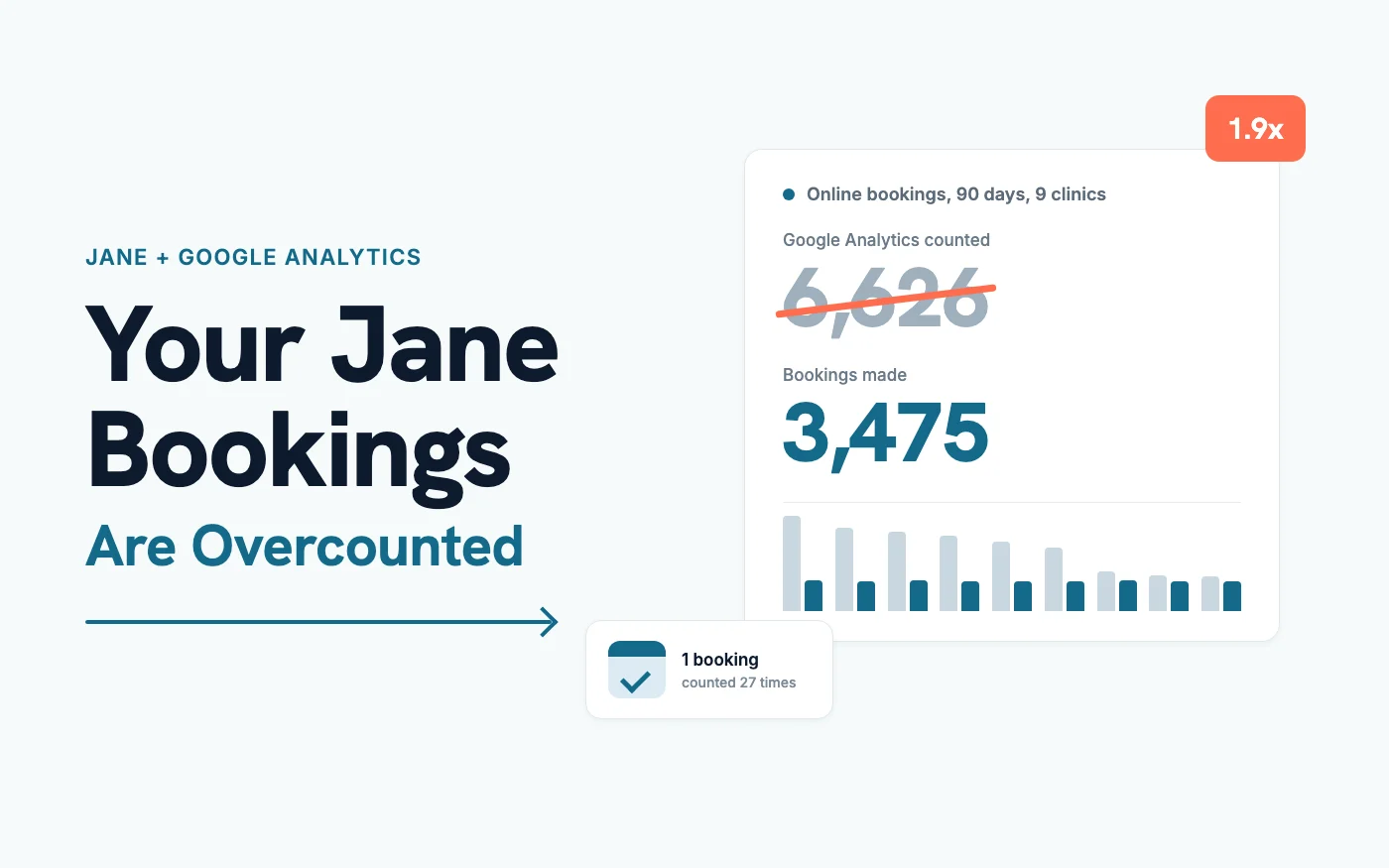
Across 9 Jane clinics, Google Analytics counted 6,626 bookings where there were 3,475, and bookings from ads were credited to the website.
Tyler · October 5, 2026
 Get Found Online
What Google Search Console Reveals About Your Patients
Google Search Console shows the searches that bring patients to your clinic site. Here's what it does, how we use it, and how to turn it into more bookings.
Tyler · October 22, 2026
Run Your Own Clinic Marketing
Cliniverse gives you the ads, posts, courses, and AI to grow your clinic, with experts on call. You own everything you build.