
How Much Do Meta Ads Cost? A Local Business Guide for 2026
The answer to "how much do Meta ads cost" is that there's no fixed price and you can spend as little as you want, from a few dollars a day to a few thousand. The real question isn't the number you put in, it's what you get back for it.
The short answer: Most local businesses should plan for at least $20 to $30 per day to give the system enough to work with. You can technically run ads for $1 a day, and they will run, but you'll learn slowly, along with Meta, and the results will trickle in. What you pay per result depends on two things: your budget and the type of campaign you choose. An awareness campaign and a purchase campaign cost different amounts to reach the same person, and that's by design.
The rest of this guide covers what drives the cost, why your campaign goal changes the math, what a small budget buys, and whether Meta ads are worth it for a local business at all.
First, What "Meta Ads" Means
Meta ads are the paid ads that run across Meta's platforms. Most people think of Facebook and Instagram, but Meta also places ads on Threads, Messenger, and the Audience Network (third-party apps and websites outside Meta). It's all one ad system, same billing, run from the same place (Meta Ads Manager). When people ask about Facebook ad costs and Instagram ad costs, they're asking about the same auction. Where your ad shows up is a placement setting inside one campaign.
So everything below applies whether you advertise on Facebook, Instagram, or anywhere else in the Meta network.
One thing worth knowing as a local business: not all placements perform the same. In our experience, the Facebook Feed tends to be the strongest spot for local lead generation, while placements like the Audience Network often spend your budget on cheaper, lower-quality attention. Meta spreads you across everything by default, so it's worth watching which placements produce results and leaning into the ones that do. The ad set checkboxes that used to hold that line are going away, so the account-level placement control is where you set it now.
What You Pay Depends on the Campaign You Choose
Your cost per result is not a fixed market rate. It's mostly decided by the goal you give Meta when you set up the campaign.
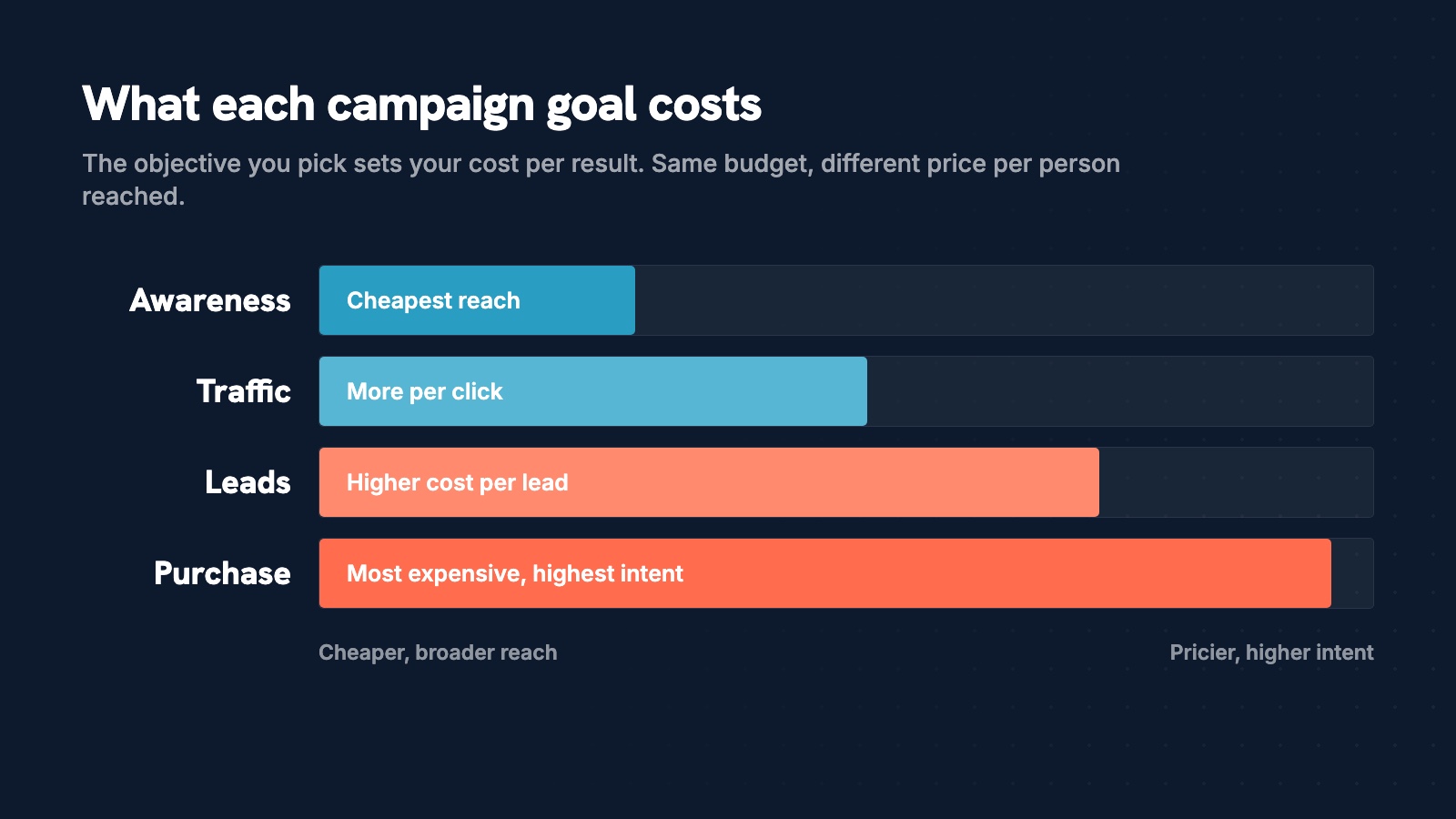
When you build a campaign, you pick an objective: awareness, traffic, leads, sales, and a few others. Meta then optimizes everything toward that one goal and prices your ads accordingly, which plays out differently for each one.
Awareness Campaigns: Your Dollars Go the Furthest
If your goal is awareness or reach, Meta puts your ad in the cheapest available spots and shows it to as many people as it can. You'll get a lot of impressions (the number of times your ad is shown) and a lot of reach (the number of different people who see it) for your money.
This is the cheapest way to get in front of people, because Meta isn't doing any heavy lifting to find buyers, it's showing your ad widely so your dollars stretch far. The trade-off is that those people aren't being filtered for intent. They saw your ad, but nothing about them says they're ready to book.
Traffic and Click Campaigns: Impressions Drop, Clicks Rise
If your goal is clicks or landing page views (someone clicking through to your website), Meta shifts who it shows the ad to. Now it's looking for people more likely to click, not glance.
Your impressions and reach go down compared to an awareness campaign, but your clicks go up. You're paying for action instead of eyeballs, so each result costs more, but the result is worth more too.
Lead and Purchase Campaigns: The Most Expensive, and the Most Valuable
If your goal is leads (a form fill, an inquiry) or purchases, Meta works hardest of all. It tries to put you in front of the people it believes are most likely to convert for your specific goal. Those are the most valuable placements, so they're the most expensive.
Your reach and landing page views drop, but your leads or sales go up, and your cost per lead or cost per sale climbs with them. That isn't the system failing, it's the system doing exactly what you asked, finding higher-intent people and skipping the rest.
So when you compare costs, you can't compare a $2 awareness result to a $30 lead. They bought you completely different things. A lead campaign costs more per result because the result is a real prospect, not a passing impression.
This is also the heart of the Meta Ads versus Google Ads decision: Meta creates demand by interrupting people, Google captures demand from people already searching, and that changes what each result costs.
Why Good Ads Cost Less (and Bad Ads Cost More)
Two clinics can run the same campaign, target the same city, set the same budget, and pay completely different amounts per result. The difference is the quality of the ad itself.
Meta is a platform that makes money by keeping people scrolling. People do not come to Facebook and Instagram for ads, so Meta has a strong interest in showing ads that don't ruin the experience, and the auction is built around that.
When you run an ad, Meta isn't giving the best spot to whoever bids highest. It weighs your bid against how likely people are to respond well to your ad, measured through engagement and signals like whether people watch it, click it, hide it, or report it. An ad people enjoy gets rewarded with cheaper, wider delivery. An ad that looks like an ad, gets scrolled past, or gets hidden costs you more to put in front of the same people, because Meta has to work against its own users' preferences to deliver it.
It isn't a punishment so much as the system pricing in how welcome your ad is. A native-feeling ad with a real face, a local landmark, and a clear offer earns lower costs because it keeps people on the platform, while a generic, stocky, salesy ad does the opposite and your cost per result drifts up.
The practical takeaway: the cheapest way to lower your Meta ad costs is usually not bidding less or spending more. It's making a better ad. The same dollar goes further when the ad earns its place in the feed.
What a Small Budget Buys
You can run Meta ads for $1 or $2 a day, and it works. One clinic owner we work with filled his associate's schedule on about $2 a day, hitting a $22 cost per lead over five months. So a small budget is not a dead end, but it is slow, and the reason comes down to how Meta learns.
Meta needs data to get good. When you launch a campaign, it goes through what's called the learning phase, a period where the system tests your ad against different people to figure out who responds. The more it can spend, the faster it learns.
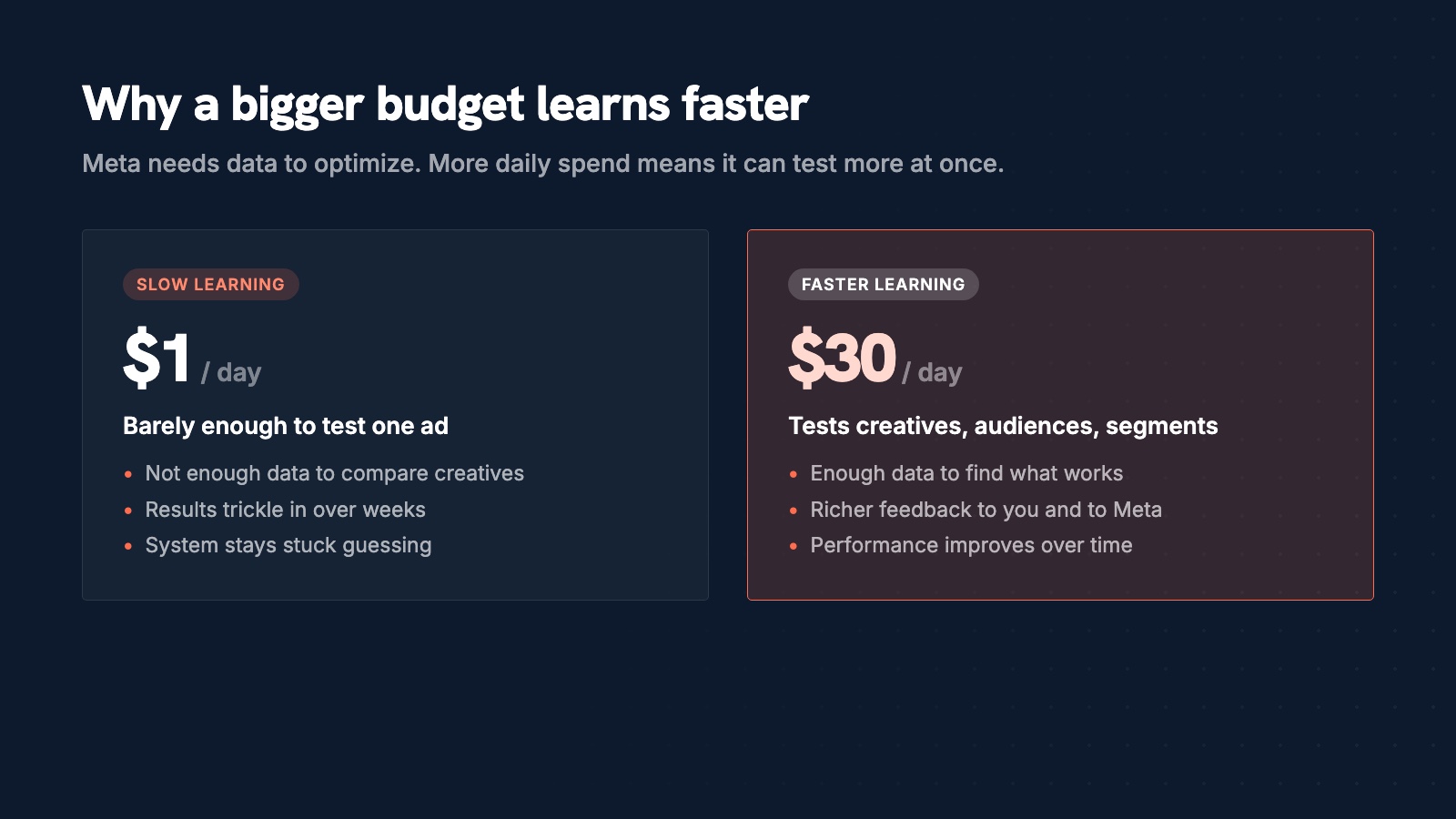
Now picture uploading 10 or 15 different ad creatives (the images and videos you're testing) on a $1-a-day budget. Meta can barely test one of them, let alone figure out which performs best, because there isn't enough money moving for it to learn. Your data comes back slowly and the system stays stuck guessing.
Spend more and the opposite happens. Meta can test different creatives, audiences, demographics, and segments at the same time. It learns faster, the data it sends back to you is richer, and its optimization improves. More spend doesn't just buy more ads, it buys faster learning, which usually improves performance over time.
Temper Your Expectations to Your Cost Per Result
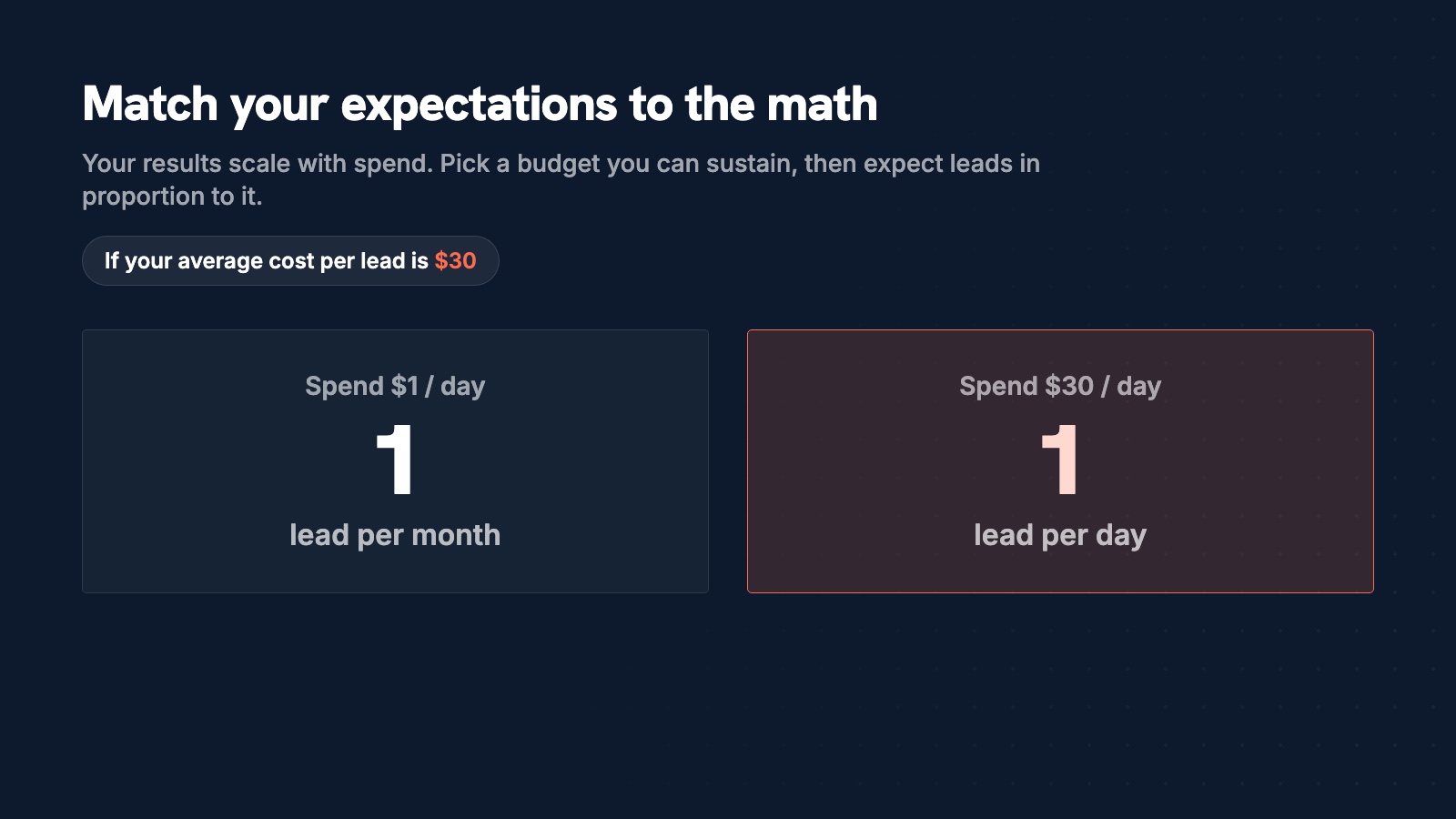
Say your average cost per lead is $30.
- At $1 a day, you're spending about $30 a month, so you should expect roughly one lead a month.
- At $30 a day, you're averaging about one lead a day, plus all the extra data that helps Meta and your creative get better over time.
Neither is wrong, and a small budget is a fine way to start and learn the platform, as long as you size your expectations to the number. One dollar a day will not produce a flood of leads, and any guide that suggests otherwise isn't being straight with you.
More Spend Helps, But It's Not Just About Spending More
The instinct is to assume a bigger budget always means better results, but it's more nuanced than that, and this example shows why.
We have a clinic that was running $100 a day, then dropped to around $60 a day. His total conversions stayed about the same, which means his conversion rate went up, and he found the leads coming in at the lower spend were better quality.
It happens because spend is only one variable. The offer, the creative, the targeting, the follow-up speed, and the campaign objective all move your cost per result, sometimes more than the budget does, so cutting wasteful spend can sharpen a campaign rather than weaken it. In one case we switched a rural clinic from a lead form to Messenger and dropped its cost per contact from about $23 to $7 without touching the budget.
That's the same discipline behind one of the best-performing local campaigns we've broken down: a physio clinic generating 150+ leads a month with Meta ads, running a tight testing-and-scaling split and fresh creative every week. The budget matters, but the system around it matters more.
Frequently Asked Questions
How much do Meta ads cost per month?
There's no fixed price. You set the budget, from a few dollars a day to thousands, so a typical local business spending $20 to $30 a day lands around $600 to $900 a month. That's enough for Meta to gather data and optimize. What you pay per result depends on your campaign objective and your market. If you're weighing it against search ads, here's how much to budget for Google Ads for comparison.
Is $10 a day enough for Facebook ads?
It's enough to run and learn slowly. At $10 a day you'll gather data and get some results, but the system has limited room to test creatives and audiences, so optimization takes longer. It's a reasonable starting point for a small local business, as long as you're patient with the pace.
Is $5 a day enough for Instagram ads?
Same answer, since Instagram and Facebook ads run on the same system. Five dollars a day will run, but it's on the low end, so expect slow learning and modest volume. If you can stretch to $20 or $30 a day, the system learns faster and your results tend to improve sooner.
How much are Facebook ads per 1,000 views (CPM)?
That number is your CPM, the cost per 1,000 impressions, and it varies widely by audience, industry, season, and competition. A broad awareness campaign in a quiet month is cheap on a CPM basis, while a narrowly targeted campaign during a busy retail season costs far more, because more advertisers are bidding for the same people. Don't anchor on a CPM figure you read somewhere. Focus on your cost per result instead, since that's what ties spend to revenue.
What is the 20% rule on Facebook ads?
It was an old Meta rule that limited how much text could appear in an ad image, roughly 20% of the image. Meta has since retired the hard limit, though image-heavy text can still hurt how widely your ad gets shown. Keep text on images light and let the ad copy do the talking.
Are Meta ads worth it for a small business?
For most local businesses, yes. Meta makes roughly $196 billion a year on advertising with millions of advertisers, so people clearly aren't spending that kind of money on something that doesn't work. When someone says "Meta ads don't work," they're implying every business in their industry running ads is wasting money, which is almost never true. What usually failed was the setup: a weak offer, broad targeting, or slow follow-up. Whether ads work for you comes down to your offer, targeting, and follow-up, not the platform itself. No one can guarantee a profit, but done right, the return can be one of the best available to a local business.
The Bottom Line on Meta Ad Costs
Meta ads cost as little or as much as you decide. The budget you set is only half the story. The campaign objective you choose decides how far each dollar goes, and the system around your ads, the offer, the creative, the follow-up, decides whether that spend turns into customers.
Start with a budget you can sustain for long enough to learn something, expect results in proportion to your cost per result, and treat the early spend as tuition while Meta learns who your buyers are. Done that way, the platform pays off for local businesses every day. The advertisers who say it doesn't work are almost always the ones who skipped the fundamentals.
If you'd rather not guess your way through it, there's a done-with-you way to run your own clinic marketing without handing it to an agency. Cliniverse gives clinic owners proven ad templates, follow-up systems, and step-by-step training so you can set up Meta ads properly from the start instead of paying to learn the hard way.
Related Articles
 Get Found Online
Meta Ads or Google Ads First? A Local Business Guide for 2026
Meta Ads or Google Ads first? It comes down to your budget and your industry. Here's how local businesses should choose in 2026.
Tyler · June 12, 2026
 Get Found Online
Google Ads Cost in 2026: Minimum Budget, CPC + ROI Breakdown
Google Ads cost breakdown: minimum daily budget, CPC by industry, and how many clicks Google needs to learn your campaign in 2026.
Tyler · February 18, 2026
 Get Found Online
Meta Advantage+ AI Writes Your Ads. You Answer for Them
Meta Advantage+ AI can rewrite your clinic's ads. Your college holds you responsible for the result, so here is what to check before it publishes.
Tyler · September 6, 2026
Run Your Own Clinic Marketing
Cliniverse gives you the ads, posts, courses, and AI to grow your clinic, with experts on call. You own everything you build.