
Meta Ads or Google Ads First? A Local Business Guide for 2026
We get this question all the time from local business owners before they spend a dollar on paid ads: which platform should I start with, Meta or Google ads? It's the same question that gets asked in marketing forums like this r/AskMarketing thread over and over, and the reason it keeps coming up is that there's no clean one-size answer.
The answer is that it depends, and the two things it depends on most are your budget and your industry.
The short answer: If your budget is on the smaller side, Meta Ads is usually the better starting point because the same dollar stretches further. If you have a bigger budget, starting with Google Ads makes more sense because you can dominate the local search auction for high-intent terms. If your budget is big enough to run both, you should, and the order matters less.
Industry matters on top of that. The same campaign can produce great results for one clinic and flat results for another running the same offer in the same city. Paid ads are variable. There's no universal right answer, only better and worse fits for your situation.
Here's how to think about which one to start with, what each platform costs, and how the two work together once you scale.
How the Two Platforms Are Different
Google Ads and Meta Ads are both auction-based ad platforms, but they work in opposite directions.
Google captures demand. Someone types "physiotherapist near me" or "emergency plumber Burlington" and your ad shows up at the moment they're looking. They already want what you sell. Your job is to win the click and the booking.
Meta creates demand. Your ad shows up while someone is scrolling Instagram or Facebook. They weren't looking for you. They might not have known they wanted what you offer. Your job is to interrupt their feed with something compelling enough that they stop scrolling and take action.
That difference influences everything downstream: the targeting, the creative, the cost per click, the lead quality, the follow-up speed. But it's not the only thing that determines which platform to start with. Budget and industry usually weigh heavier in the decision than search intent alone.
Here's how Google Ads and Meta Ads compare across the things local business owners care about most:
| Factor | Google Ads | Meta Ads |
|---|---|---|
| How it works | Captures existing demand (pull) | Creates demand (push) |
| Best for | Service businesses with strong local search intent | Visual, discovery, or offer-driven businesses |
| Customer mindset | Actively searching for a solution | Scrolling, not shopping |
| Typical CPC | $3 to $25 | $0.50 to $3 |
| Useful daily budget | $20 to $50 minimum | $15 to $30 minimum |
| Lead volume | Lower | Higher |
| Lead quality | Higher intent | Higher volume, lower intent |
| Follow-up speed needed | Fast, but slightly more forgiving | Within minutes or you lose them |
| Better fit for bigger budgets | Yes | |
| Better fit for smaller budgets | Yes |
The table makes the framework easy to scan, but the nuance is in the prose below. Each platform has trade-offs the table can't capture, like the variability we see between two clinics in the same city running identical campaigns.
When Google Ads Is Usually the Better Start
Google Ads tends to be the better starting point when you have a bigger budget and your industry has strong, consistent local search demand.
The kinds of businesses where Google often pays off first include dentists, lawyers (expensive industry), plumbers, electricians, HVAC, roofers, accountants, and optometrists. The common thread is that customers type a specific need into Google before they pick a provider, and a click in the right city can be worth a lot.
The advantage is intent. Someone searching "plumber near me" most likely needs help now compared to someone scrolling a feed. They've decided they need the service. The only question left is who they pick.
The trade-off is cost per click. Google Ads is an auction, and high-intent keywords get expensive fast. Local service keywords in competitive markets can run $5 to $25 per click. Some niches push past $50. If your budget can only support a handful of clicks per day, you'll struggle to learn anything and optimize before the spend runs out.
Lead quality is usually higher than Meta because the searcher has self-selected. They want the service. Volume is usually lower for the same reason. Fewer people search "deep tissue massage Burlington" in a month than scroll past a wellness ad on Instagram.
We've also seen identical Google Ads setups perform completely differently across two clinics in the same city. Same industry, same offer, different results. Google Ads gives you a shorter path to a booking when it works, but it's not a guarantee, and the bigger budget requirement makes the cost of finding out higher.
When it works, the gains can be huge. We documented how one of our clinic clients built and runs their own Google Ads in-house and what the cost per booked patient looks like once the auction settles.
If you have the budget to compete in your local auction and you want to capture people already looking for what you do, start with Google. If you're new to Google Ads and not sure how much to spend, we wrote a full breakdown of what Google Ads cost in 2026, including minimum budgets and what a useful daily spend looks like.
When Meta Ads Is Usually the Better Start
Meta is often the better starting point when your budget is on the smaller side, because the same dollar stretches further. It's also the better fit for industries where the buying decision is visual, emotional, or driven by a promotion: med spas, aesthetic clinics, gyms, fitness studios, restaurants, retail, salons, event venues, photographers, and any local business that runs an introductory offer.
If you're a service business that could go either way, like a physio clinic, chiro, or RMT, Meta can still be the right first move when your budget is limited. A smaller daily spend on Meta usually produces enough leads to learn something. The same daily spend on Google often buys two or three clicks and not much else. This makes it tough to optimize and make informed decisions.
The advantage is reach and volume. Meta lets you put a single offer in front of tens of thousands of locals for a fraction of what Google charges per click. CPCs in the $0.50 to $3 range are normal. The cost per lead can come in well below Google for the same audience.
The trade-off is intent. People on Meta aren't shopping. They're scrolling. Your ad has to do three jobs at once: stop the scroll, communicate the offer, and make booking feel low-friction. That usually means a strong promotion, a clear visual, and a fast follow-up system on the other side.
Lead quality is where it gets nuanced. Meta leads are usually higher volume but lower intent. If you're running a discount, expect a percentage of leads to be price shoppers, cash-only patients, or people who never planned to book full price after the offer expired. That's not a flaw in Meta. It's the nature of demand creation.
And it's worth saying again: results are variable. We've seen the same Meta offer run beautifully for one clinic and barely move for another. Industry, location, offer, creative, and follow-up speed all stack on top of each other. There's no setting that works the same way twice. Creative carries more of that weight every year, now that Meta's AI rewrites the ads you upload unless you go in and stop it.
One of our clinic clients runs Meta ads so well their cost per lead sits at a fraction of the industry average and the bigger problem became handling the volume of inbound enquiries, not generating them. That's the upside when Meta clicks: the leads come in faster than you can answer them.
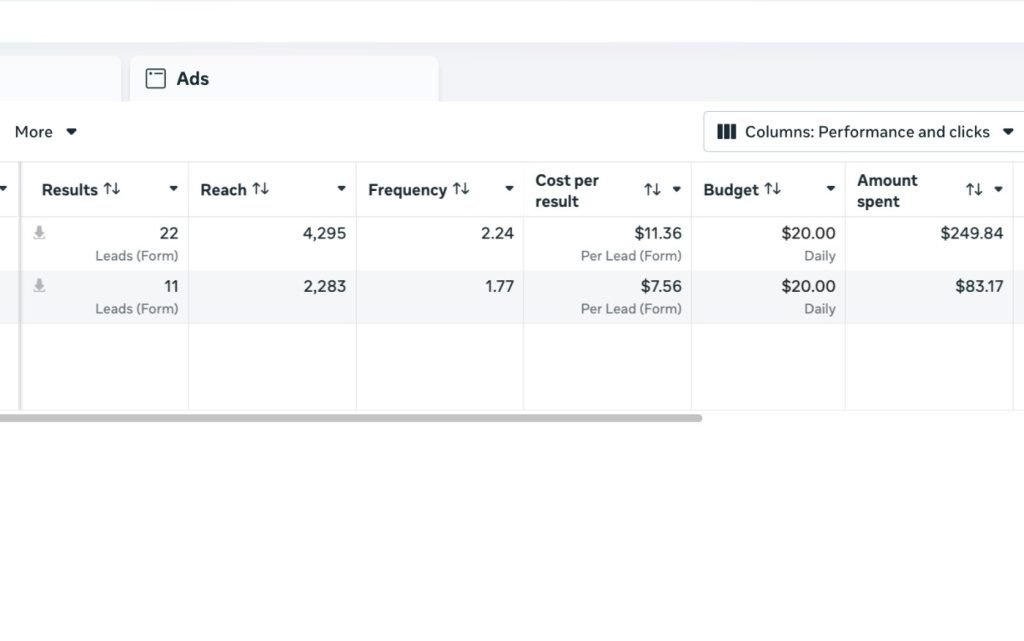
We also broke down how one independent physio clinic generates 150+ leads a month on Meta using a similar playbook. Their conversion from lead to patient sits around 66%, which is excellent, but the owner is clear that a portion of those patients are cash-pay or uninsured. The volume more than makes up for it, but you have to know what you're signing up for.
If you have a smaller budget, want leads fast, and can follow up within minutes, Meta is usually the place to start. We also put together a YouTube playlist walking through Meta ads setup for physio, chiro, massage, and other local service businesses if you want to see what the build looks like end to end.
What Each Platform Costs
Cost is the question every local business owner asks first, and the answer is that it varies more than a lot of ad agencies will tell you.
Here's the rough range we see across our clinic and local business accounts:
Google Ads (local service businesses):
- CPC: $3 to $25 depending on the niche and city
- Daily budget that produces useful data: $20 to $50 minimum
- Monthly spend for a single-location business: $1,500 to $5,000 is typical
- Cost per lead: $30 to $150+ depending on the market
Meta Ads (local service businesses):
- CPC: $0.50 to $3
- CPM (cost per 1,000 impressions): $5 to $25 depending on campaign goal
- Daily budget that produces useful data: $15 to $30 minimum (with a caveat: we have a clinic client running Meta ads at $2 a day to fill an associate's schedule and it works, but the data builds slower)
- Cost per lead: a typical average of $20 to $70+, sometimes lower if the offer is strong or connects with the audience
Meta is almost always cheaper per click and per lead. Google is almost always higher quality per lead. Both numbers vary wildly based on your city, your competition, your offer, your creative, your landing page, and your follow-up speed. We dug into how much Meta ads cost on their own, including why your campaign objective moves the cost per result more than your budget does.
The question isn't "which is cheaper." It's "which gives me a better cost per booked patient or customer." That's the number you should track from day one.
Lead Quality and Follow-Up Speed
Meta leads need to be contacted within minutes. Five minutes is the gold standard. Fifteen minutes is workable. An hour is too long. If you don't have a system to text or call every new lead the moment they fill out a form, Meta will feel broken even if the ads are technically working.
The reason is Meta leads aren't searching. They saw an offer, got excited, filled out a form, and within ten minutes their attention has moved on to the next post in their feed. If you call them an hour later they often don't remember filling out the form at all and potentially aren't on their phones anymore.
Google leads are slightly more forgiving because the person was actively searching. They remember why they reached out. You still want to follow up fast as they may have contacted multiple businesses, but you have more breathing room.
This is why a lot of local businesses run Meta Ads and feel like the leads are bad. The leads aren't bad. The follow-up is too slow. Tighten that up with a speed-to-lead system and Meta usually outperforms expectations.
The Flywheel: Running Both Together
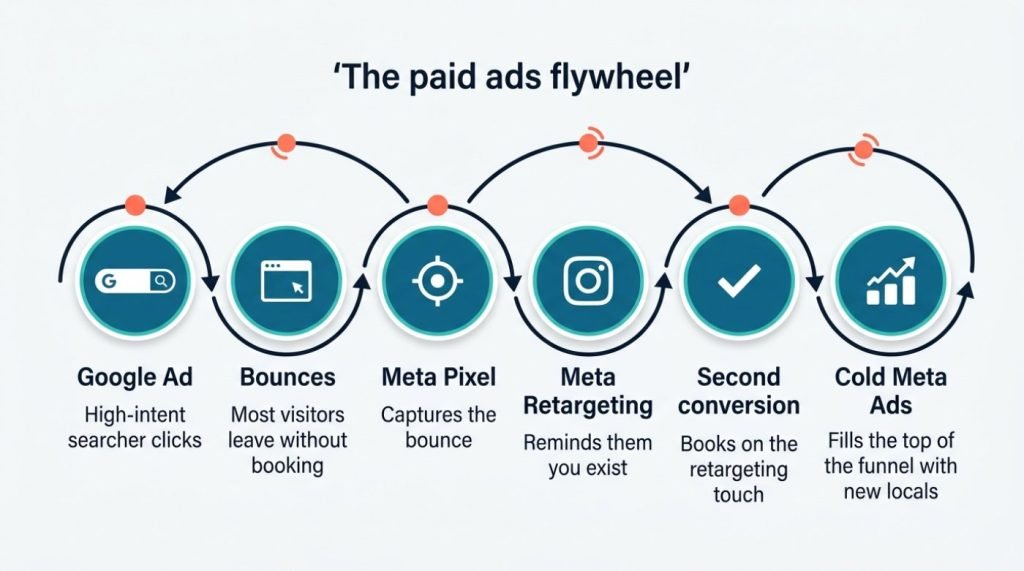
Once you've validated one platform, the smartest move is to run both. They cover gaps for each other.
Here's how the flywheel works:
- Google Ads catches high-intent searchers at the moment they're ready to book.
- Some of those visitors convert. Most don't. They bounce (leave your website without contacting).
- Your Meta pixel is firing on every visitor, so the people who bounced now sit inside a retargeting audience.
- Meta retargeting ads show up in their feed over the next few days reminding them you exist.
- A second slice converts on the retargeting touch.
- Meanwhile, your top-of-funnel Meta ads keep filling the audience with new locals who didn't know they needed you yet.
Done well, this gives you compounding returns. Every dollar you spend on Google not only buys clicks, it feeds your Meta retargeting pool. Every dollar on Meta builds awareness that improves your Google click-through rate over time.
A reasonable budget split when you're running both as a single-location local business is roughly 60% Google and 40% Meta if you have enough budget to compete in your local Google auction and your industry has strong search intent. Flip it if your offer is visual, your budget is tighter, or your industry runs on promotions. That's a starting point, not a rule. Your data should rebalance it within a few weeks.
The Long Game: Ads Are Rented, Search Is Owned
One thing worth saying before you commit to either platform: paid ads are rented traffic.
The day you turn off Google Ads, your leads stop. The day you stop running Meta Ads, the pipeline dries up within a week. Ads are useful for short-term pipeline and for testing offers fast, but they don't compound. You pay every month, forever, to keep the leads coming.
Content and search ranking compound. A blog post that ranks today can still be sending you booked patients five years from now. That's why we always recommend running paid ads alongside a long-term content and local SEO strategy, not instead of one. We wrote more about that trade-off in our breakdown of SEO vs Google Ads, and about where ads fit when you're marketing a physiotherapy clinic.
Ads are a faucet. SEO is a well. You want both, but you should know which one you're paying for at any given moment.
Frequently Asked Questions About Meta Ads & Google Ads
Do Google Ads work better than Meta Ads?
Neither is universally better. It depends on your budget, your industry, your offer, and how fast you follow up with leads. The same campaign can perform completely differently for two businesses in the same city. Google tends to produce higher-intent leads when you have the budget to compete in the auction. Meta tends to produce more leads per dollar when budgets are tighter or the offer is visual. Both can win, both can fail.
Should I run Meta Ads and Google Ads at the same time?
Yes, once you've validated one of them. Starting both at the same time with a small budget usually means neither gets enough data to optimize. Pick the one that fits your business model best, prove it works for 60 to 90 days, then layer the other one on top with retargeting tied between them.
Does Google Ads or Meta Ads have better lead quality?
Google leads are usually higher quality because the searcher has self-selected intent. Meta leads are usually higher volume but require faster follow-up to convert at the same rate. Quality also depends heavily on your offer. A free consult offer on Meta will bring in tire-kickers. A paid intro session on Meta will bring in serious buyers.
So Should You Start With Meta Ads or Google Ads?
If your budget is on the smaller side and you want leads fast, start with Meta. The same dollar usually stretches further, and you'll learn whether your offer resonates inside a few weeks.
If you have a bigger budget and your industry has strong local search demand, start with Google. The leads cost more, but you're catching people at the moment they're ready to book.
If your budget supports running both, run both. The order matters less, and the two platforms feed each other through retargeting once the pixel is firing.
If you're not sure where to start, look at where your best existing customers came from. The channel that already feeds you is the one most likely to scale. And keep in mind that paid ads are variable. Two clinics down the road from each other can run the same campaign and get different results. There's no plug-and-play setting that works the same way twice.
If you'd rather not figure this out alone, that's what Cliniverse is built for. You run your own ads with our team, our courses, our AI, and our community of clinic owners behind you. Cheaper than hiring an agency, less guesswork than going it alone. Take a look at our done-with-you clinic marketing approach to see how it works.
Related Articles
 Get Found Online
How Much Do Meta Ads Cost? A Local Business Guide for 2026
How much do Meta ads cost? There's no fixed price. What you pay per result comes down to your budget and the campaign you run. Here's the breakdown.
Tyler · June 18, 2026
 Get Found Online
Google Ads Cost in 2026: Minimum Budget, CPC + ROI Breakdown
Google Ads cost breakdown: minimum daily budget, CPC by industry, and how many clicks Google needs to learn your campaign in 2026.
Tyler · February 18, 2026
 Get Found Online
SEO vs Google Ads: Which is Better in 2026?
SEO vs Google Ads - which should you do? SEO builds traffic you own forever. Google Ads gets you there fast. Here's what you should do.
Tyler · March 15, 2026
Run Your Own Clinic Marketing
Cliniverse gives you the ads, posts, courses, and AI to grow your clinic, with experts on call. You own everything you build.