
What Google’s New AI Search Bar Changes for Your Local Business
The headlines this week called it the biggest change to Google search in 25 years. So is the search bar you’ve used for two decades gone? Not yet.
Google’s new AI Mode is an option you select at the top of the results page. You have to click into it. Most of your patients haven’t.
That could change. Google might roll AI Mode out to more people over time, or even make it the default down the road. Nobody outside Google knows the timeline. What we do know is what AI Mode looks like today, and what your clinic should be doing either way.
What AI Mode Looks Like for a Local Search
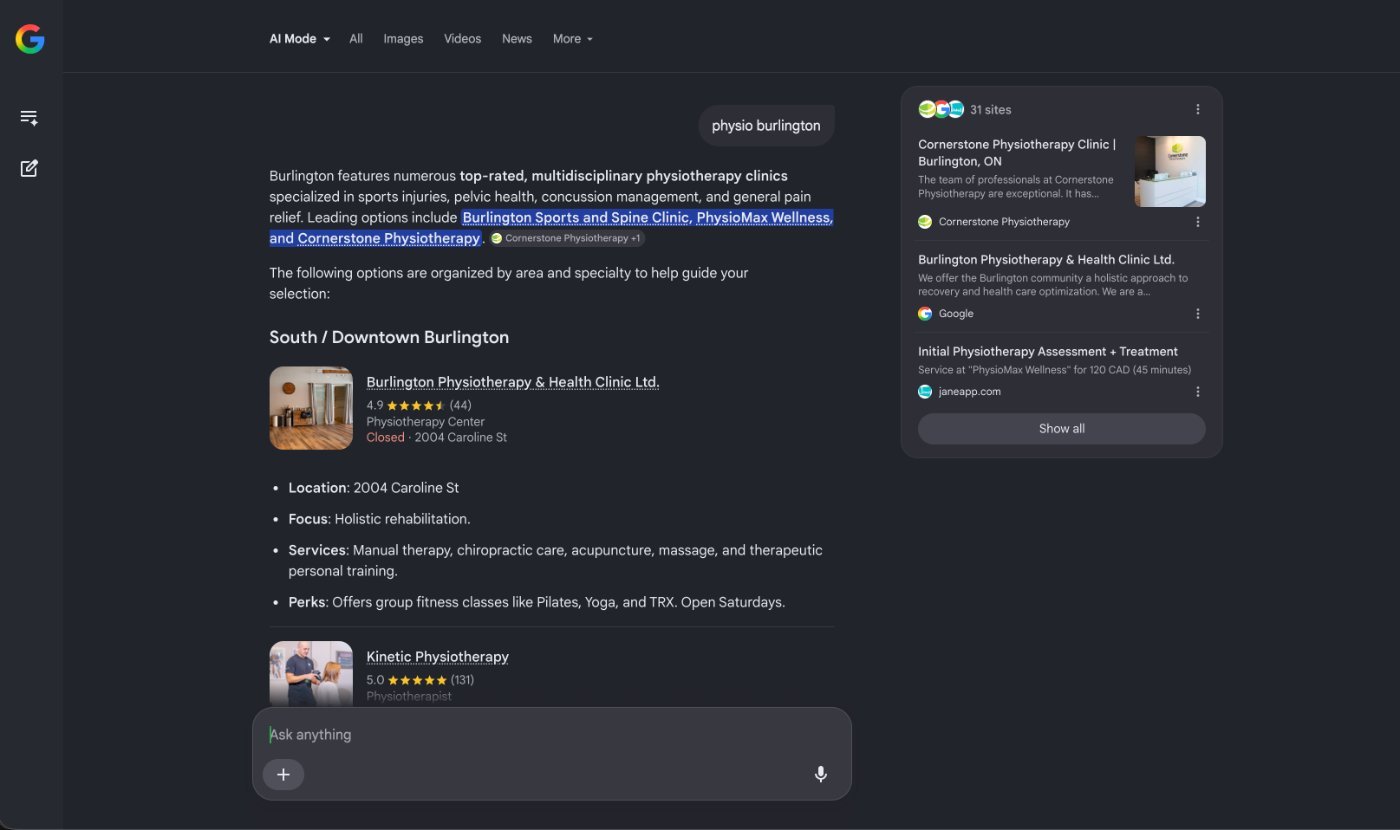
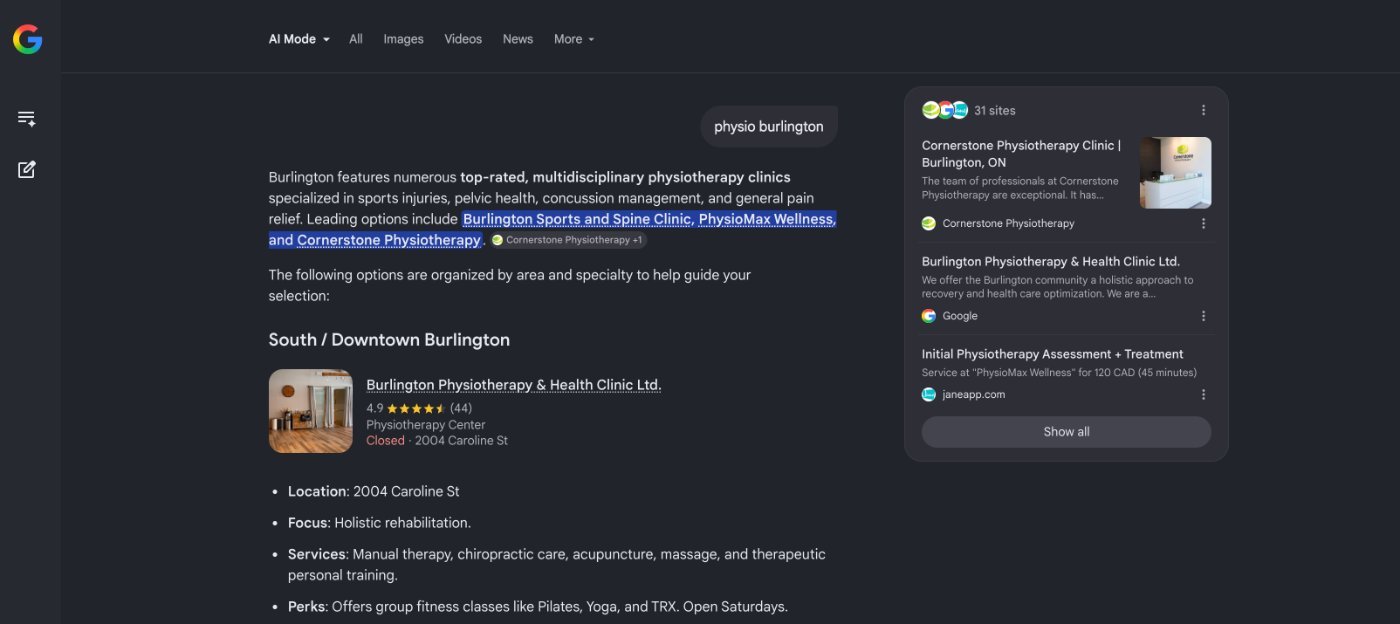
Search “physio burlington” in AI Mode and you don’t get a wall of text or the traditional links to websites. You get a list of clinics by name, with the same info you’d see in the Map Pack: photos, ratings, hours, and address. Each one also gets a short written description, like “a sports-centric clinic serving local athletes for over 15 years.”
That description? AI Mode wrote it by reading the clinic’s reviews and website. The phrasing came from real patients who left reviews about sports recovery.
Click any clinic on the list and you don’t go somewhere new. You land on the same Google Business Profile card you’ve always seen, with the same booking button, phone number, and reviews.
Why This Matters Less Than the News Made It Sound
Three things to keep in mind:
- AI Mode is opt-in today: your patients have to click the tab, and most won’t, at least not for a while. Habit is sticky, and 25 years of muscle memory doesn’t flip overnight.
- Traditional search is still there: the Map Pack, the website links, and the sponsored ads at the top haven’t gone anywhere. Google now has more places to show your clinic, not fewer.
- GBP is still the destination: no matter how someone finds you, they end up on the same Google Business Profile.
What Does Change (and What to Do About It)
Inside AI Mode, your Google reviews stop being a ranking signal alone. They become the raw material AI uses to write the summary of your clinic. The words your patients use to describe you are the words a stranger reads first.
This sharpens an action you should already be doing rather than adding a new one. Here’s the 3-part check worth running this week:
- Your Google Business Profile: is it fully filled out, with services, accurate hours, recent photos, and a working booking link? AI Mode sends people straight to this card, so anything missing is a missing booking.
- A steady flow of new, specific reviews: you can’t change what past patients already wrote, but you can shape what comes next. Ask happy patients to mention what you helped them with, beyond “great staff,” and automating that review ask after every visit is the most reliable way to keep them coming. Reviews like “helped my dizzy spells after two sessions” give AI something real to work with. Generic ones get you a generic summary. Reviews also need to stay within Google’s 2026 policy, so it’s worth knowing what you can and can’t ask for.
- Your website’s main pages: do they say plainly who you treat, where you are, and when you’re open, right on the page someone lands on first? AI Mode reads this to write your description and answer follow-up questions about your clinic.
Google search hasn’t shifted in a visible way yet, but the signals behind the 3-part check are the same ones AI Mode is already reading. Doing them now means you’re ready either way.
What This Might Look Like Later
If Google rolls AI Mode out wider, or makes it the default, the experience shifts in one important way. The description above your clinic, written by AI from your reviews and website, becomes the first impression instead of your own homepage. Patients might read three sentences about you before they ever click through.
The card, the booking link, and the reviews still drive the visit. What changes is who writes the pitch. Right now that’s you, on your site. Later, more often, it’ll be AI summarizing what’s already out there about you.
This pulls trust even further toward what other people say. AI doesn’t sell you, it reports what your patients reported. That’s closer to a friend’s recommendation than a sales page, and it lands harder. It also means a thin review profile shows up as a thin AI description, no matter how polished your homepage looks.
That’s why the 3-part check is worth running this week instead of next year. Clinics with full profiles, fresh specific reviews, and clear website copy give AI good material to work with. Clinics without it get a generic summary written from thin air. Getting ahead of this now means your AI description is built on what you’ve already shaped, not what’s left over.
The Bigger Picture
Google didn’t replace search. It added a layer on top of it. Whether AI Mode stays a tab or becomes the default later, the same things still matter: a website that says who you treat, an active Google Business Profile, and reviews that say something specific. The same goes for the testimonials on your own site, where the format you use changes whether AI can read them at all.
The clinic owners who’ll struggle in this shift are the ones who were already struggling, with empty profiles, no reviews, and vague website copy. Owners who’ve done the work will mostly find their answers got better-looking inside a new tab. If you want a second set of eyes on where your clinic sits today, our clinic audit tool walks the same 3-part check in about two minutes.
Related Articles
 Case Studies & News
Canada-U.S. Trade War And Its Costly Impact On Businesses
Discover how the Canada-U.S. trade war is affecting businesses, industries, and supply chains. Learn key strategies to navigate & stay competitive.
Tyler · February 2, 2025
 Get Found Online
Apple Business Launched: What It Means for Local Businesses
Apple just folded Business Connect, Manager, and Essentials into one free platform called Apple Business, and Maps ads are rolling out this summer.
Tyler · April 17, 2026
 Get Found Online
What's Image Alt Text For in 2026?
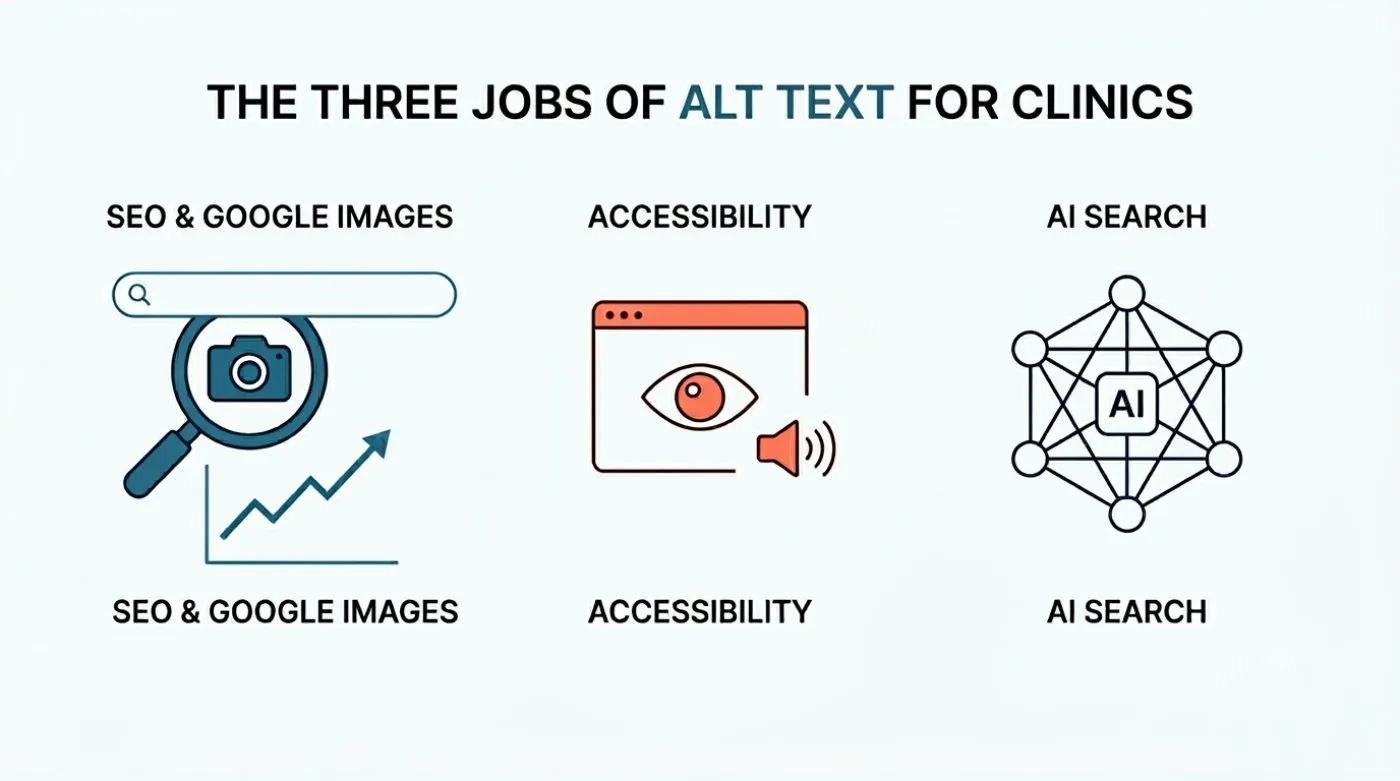
Image alt text does three things in 2026: SEO, accessibility, and AI search. Here's what each job looks like for local business websites, with proof.
Tyler · May 30, 2026
Run Your Own Clinic Marketing
Cliniverse gives you the ads, posts, courses, and AI to grow your clinic, with experts on call. You own everything you build.