
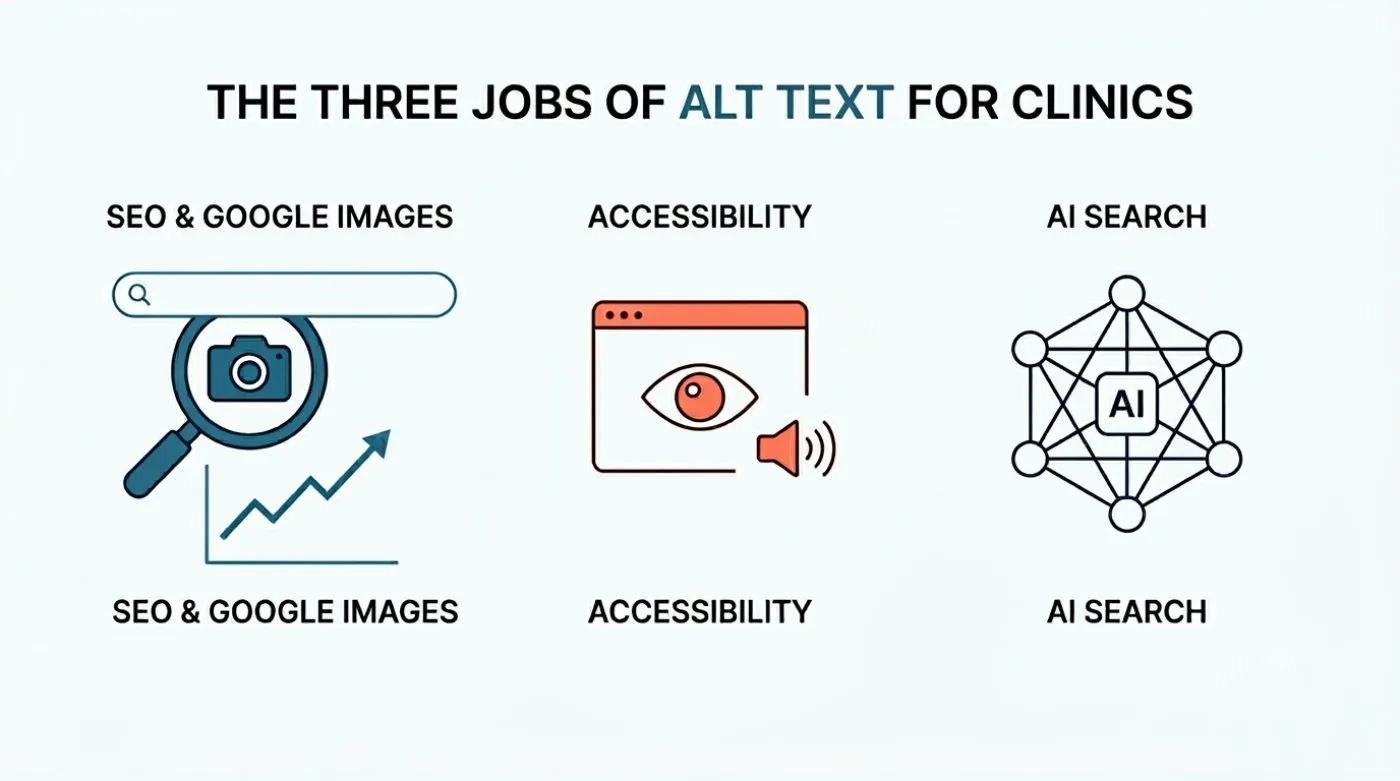
What's Image Alt Text For in 2026?
Most local business owners we talk with either have no idea what alt text is or treat it as a chore. They upload a photo, leave the alt text blank, and move on. The ones who don’t, write something like “clinic” or “store” and call it done.
Alt text does three different jobs in 2026: SEO (especially Google Images), accessibility for screen readers, and helping AI search engines understand what’s on your page. Skipping it costs you on all three.
1. SEO (Especially Google Images)
Alt text still helps you rank, and it helps you rank in places most local business owners forget exist. Google Images is one of those places.
An example: a clinic we built the website for, has three images ranking on the first page of Google Images for “[LOCATION] physiotherapy.” That’s in a SERP (Search Engine Results Page) otherwise dominated by chains like Lifemark. The images aren’t there by accident. The alt text, file names, and surrounding copy all line up.
Google Images traffic is significant traffic. It also tends to convert well for local businesses, because someone searching “[LOCATION] physiotherapy” or “[LOCATION] florist” in images is usually trying to see what the business looks like before they book or visit.
2. Accessibility
The original purpose of alt text was to let screen readers describe images to people who can’t see them and that still remains true.
For any local business site, this matters more than it sounds. Some of your customers use screen readers and some have low vision. Alt text is what makes your site usable in these moments. It’s also what keeps you compliant with AODA in Ontario and accessibility standards in other provinces.
3. AI Search
AI search engines like ChatGPT, Claude, Perplexity, and Gemini don’t see images the way humans do. They read the alt text and the surrounding copy to understand what’s on the page.
If your service page shows a photo of your business but the alt text is blank, an AI tool generating an answer about businesses in your area has less to work with. If the alt text says “interior of [LOCATION] physiotherapy clinic with treatment beds and exercise equipment,” now the AI has context it can use to cite or recommend you.
Reviews, photos, and the words around them are some of the most consistent signals AI search engines use to decide which businesses to surface and alt text is part of that.
The Takeaway
The right way to write alt text is to describe what’s in the image, like you’re explaining it to someone who can’t see it. That single rule covers all three jobs at once. Screen readers, search engines, and AI tools all benefit from the same description.
Skip the keyword stuffing, skip not filling anything in, skip the auto-generated name, and skip the one-word labels. One sentence of the description per image will outperform almost any local business site in your area.
If you want a second set of eyes on how your site is doing in other areas, our clinic audit tool catches the quick wins most local businesses miss.
Related Articles
 Get Found Online
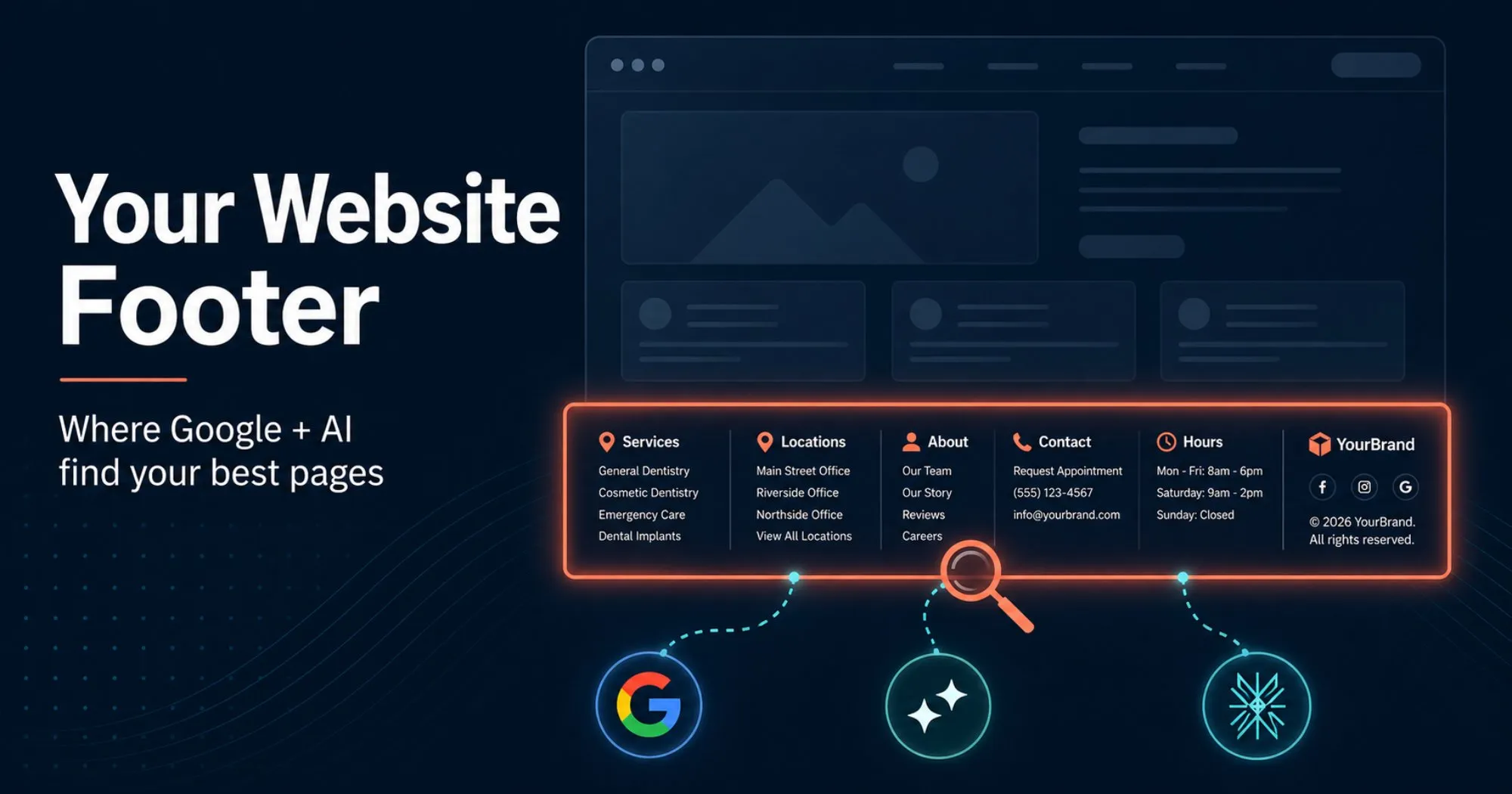
What Should Your Website Footer Include? (And Why It Matters for AI)
Your website footer is prime real estate for SEO and AI search. Here's what to include so Google and AI engines can crawl and cite your best pages.
Tyler · May 2, 2026
 Get Found Online
Are Embedded Testimonial Sliders Good for SEO?
Embedded review widgets are great for visitors, but a weak signal for Google and AI search. Here's what they do and the easy fix.
Tyler · May 7, 2026
 Get Found Online
Simplifying SEO: Best Practices for Your Website to Rank on Google
Unlock SEO success with easy best practices to boost your website's ranking on Google. Learn about all the basics and how you can rank higher.
Tyler · March 17, 2024
Run Your Own Clinic Marketing
Cliniverse gives you the ads, posts, courses, and AI to grow your clinic, with experts on call. You own everything you build.