

The Truth About Google Reviews for SEO and AI in 2026
A clinic owner came to us recently thinking he needed a new website. ChatGPT was recommending six competitors above him when patients searched for the best physiotherapist in his city, and Chat said it was because of their website. We pulled up Google for each one: four of the six had way more reviews than him. He had 175; the top one had close to 800. It wasn’t a website problem, it was a review problem.
Yes, Google reviews help SEO. They influence local pack rankings, organic rankings for local intent searches, and increasingly, which businesses get cited in AI search engines like ChatGPT, Perplexity, Claude, and Google’s AI Overviews. Reviews are no longer just social proof. They’re a primary ranking signal.
Below you’ll learn what reviews do for your rankings, the AI search angle most local businesses are missing, benchmark data on how many reviews you need to compete, and what to do this week.
What Google Reviews Do for SEO
Reviews aren’t a soft “nice-to-have” anymore. They’re feeding three concrete local business SEO ranking mechanisms.
Local Pack Rankings
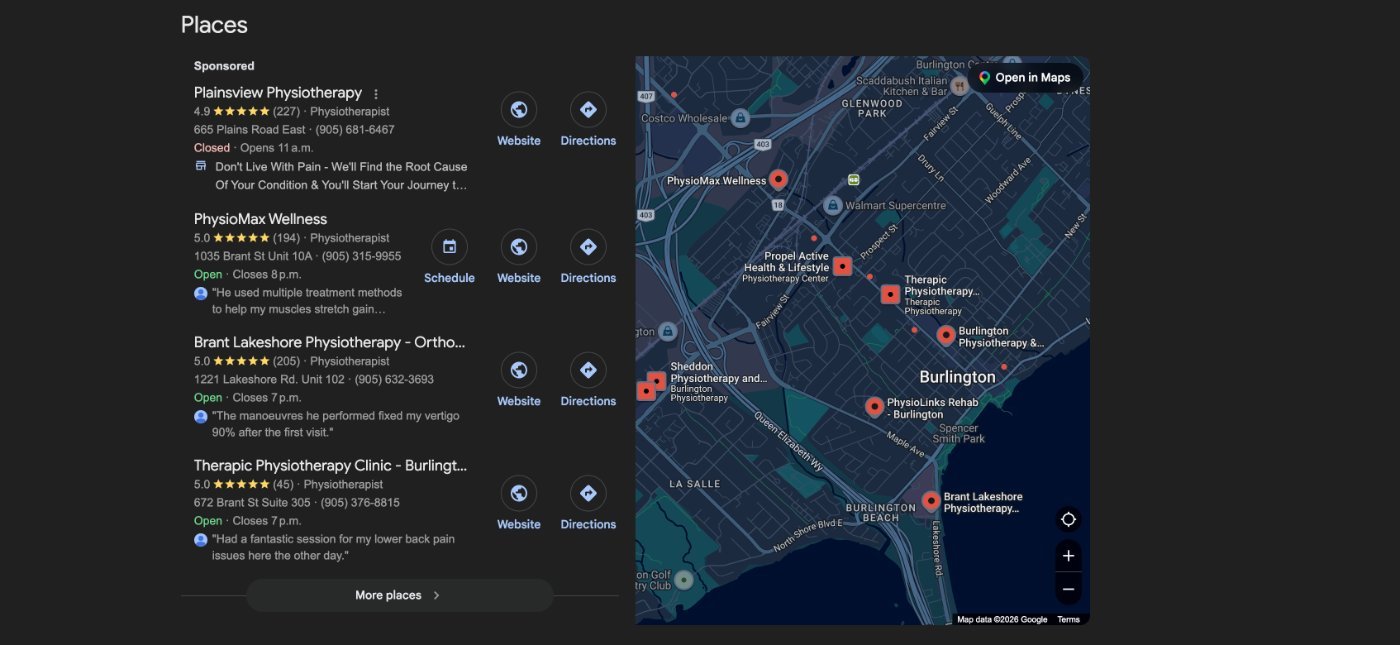
Google’s local pack (the map results that show up at the top of a local search) ranks businesses on three core factors: relevance, distance, and prominence. Google itself confirms that more reviews and positive ratings can improve your local ranking as part of the prominence signal. Two clinics on the same street, offering the same services, will rank differently if one has 400 reviews at 4.7 and the other has 80 at 5.0. The first one wins, almost every time.
Organic Rankings for Local Intent
Searches like “physiotherapist near me” or “chiropractor downtown Burlington” pull review-rich businesses higher in the organic results, not just the local pack. Star ratings show up under business names with the review count, which improves click-through rate and reinforces the ranking position over time.
Trust Signal for Branded Searches
When someone Googles your clinic name, the knowledge panel on the right side shows your review count and rating. A new patient comparing you to two competitors will use that count as a tiebreaker. They might not say it out loud. They’ll just book the place with more reviews.
Reviews Are the New Backlinks for AI Search
Backlinks were the dominant authority signal of the old web. For AI search engines, reviews are filling that role for local businesses. This is the single biggest shift in local SEO in the last decade, and most clinic owners haven’t caught up to it yet.
A Case Study: 175 Reviews vs 800
Back to the clinic owner from the intro. When he sent us the six clinics ChatGPT had recommended above him, here’s what we found:
- His clinic: 175 reviews, strong rating
- Top competitor ChatGPT cited: close to 800 reviews
- Two more competitors: 400-500 reviews each
- Two more: 200-300 reviews each
- Only two of the six had review counts less than his
It wasn’t a content problem. It wasn’t a website problem. ChatGPT was weighing review volume and recency heavily, and the businesses with the most reviews were the ones being recommended. This is part of a broader shift toward generative engine optimization (GEO), where AI engines pick businesses using a different set of signals than traditional search.
Why AI Engines Lean So Hard on Reviews
Large language models (essentially what you know as ‘AI’) aren’t crawling hundreds of obscure ranking signals the way Google does. They’re pulling from data that’s already structured and trustworthy, and reviews check every box:
- Public and verifiable (anyone can read them)
- Rich with natural language (LLMs love that)
- Numerical (star ratings give a clean signal to weigh)
- Recent (a fresh review in the last month means more than a backlink from 2019)
The same logic now sits inside Google itself. The short clinic descriptions that show up in Google’s new AI Mode are written by reading the reviews and website of each business, so a thin review profile becomes a thin AI summary on the first screen a patient sees.

The Keyword-Inside-the-Review Effect
Here’s something that doesn’t get talked about much. Reviews aren’t just a trust signal. They’re a content signal.
If your patients describe what you do in their words (“pelvic floor physio,” “auto accident chiropractor,” “sports massage near the airport”), those words become searchable. Your reviews become a piece of indexed content that’s basically free to produce.
How Many Google Reviews Do You Need?
There’s no universal number. But there’s benchmark data, and it’s more useful than the “more is better” advice most blog posts give.
Google Review Benchmark Data by Industry
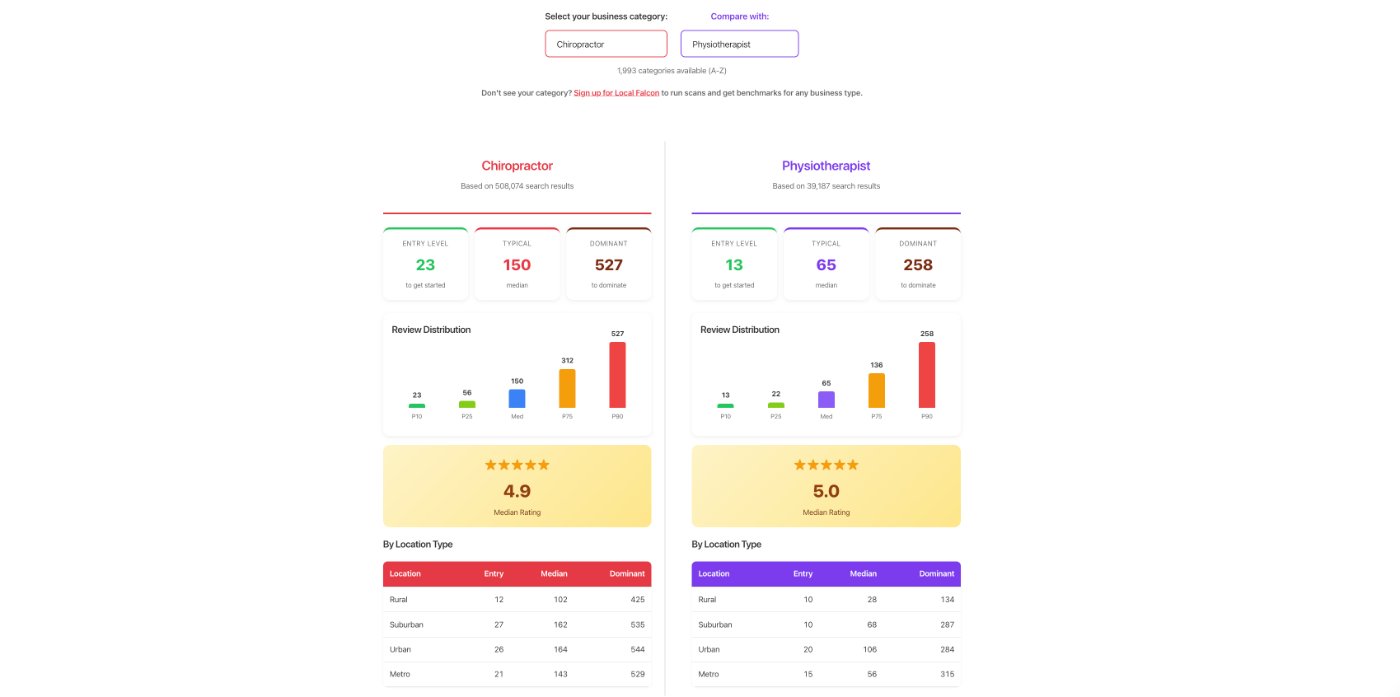
The team at Local Falcon built a free tool that pulls Google Business Profile benchmarks by industry. Here’s what it shows for two of the categories we work with most:
Physiotherapist (39,187 search results analyzed)
- Entry level (to get started): 13 reviews
- Typical (median): 65 reviews
- Dominant (to dominate): 258 reviews
- Median rating: 5.0
Chiropractor (508,074 search results analyzed)
- Entry level (to get started): 23 reviews
- Typical (median): 150 reviews
- Dominant (to dominate): 527 reviews
- Median rating: 4.9
Notice the gap between “typical” and “dominant.” A median chiropractor has 150 reviews, but the top of the pack has nearly four times that. The same shape shows up in physio, RMT, dental, and most other local service categories. The bar to be average is low. The bar to win is steep.
It Changes by Geography Too
Local Falcon also breaks the data down by location type. For chiropractors, urban dominant sits at 544 reviews. Rural dominant is 425. For physios, metro dominant is 315 and rural is just 134. The competitive bar is set by your geography, not by some universal number. A rural physio doesn’t need 300 reviews to dominate. A downtown Toronto physio probably does. Run your own industry through the same tool before you set a goal.
The Trust Paradox: Why a 5.0 Looks Fake
Twenty reviews at a perfect 5.0 looks less trustworthy than 500 reviews at 4.8 with a few 3-star reviews mixed in. Don’t fear the occasional bad review; it makes the overall pattern look real. Consumers know real businesses get the occasional unfair review, and a flawless rating with low volume reads as either fake, gamed, or new (none of which build trust).
Velocity Matters More Than Total
A clinic adding 8 new reviews per month will outrank one with a static 300 reviews from three years ago. Google reads dormancy as a signal that the business may not be active anymore. Steady review velocity is the heartbeat of a healthy profile.
Replying to Reviews Is a Soft SEO Signal
Yes, replying helps. Google has confirmed it directly. But the bigger reason is what replies signal about your profile health.
Replying is a positive signal of a healthy, active profile. Google wants to surface businesses that are clearly still operating, still monitored, still engaged. A profile with 400 reviews and zero replies looks abandoned. A profile with 400 reviews and consistent replies looks alive. The first one drops in rankings over time. The second one climbs.
The Natural-Keyword Reply Angle
If your replies naturally mention the service or the location, it’s another soft positive signal. Don’t stuff, don’t make it awkward. But if a patient writes “Dr. Smith helped me with my knee pain after my marathon,” and your reply naturally says “Glad we could help with the knee pain, runners need that kind of support,” you’re reinforcing relevant keywords without forcing them.
This isn’t a massive lever. It’s a 1-2% nudge per reply, but it compounds over hundreds of reviews.
The Way You Ask Matters as Much as Whether You Ask
The boring “please leave us a review” link in an email signature gets a 1-2% response rate. The way the best local businesses ask gets 10x that, because they make it personal.
Humanize the Ask
The strongest pattern we’ve seen across local businesses isn’t asking on behalf of the business. It’s asking on behalf of the person who delivered the service.
Picture this. A patient finishes their session. The manager walks over and says, “If you felt like Cindy did a great job today, it would mean a lot to her if you left a review and mentioned her name. Her bonus is partly based on that kind of feedback.”
Now the patient isn’t doing the business a favour. They’re doing Cindy a favour. The reciprocity is direct, the response rate is dramatically higher. This works in service-based businesses because patients form a relationship with one practitioner, not the brand.
A Note on Incentivizing
Some industries can offer small thank-you gestures for honest feedback (a coffee, a draw entry, a discount on a future service). Some can’t. So:
- If you run a clinic: don’t offer incentives. Healthcare regulators (CPO, CCO, College of Physiotherapists, and most provincial bodies) prohibit clinics from incentivizing reviews. Use the “Cindy” framing or peak-satisfaction asks instead.
- If you run a non-regulated local business: small, transparent incentives can work, but Google’s terms still prohibit incentives that are conditional on a positive review. Tie any incentive to “leave honest feedback,” not to “leave a 5-star review.”
The point isn’t the incentive. It’s that the ask should feel personal, not transactional.
Before You Optimize for Reviews, Optimize the Service
If your service is bad, no clever ask sequence saves you. Five-star reviews come naturally when you’ve genuinely delivered. Asking is a multiplier on a strong base, not a fix for a weak one. The clinics with 800+ reviews at 4.9 didn’t get there by pestering. They got there by being worth talking about.
Most businesses ask too early or too aggressively. The fix isn’t a better template. The fix is better service first. Then ask at the moment of peak satisfaction (right after the win, the relief, the breakthrough), and you’ll find the reviews come on their own.
What to Do This Week
1. Benchmark Yourself by Industry and Geography
Run your industry through the Local Falcon benchmark tool linked above. Note the entry-level, typical, and dominant numbers for your category and your location type. That’s your competitive bar. If you’re below “typical,” that’s your first target.
2. Audit the Top 3 Competitors in Your Local Pack
Google your service plus your city. Note the top 3 results in the local pack. Write down their review count and rating. That’s the bar you need to beat to outrank them, regardless of what the industry average says.
3. Audit the Keywords Inside Your Existing Reviews
Open your last 30 reviews. Are patients using the words you want to rank for? “Pelvic floor physio,” “sports massage,” “auto accident chiropractor,” whatever your money keyword is. If those phrases aren’t in your reviews, you’re missing a ranking signal that’s effectively free.
4. Pick One Way to Ask and Commit for 30 Days
Pick one channel. Post-appointment SMS through your booking system, a QR code at the front desk, or the “Cindy” verbal ask. Don’t run all three at once. Pick the one your team will do consistently for 30 days, and if remembering to send the ask is the sticking point, an automated review request that fires after each appointment takes the discipline out of it.
5. Reply to Every Review for 30 Days
No backlog clearing required. Just commit to replying to every new review (positive and negative) for the next month. You’ll see the profile health signal lift on its own.
What Not to Do
- Don’t buy reviews. Google’s prohibited content policy bans fake and conflict-of-interest reviews. Accounts that violate it get suspended, and the FTC can fine US businesses for fake reviews.
- Don’t run a “review of the month” contest. That violates Google’s terms.
- Don’t ask 50 patients on the same Tuesday. A sudden spike from a static baseline looks suspicious.
Frequently Asked Questions
How Many 5-Star Reviews Cancel Out a 1-Star Review?
Mathematically, four 5-star reviews bring a single 1-star review back to a 4.0 average. But the trust impact of a single bad review fades faster than the math suggests, especially when you reply to it professionally. A real-looking pattern of mostly 5-star reviews with the occasional 3-star sprinkled in often outperforms a flawless 5.0 in both rankings and conversion.
Is SEO Dead or Evolving in 2026?
Evolving. Reviews became more important. Technical SEO became less differentiating. AI search became a third channel alongside organic and the local pack. The fundamentals (relevance, authority, trust) didn’t change. The signals that prove them did.
Can You Pay Google to Remove a Bad Review?
No. Google does not accept payment to remove reviews. The only legitimate way to get a review removed is to flag it as a violation of Google’s content policies (fake, off-topic, conflict of interest, hate speech, etc.) and have Google review it. Most flagged reviews stay up. The better play is to respond professionally and let the volume of newer positive reviews dilute it.
Where to Go From Here
Reviews are now the most consistent ranking signal across both Google and AI search for local businesses. The local businesses dominating their local pack and getting cited by ChatGPT aren’t doing anything mysterious. They’re just ahead on review volume, recency, content, and replies. If you want help building a system around any of this, our done-with-you marketing platform walks clinic owners through it step by step, or you can run a free clinic audit to see how your profile stacks up against competitors in your area.
Related Articles
 Get Found Online
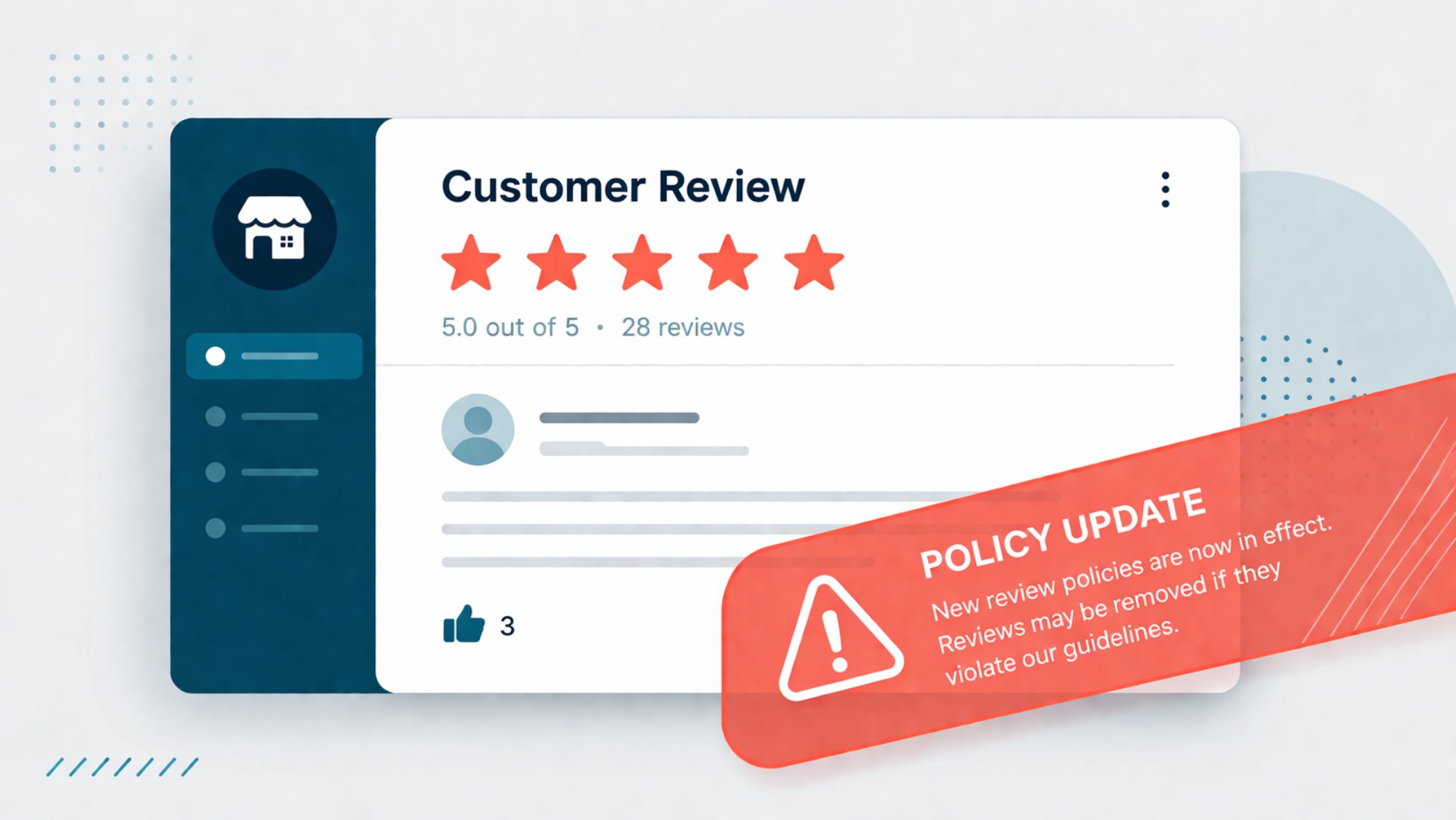
The 5 Review Practices Google Just Made Illegal in 2026
Google quietly updated its review policy in April 2026 and made 5 common practices illegal. Here's what changed and what to do instead.
Tash · May 5, 2026
 Get Found Online
How to Help Your Clinic Rank Higher With Google Business Profile in 2026
If patients cannot find your clinic on Google Maps, here's what to check on your Google Business Profile and how to fix it, step by step.
Tash · September 12, 2026
 Get Found Online
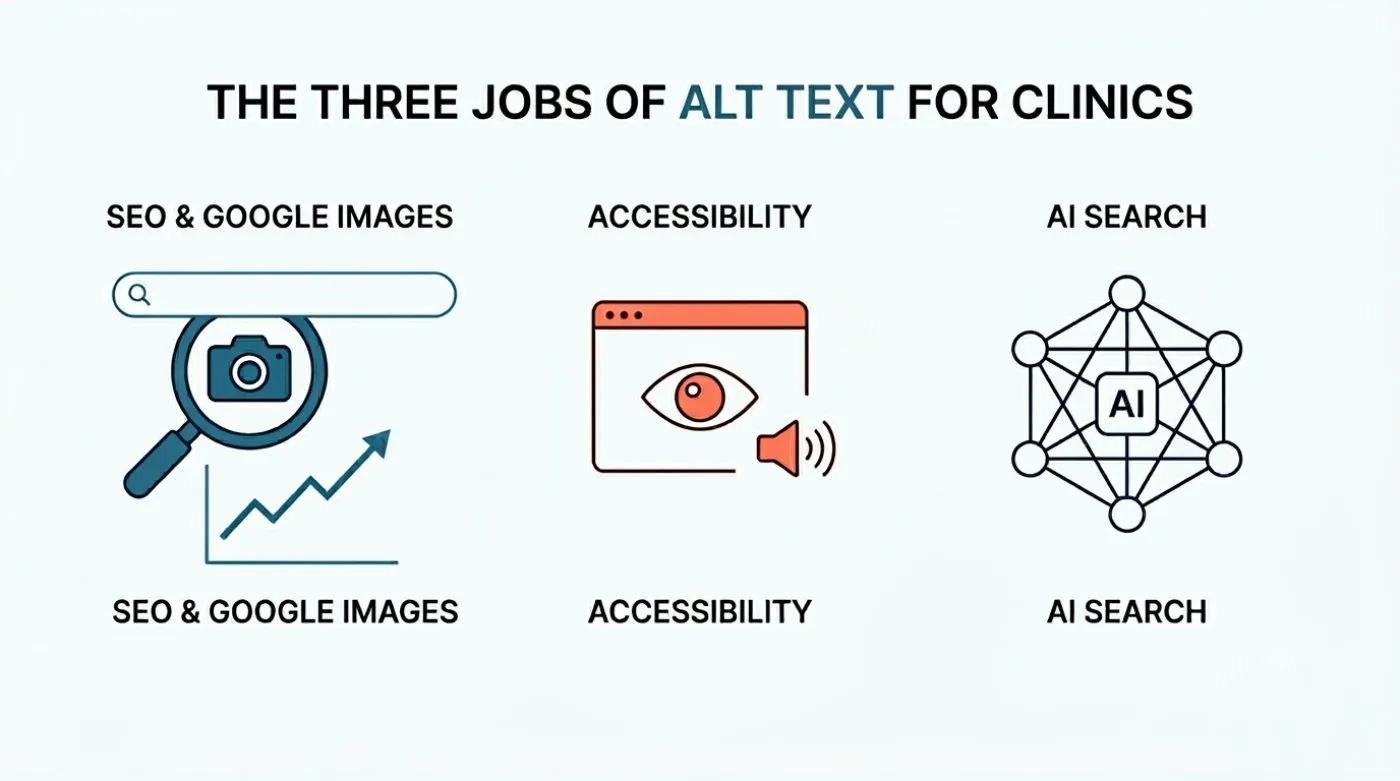
What's Image Alt Text For in 2026?
Image alt text does three things in 2026: SEO, accessibility, and AI search. Here's what each job looks like for local business websites, with proof.
Tyler · May 30, 2026
Run Your Own Clinic Marketing
Cliniverse gives you the ads, posts, courses, and AI to grow your clinic, with experts on call. You own everything you build.