

What Is GEO (Generative Engine Optimization) and Why It Matters for Your Business
You have been hearing about SEO for years. Maybe you have a blog. Maybe you show up on Google. But right now, something bigger is changing how people find businesses like yours, and most clinic owners and local business owners have no idea it is happening.
It is called GEO (Generative Engine Optimization).
And if you have ever typed a question into ChatGPT, Claude, Perplexity, or Google’s AI Overview and gotten a direct answer back, you have already seen GEO in action. The question is: was your business the one getting mentioned?
What Is GEO (Generative Engine Optimization)?
GEO stands for Generative Engine Optimization. It is the practice of structuring your online content so that AI-powered search platforms like ChatGPT, Google AI Overviews, Perplexity, and Gemini cite your brand when answering user questions.
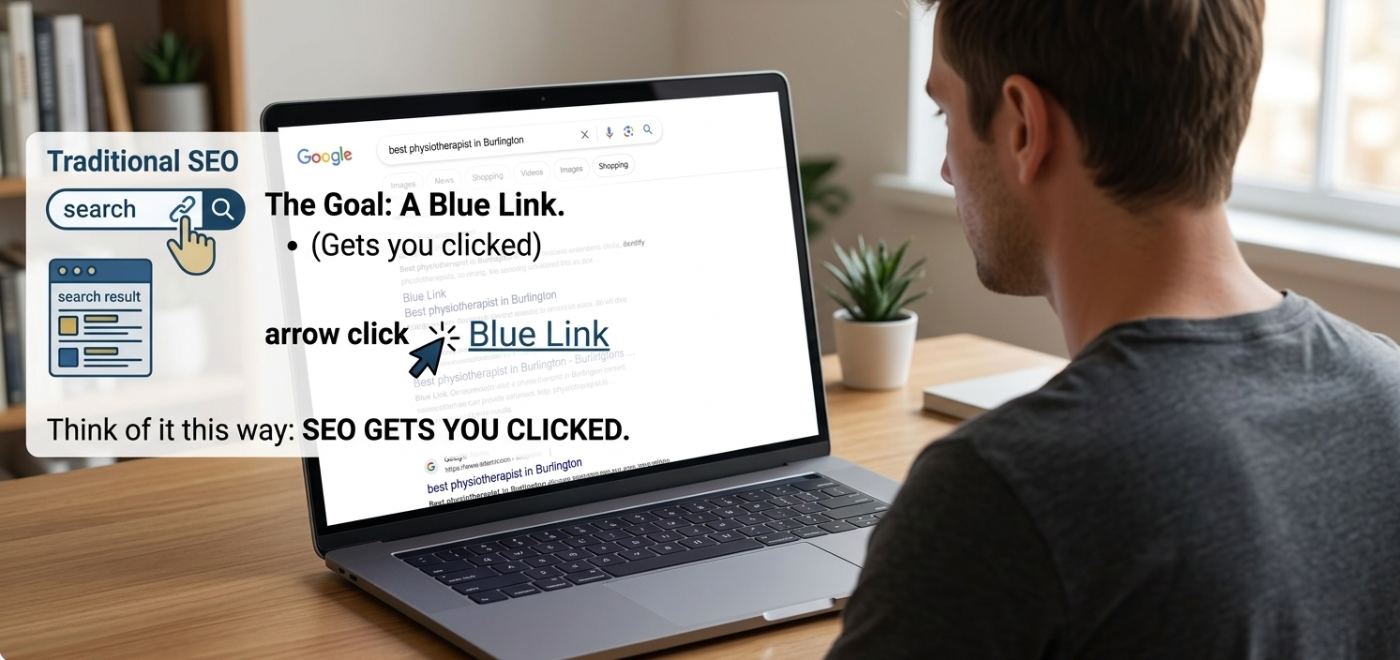
Traditional SEO gets you a blue link on a Google results page. GEO gets you quoted in the AI’s answer.
Think of it this way: SEO gets you clicked. GEO gets you quoted.
When someone types “best physiotherapist in Burlington” or “how do I market my clinic without an agency,” the AI does not show a list of websites. It gives a direct answer, pulling from sources it considers credible and well-structured. GEO is what puts your content in that answer.
Why GEO Matters Right Now
Here are the numbers that should get your attention:
- ChatGPT now reaches over 800 million weekly users. Google’s AI Overviews appear in up to 60% of searches.
- 60% of searches now end without a click, meaning your audience is getting answers and brand recommendations from AI, not from your website.
- AI-referred sessions jumped 527% year-over-year in the first five months of 2025, according to Previsible’s 2025 AI Traffic Report.
- Gartner projects that organic search traffic to commercial websites will decline 25% by 2026 as consumers shift discovery to AI-powered tools.
This is not coming. It’s already here.
And while most businesses are still chasing Google rankings, 47% of brands have no documented GEO strategy. That is an opportunity.
The businesses that move now will own those AI answers before the space gets competitive.
How GEO Is Different From Traditional SEO
SEO and GEO work together. They are not enemies. But they do different things.
The most important takeaway: SEO and GEO are not competing disciplines. A brand that ignores traditional SEO in favour of GEO will fail. AI systems use your existing SEO authority and backlink profile as a trust signal. Conversely, a brand that invests only in traditional SEO is increasingly invisible in the AI-first search environment.
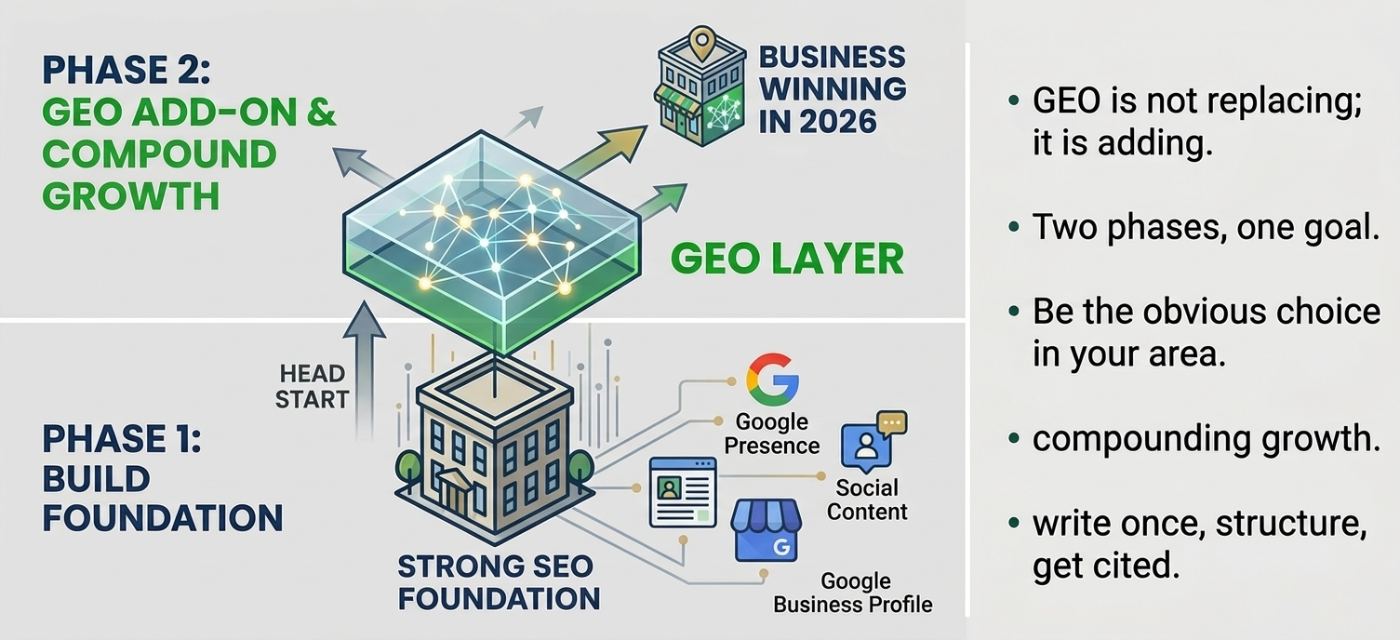
In short: strong SEO is the foundation. GEO is the next layer.
What About AEO?
You may also see the term AEO, which stands for Answer Engine Optimization. AEO originally referred to optimizing for voice search and Google’s featured snippets. In 2026, AEO and GEO have largely merged into the same concept. GEO is the broader framework. AEO is a subset of it. If you see the two terms used interchangeably, that is why.
How Generative AI Engines Work
To optimize for something, you need to understand how it works.
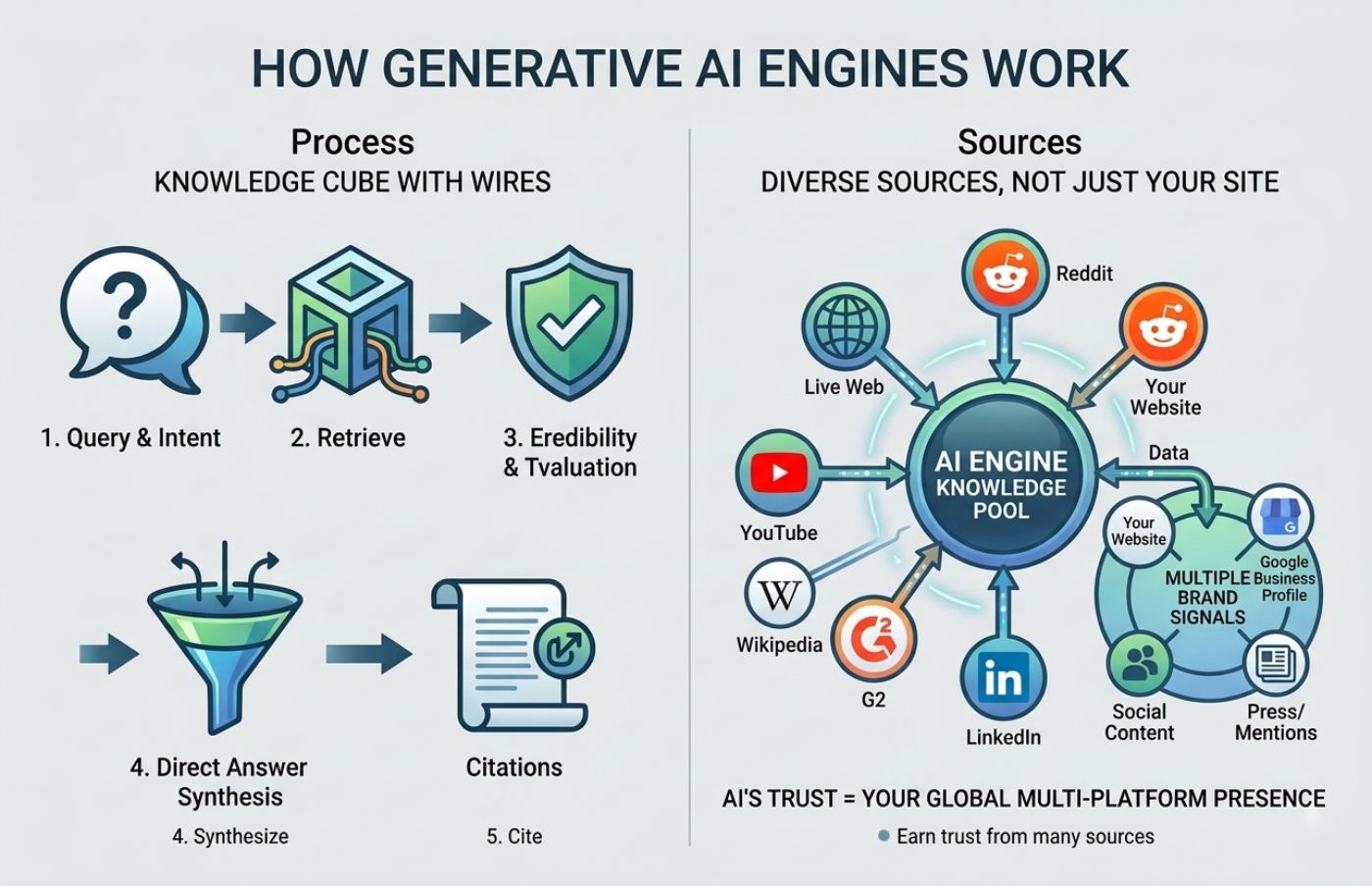
When someone asks ChatGPT or Perplexity a question, the AI does not just grab the top Google result. It goes through a process:
- It reads the query and identifies the intent behind it.
- It retrieves content from its training data or live web results.
- It evaluates which sources are credible, current, and clearly structured.
- It synthesizes a direct answer, pulling the most relevant details from the sources it trusts.
- It cites those sources.
LLMs (large language models) also pull from platforms like Reddit, YouTube, Wikipedia, G2, and LinkedIn, not just your website. This means more factors influence what a generative engine includes in its answer. You cannot just rely on your web domain.
This is why showing up in multiple places matters. Your website, your Google Business Profile, your social content, and any press or mentions you have earned all feed into how AI systems understand and trust your brand.
What AI Systems Look for When Choosing Sources
Research from Princeton University and IIT Delhi confirmed that GEO techniques can boost content visibility in AI responses by 30 to 40%. The study found that the strongest performance improvements came from adding statistics, citing sources, and including expert quotes. Traditional tactics like keyword stuffing performed poorly in generative contexts.
Here is what works:
Clear, Direct Answers at the Top of Your Content
AI systems that use real-time retrieval evaluate a page’s relevance primarily on its opening content. The first 200 words of any article should directly and completely answer the primary query, not build up to the answer.
Question-Based Headings
A header that reads “What Is GEO?” is more likely to be cited for the query “what is generative engine optimization” than a header that reads “GEO Overview.” Reformatting headers as questions that mirror actual search and conversational queries is one of the highest-ROI GEO changes you can make to existing content.
Structured, Easy-to-Extract Content
Use headings, lists, tables, and clear sections. AI systems need to be able to pull a clean snippet from your page. If your content is a wall of text, it gets skipped.
Data and Proof Points
Numbers, statistics, and cited sources signal that your content is credible. AI engines weight this heavily.
Authority and Trust Signals
Reviews, mentions on other websites, and consistent presence across multiple platforms all tell AI systems that your brand is a real, reliable source.
GEO for Clinic Owners and Local Businesses
This is where it gets specific to you.
If someone asks ChatGPT “how do I find a good physio in Burlington” or “what should I look for in a chiropractor near me,” the AI answers that question by pulling from sources it considers credible. That could be your Google Business Profile. It could be your website. It could be a local directory that mentions your clinic. Or it could be your competitor who had better-structured content.
Here is what you can do right now:
- Write clear, direct answers on your website. Every service page and blog post should answer a specific question in the first two paragraphs. Do not bury the answer. Put it at the top.
- Use question-based headings. “What does a physiotherapist treat?” performs better than “Our Services.” Structure your headings the way your patients speak or ask AI.
- Build your Google Business Profile. AI pulls from your Google listing. Keep it complete, accurate, and updated with recent reviews.
- Get mentioned in more places. Local directories, association websites, press mentions, and partner links all build the kind of multi-platform presence that AI systems use to verify credibility.
- Add data and specifics to your content. Vague content gets skipped. Specific, factual content gets cited. Use specific numbers, real results, and real patient outcomes where you can (while staying compliant with your regulatory guidelines).
- Publish consistently. AI engines weigh recency when selecting sources. A guide published in 2024 with no updates will lose ground to a 2026 article on the same topic. Refresh your cornerstone content regularly and add a clear “last updated” timestamp.
How to Track If GEO Is Working
You will not find GEO results in Google Analytics. Traditional rank tracking tools do not measure GEO performance. The current best practice is to set up a manual testing cadence: at least once a month, search your core topics in ChatGPT, Perplexity, and Google AI Overviews and record whether your brand is cited.
The three metrics that matter most in GEO:
- Mention rate: How often does your brand name appear in AI-generated answers for your target topics?
- Citation rate: How often does the AI include a link to your website?
- Position: When cited, where does your brand appear? First mention or buried at the bottom?
Start by defining 10 to 15 questions your ideal clients are asking. Then go check those questions in ChatGPT and Perplexity. See who is showing up. That will tell you exactly where the gap is.
GEO Is Not Replacing What Works. It Is Adding to It.
If you already have a solid Google presence, active social content, and a strong Google Business Profile, you have a head start. GEO builds on all of that.
If you are starting from zero, the right move is to build your SEO foundation first and layer GEO on top as you go. They are not separate strategies. They are two phases of the same goal: being the obvious choice when someone in your area needs what you offer.
The businesses winning in 2026 and beyond are not doing more. They are doing things that compound. Good content that ranks on Google and gets cited by AI is exactly that. You write it once, structure it right, and it works for you in two channels instead of one.
What We Are Doing at NewFrame Digital
At NewFrame Digital, we build content and marketing systems that are built for where search is going, not just where it has been.
Inside Cliniverse, our AI marketing assistant is trained on compliant, profession-specific content that helps you produce exactly the kind of structured, credible content that both Google and AI engines reward. Our templates are built to answer questions clearly and directly, which is exactly what GEO requires.
If you want to know where your clinic stands right now in terms of online visibility, our free Clinic Audit Tool checks your website, Google presence, and citation health in under two minutes.
Related Articles
 AI & Tools
What Is AEO (Answer Engine Optimization) and How Businesses Get Chosen by AI
What Answer Engine Optimization means, how AI tools decide which sites to quote, and the changes that make your content easier to reuse.
Tash · August 19, 2026
 AI & Tools
How to Rank on AI Search Engines in 2026 (ChatGPT, Perplexity, Gemini, SearchGPT)
Learn how AI search engines rank businesses today. We explain AI Search SEO, trust signals, entity strength & the steps to show up in AI answers.
Tyler · November 29, 2025
 AI & Tools
Does Google Penalize AI Content? What Claude's New Watermark Means for Your Clinic
Anthropic now watermarks Claude's AI text, but Google does not penalize content for being made with AI. Here is what the change means for your clinic.
Tash · August 23, 2026
Run Your Own Clinic Marketing
Cliniverse gives you the ads, posts, courses, and AI to grow your clinic, with experts on call. You own everything you build.