
How to Market a Chiropractic Clinic Without Risking Your Licence
Chiropractic marketing has 2 problems other clinics don't. Some people searching for a chiropractor are still deciding whether chiropractic is for them, and your advertising rules are stricter than those of many regulated health professions. Generic small business marketing ignores both.
Start with your Google Business Profile and reviews, because that's where local patients pick a chiropractor. Build a page for each condition you treat, written in the words patients type. Explain what a first visit involves and costs, keep every offer and claim inside your college's standard, and look after the patients you already have before paying for new ones.
Win the Map Results First
When someone searches "chiropractor near me," Google shows a map with 3 clinics before any website. Those spots come down to distance, your reviews, and how complete and active your Google Business Profile (your listing on Google Maps) is. You can't move your clinic, but the profile is free to improve.
Set "Chiropractor" as your primary category. Add every service, your hours, your direct billing details, and photos of your treatment rooms and team. Post to it regularly. A sceptical patient comparing 3 clinics on a map wants a reason to trust one, and a full profile gives them one.
A lot of booking happens on the listing itself. For one chiropractic clinic we work with, the profile brings in 26 to 45 phone calls a month, while its website took about 3 online bookings in its first month. Our walkthrough on ranking your clinic higher with Google Business Profile covers the setup in order.
Use the Word Patients Type: Chiropractor
People search for the person, not the profession. In Canada, "chiropractor near me" gets about 7,800 searches a month and "chiropractic near me" about 1,000. "Chiropractor calgary" gets about 1,400 against 200 for "chiropractic calgary" (Ahrefs, October 2026). The ad and Search Console data we see from chiropractic clinics shows the same gap.
Put "chiropractor" in your page titles, main headings, and the opening lines of your homepage and service pages. Keep "chiropractic care" where you're naming the service. A page where every heading says "chiropractor" reads as stuffed, to patients and to Google.
The wording flips when you're the one shopping. Chiropractors looking for a site search "chiropractic website design" (about 200 a month in Canada) more than "chiropractor website design" (about 100). Good chiropractic website design starts from your patients' word, not yours.
Get Reviews, and Know the Testimonial Rules
Reviews are one of the biggest things Google weighs when ranking local clinics, and they're what a new patient reads before choosing between you and the clinic down the street. Ask every patient, make it effortless with a direct link or a QR code at the front desk, and never filter who you ask: Google now bans review gating and several related practices.
Testimonials on your own website and in ads are a different matter. In Ontario, the College of Chiropractors of Ontario's standard allows testimonials that mention you or your clinic only on your own website, and only with the patient's written consent in their file, no incentive, a statement that results may not be typical, claims within chiropractic scope, and nothing from your own family. Other provinces and states draw the line elsewhere, so check your college before a patient quote goes on your homepage. More on how reviews affect search and AI answers.
Build a Website That Answers the Sceptic
Your website is where people decide whether to book, and for a chiropractor that decision is often "do I trust this?" before "is this convenient?"
A Page for Each Condition You Treat
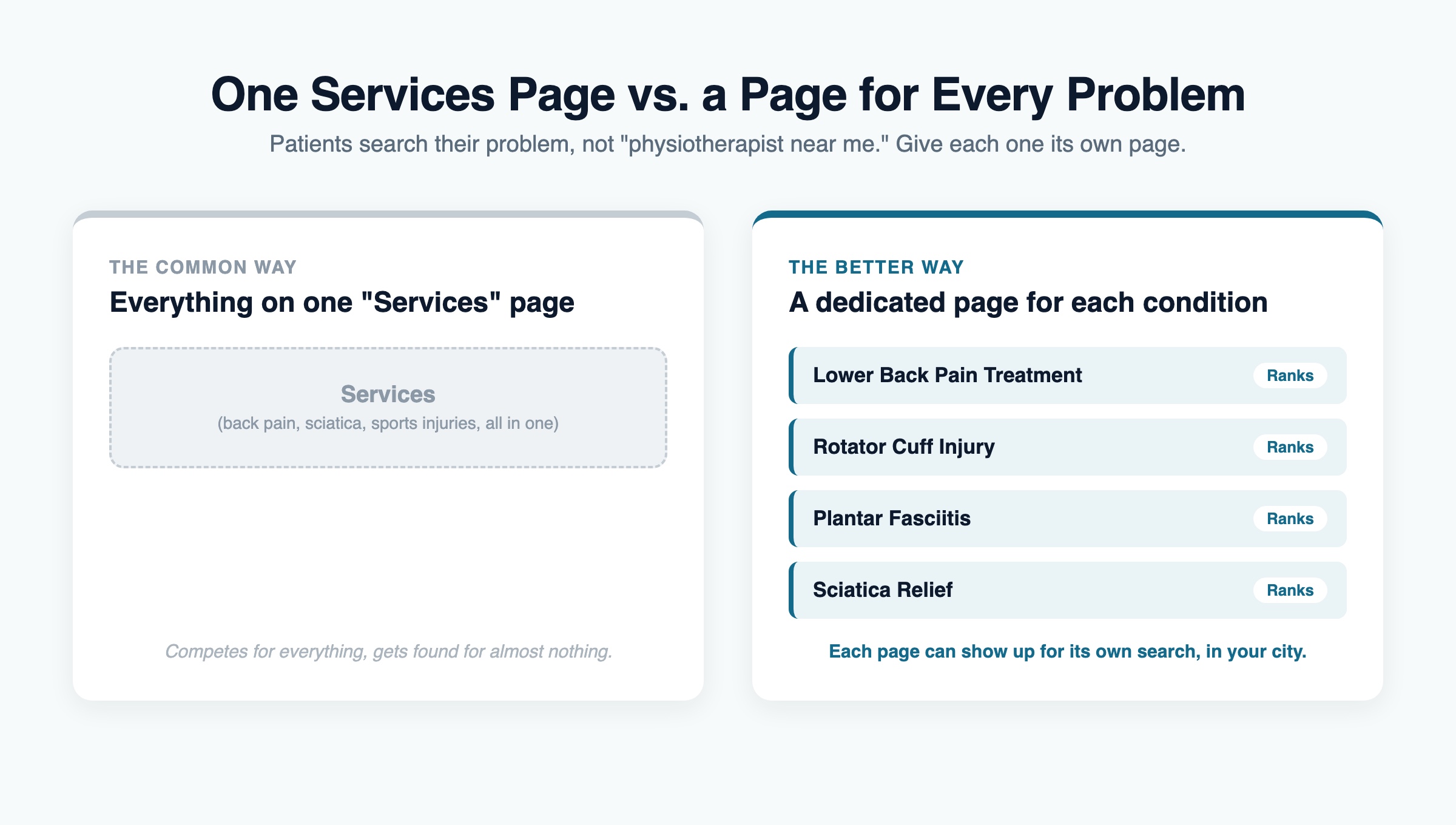
Patients search their problem plus their city: "lower back pain," "sciatica," "neck pain," "headaches." One page listing all your services can't rank for any of those. A page for each condition can rank for that search in your area.
Explain the First Visit, the Cost and the Sound
The questions that stop a hesitant patient from booking are practical. What happens at the first appointment, and will you adjust me on day 1? How many visits will I need? What does it cost, and do you bill my insurance directly? What's the popping sound? Answer them on a page patients can find. It removes the reasons to wait without making a single claim.
Make It Fast on a Phone
About 64% of "chiropractor near me" searches in Canada happen on a phone, even though overall web traffic here is close to an even split between phone and desktop (mobile vs desktop traffic stats). One chiropractic clinic we worked with had a homepage that took 18.5 seconds to load on mobile and under a second on desktop, so the problem never showed on the office computer. After rebuilding the site, mobile load dropped to 3.7 seconds and site health went from 8 to 100. Test yours on your phone, on mobile data.
Pick a platform that lets you control the behind-the-scenes details Google reads, and that doesn't trap you when you outgrow it. We compared the options in our roundup of website builders for chiropractic and physio clinics. Cliniverse Sites builds a chiropractic website with a page per condition, checked against your advertising rules, that you set up and own.
Keep Every Claim Inside Your College's Standard
This is where chiropractic marketing gets clinics in trouble, usually through wording inherited from a template or an old website. Using Ontario's standard as the example:
- Outcome wording: avoid "will help" or "relieves." The college's guideline suggests "may be able to help."
- Superlatives and comparisons: "best chiropractor in town" or "better than the clinic down the road" aren't allowed.
- Specialty-sounding titles: "pediatric chiropractor" can read as a specialty the college doesn't recognize. "A focus on" pediatric care is the safer phrasing.
- Registration: your website should state that you're a registered chiropractor and a member of your college.
- Statistics: a claim like "80% of adults get back pain" needs its source shown on the page.
Read Ontario's advertising standard for chiropractors on the college's site, or your own college's equivalent.
Use Ads With Offers That Follow the Rules
Ads bring in patients this week, but they're rented: when the budget stops, the leads stop. Your profile, pages and reviews keep working after you've paid for them. That's the rent-versus-own tradeoff between ads and search, and it's why ads work as an accelerator on top of a foundation you own.
Chiropractors we work with have done well on both platforms, unlike physiotherapy, where Meta usually wins on cost. On Google, one clinic owner built his own first Google Ads campaign and got 92 conversions at $14.61 each in his first month, on $1,344 of spend and about $1.15 a click. Searches with the town name were clicked about twice as often as "near me" searches, so name your town in the ad. On Meta (Facebook and Instagram), another owner filled his associate's schedule on about $2 a day: 28 leads at $22 each over 5 months.
The chiropractor on camera made the difference on Meta. Short videos of the doctor explaining a visit, plus fast follow-up on every lead, beat offer-led ads with an instant form (a form that fills in without leaving Facebook) in the accounts we looked at. The instant form version cost $48 a lead, and one offer-led campaign spent $231 for a single lead. A free downloadable guide brought in leads at $10 to $29 each, and none of them became patients.
Check the offer before you pick the platform. In Ontario, a promotional fee has to state its exact timeframe, can't be limited to a set number of people, and can't require follow-up visits. A standing "new patient exam $49 (reg. $125)" banner with no end date is the breach we see again and again.
Keep the Patients You Already Have
Chiropractic care often takes more than 1 visit, so a patient who drifts away mid-plan is the cheapest booking you're missing. Check what happens after the first visit before spending more on ads.
Send appointment reminders to cut no-shows. Answer new inquiries the same day, because an inquiry answered tomorrow is often a patient who booked elsewhere today. Send patients you haven't seen in a while a short, personal note that you have openings. Two chiropractic clinics we work with do this on a schedule: one emails at 30, 60 and 90 days after a patient's last visit, the other at 120 days.
Show the Room on Social and Video
Social media rarely turns a stranger into a booking on its own. For a chiropractor, it's the preview: an unsure patient sees the treatment room, hears you explain an adjustment, and decides whether to trust you before walking in.
Short videos answering your first-visit questions keep working, because Google shows Instagram, Facebook and YouTube content in search results. You can check which of your posts are showing up in Search Console. A blog does the same job in writing. On one chiropractic clinic's site, a post explaining why chiropractors crack your neck brought in 80 search clicks in 2 months, more than 3 times the homepage over the same period. Answer the question, then link to the matching condition page.
Get Known Locally and Earn Your Referrals
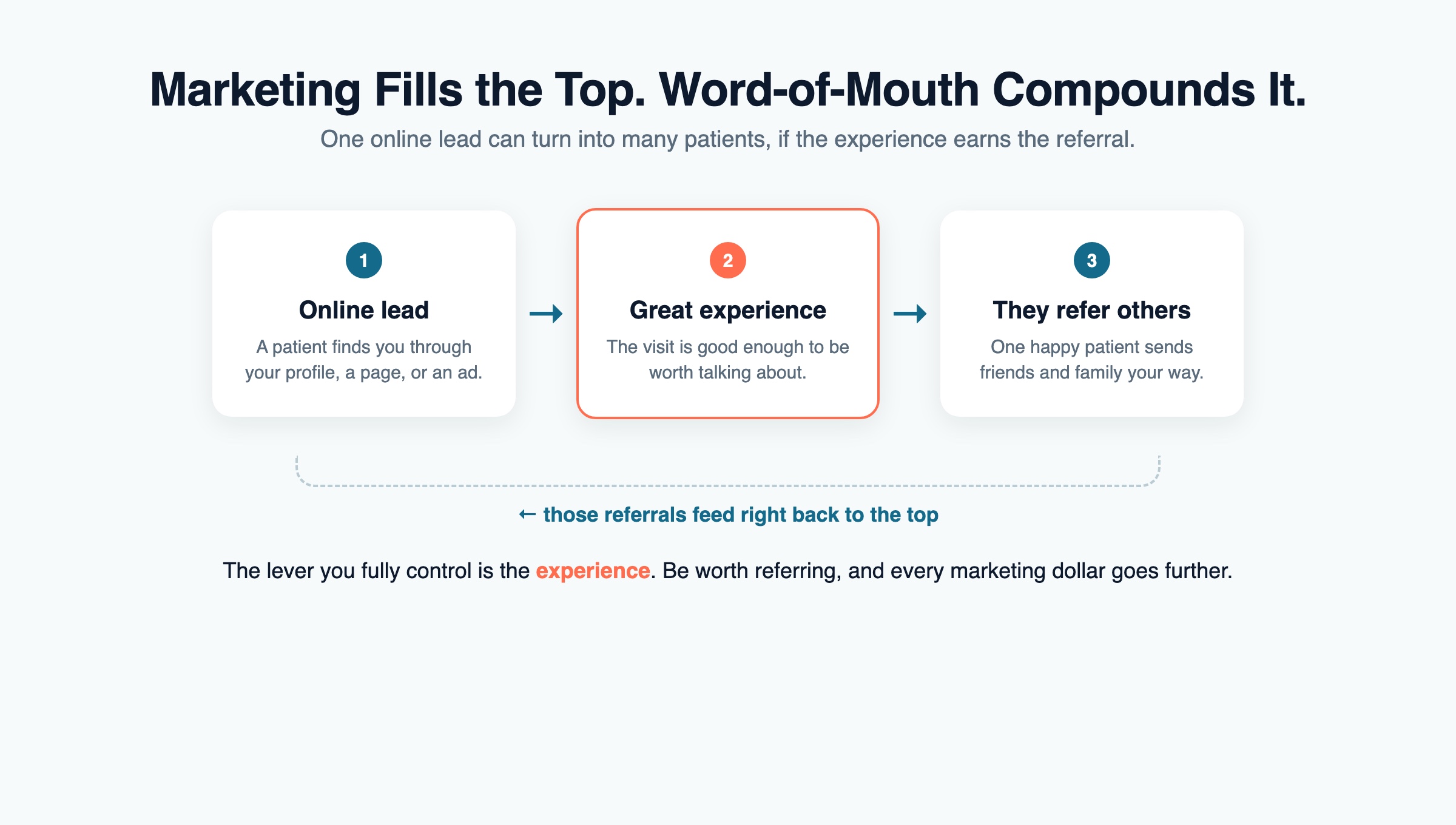
Word-of-mouth brings in a chiropractor's warmest patients, and you can build it on purpose. Get to know the massage therapists, physiotherapists and personal trainers near you, and help out in local Facebook groups and on Reddit when someone asks for a chiropractor recommendation.
Then get in front of your community:
- Your chamber of commerce: the membership listing and link from a trusted local website help you show up on Google.
- A local sports team: sponsoring a soccer or hockey club puts your name in front of the same families all season, and most clubs list sponsors on their website with a link.
- Talks: a lunch-and-learn at a workplace or a session at a fitness club lets people meet you before they need you.
- A charity day: Ontario allows treatment in exchange for a donation when the money goes to a registered charity and you name it.
At events, don't pressure anyone to bring a friend or family member, and don't contact people who haven't asked to hear from you. Ontario's standard rules out both. And earn referrals rather than paying for them, since referral fees and incentives break chiropractic rules in many provinces.
Where to Start
This month: finish your Google Business Profile, ask every patient for a review, and check your homepage against your college's advertising standard. Then build a page for each condition you treat and a first-visit page covering cost and what to expect. Add ads once that foundation is in place.
Cliniverse gives you done-with-you clinic marketing: courses, templates written for chiropractors, an AI assistant that drafts copy against your advertising rules, and our team when you want a second opinion. You do the marketing, from accounts you own.
Related Articles
 Clinic Marketing
How to Market a Physiotherapy Clinic (What to Prioritize First)
A practical guide to marketing a physiotherapy clinic: what to prioritize first, from Google Business Profile and reviews to your website, content, social, and ads.
Tyler · November 16, 2026
 Get Found Online
How to Help Your Clinic Rank Higher With Google Business Profile in 2026
If patients cannot find your clinic on Google Maps, here's what to check on your Google Business Profile, why competitors rank above you, and how to fix it.
Tash · November 16, 2026
 Get Found Online
Local Business SEO: What Moves the Needle in 2026
Most clinics lose patients to competitors with worse care. Learn the local business SEO ranking factors that determine who Google recommends.
Tyler · March 8, 2026
Run Your Own Clinic Marketing
Cliniverse gives you the ads, posts, courses, and AI to grow your clinic, with experts on call. You own everything you build.